|
|
|
|
|
|
|---|---|---|---|---|---|
 |
 |
|---|---|
Hydrogen bombs are the best way to deflect asteroids. We should have bombs in space ready to go if an asteroid is found. We also need wide-angle telescopes to detect asteroids, like the Rubin telescope.
Suppose you bomb an asteroid. The goal is to maximize momentum delivered to the asteroid, which means ejecting as much mass as possible from the asteroid.
Ejecta energy      =  Ee
Ejecta mass        =  me
Ejecta momentum    =  Qe  =  (2 me Ee)½
If you have enough time to land on the asteroid, bury the bomb as deep as possible. If you don't, then settle for putting the bomb on a glancing collision course with the asteroid and detonate it just before it hits. The mass ejected can be increased by hitting the asteroid with a pre-impactor, to launch material into space which is then heated by the bomb.
The ejection speed should be slow, to maximize mass ejected, but it should larger than the escape speed. We usually set it to be 3 times the escape speed. The relationship between momentum and energy is
Ejecta speed       =  ve
Ejecta momentum    =  Qe  =  2 Ee / ve
 |
|---|
A mass can be launched from Earth to impact the asteroid and give it a glancing blow to deflect it sideways. The fact that the asteroid is already moving toward Earth adds to the impact speed.
For an impact crater, the ejected momentum tends to have the same magnitude as the impactor momentum.
The asteroid Apophis is moving toward Earth at 6 km/s.
We calculate the minimum mass of the impactor, using Apophis as an example.
Asteroid mass                            =  M
Asteroid sideways deflection distance    =  X                =    10    Mmeter            Size of Earth
Time before asteroid hits Earth          =  T                =    10    Msecond           3 months
Asteroid min sideways deflection speed   =  V  =  X/T        =     1    meter/second
Asteroid distance from Earth when hit    =  L
Impactor mass                            =  mi
Impactor speed                           =  vi               =     6    km/s
Impactor momentum                        =  Qi =  mi vi
Ejecta momentum                          =  Qe =  Qi
Required deflection momentum to asteroid =  Q  =  Qe  =  M V
Impactor mass requirement                =  mi >  M V / vi
Ejecta energy is typically much less than impactor energy.
Impactor energy                          =  Ei  =  ½ mi vi2
Ejecta energy                            =  Ee  =  ½ me ve2 =  Ei ve / vi
 |
|---|
If there is insufficient time to deflect the asteroid, then destroy it. This means gravitationally unbinding it. It still hits the Earth but in pieces. This makes a big difference for tsunami.
If an impactor intercepts an asteroid, we calculate the mass required to unbind the asteroid.
Asteroid radius             =  R                         =   1000    meter
Asteroid density            =  D                         =   3200    kg/meter3
Asteroid mass               =  M  =  4/3 π D R3          =     13    Tkg
Asteroid gravitatioal energy=  Eg =  3/5 G M2 / R        =      7.2  TJoule
Asteroid escape speed       =  v  = (8/3 π G D)½ R       =      1.34 meter/second
Ejection speed factor       =  f  =                      =      3
Ejection speed              =  ve  =  f v                =      4.02 meter/second
Ejection mass               =  me
Impactor mass               =  mi
Impactor speed              =  vi                        =      6    km/s
Impactor momentum           =  Qi =  mi vi
Ejection momentum           =  Qe =  me ve  =  Qi
Ejection energy             =  Ee  =  ½ me ve2  =  ½ me ve vi
Impactor mass               =  mi  =  16/15 6-½ π2 G½ D3/2 vi-1 R4  =  1.06e9 (R/1000)4  kg
If the asteroid is large, it's easier to deflect than destroy. If small, it's easier to destroy than deflect. The astroid radius for which the impactor mass required is the same for cases is:
Asteroid radius = R = 5/12 (3/π)½ (GD)-½ f X/T = 2640 X/T meter
First, cameras arrive and pass by the asteroid and survey. Have at least 4 cameras, one passing over the top, one over the bottom, and 1 passing by each side.
The cameras don't slow down so that they can get to the asteroid fast.
A set of impactors arrives just before the cameras and hits a diverse set of spots on the asteroid. Cameras observe.
A second wave of cameras slows down and parks at the asteroid. Then another set of impactors hits and cameras observe. Impact spots are informed by the first wave of observations.
 |
 |
|
|
|
|---|---|---|---|---|
 |
 |
|---|---|
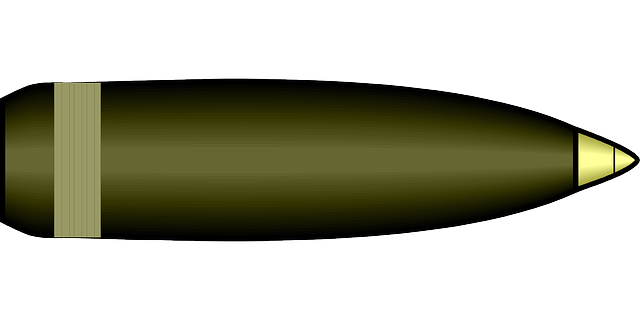
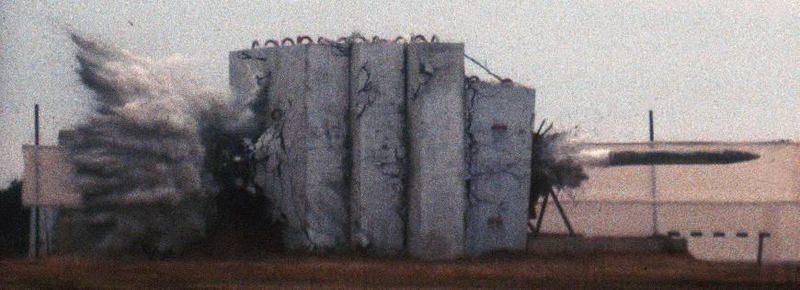
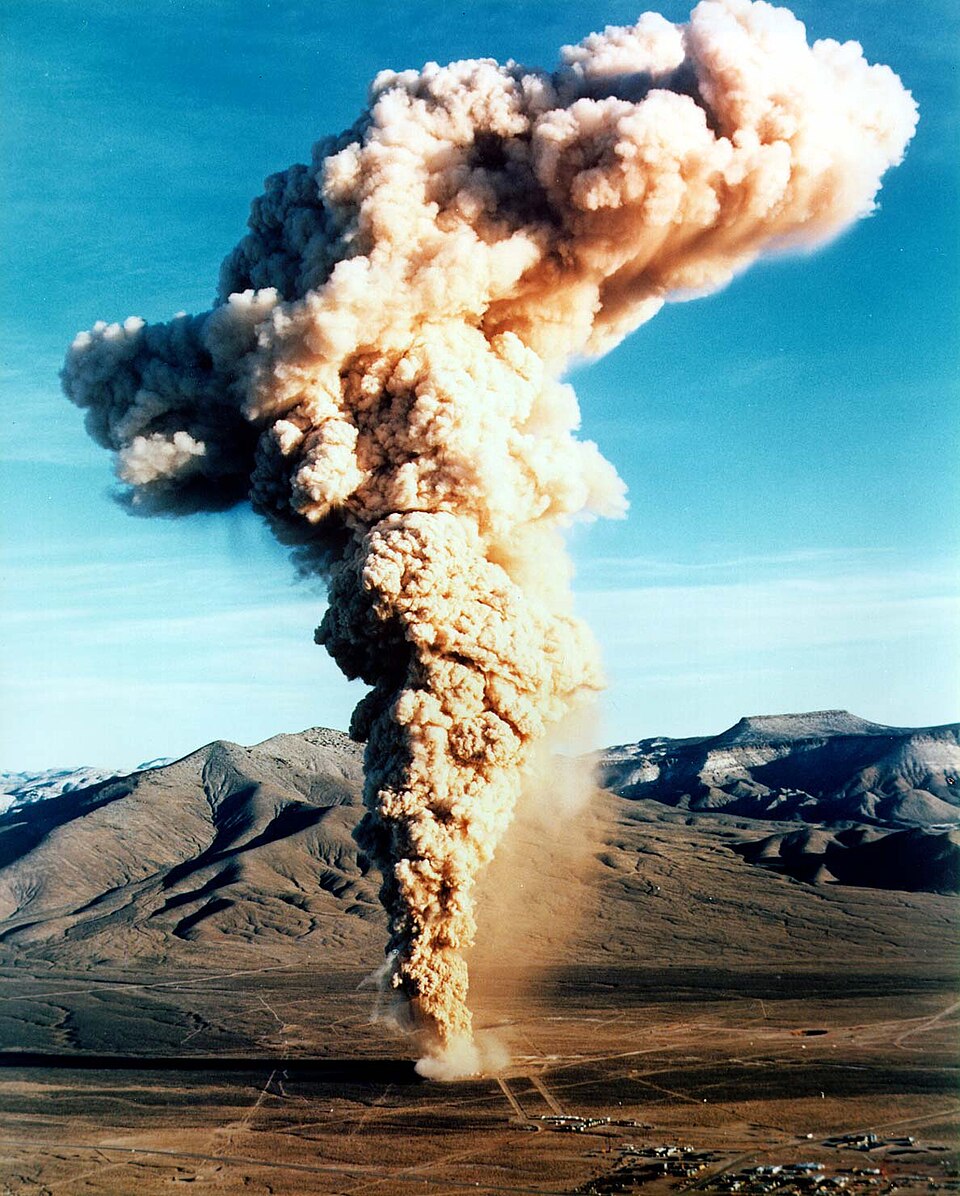
For a meteor impact, only a small fraction of the incoming kinetic energy becomes ejecta kinetic energy. It may be possible to improve the ejecta energy by tamping, like a gun barrel.
If you sent a nuke to an asteroid, have pre-impactors make a hole. Send the nuke down the hole and detonate it at the bottom. You can have post-impactors that close the hole after the nuke goes in.
For a gun, bullet energy is 1/3 powder energy. This is the limit on what the buster strategy can do.
 |
|---|
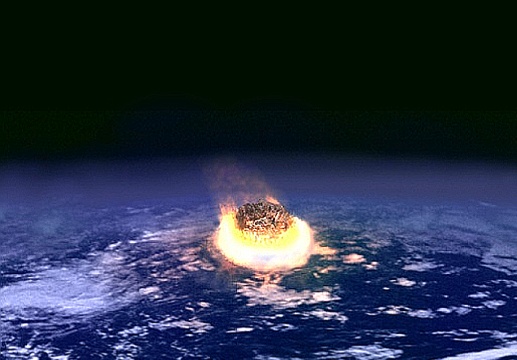
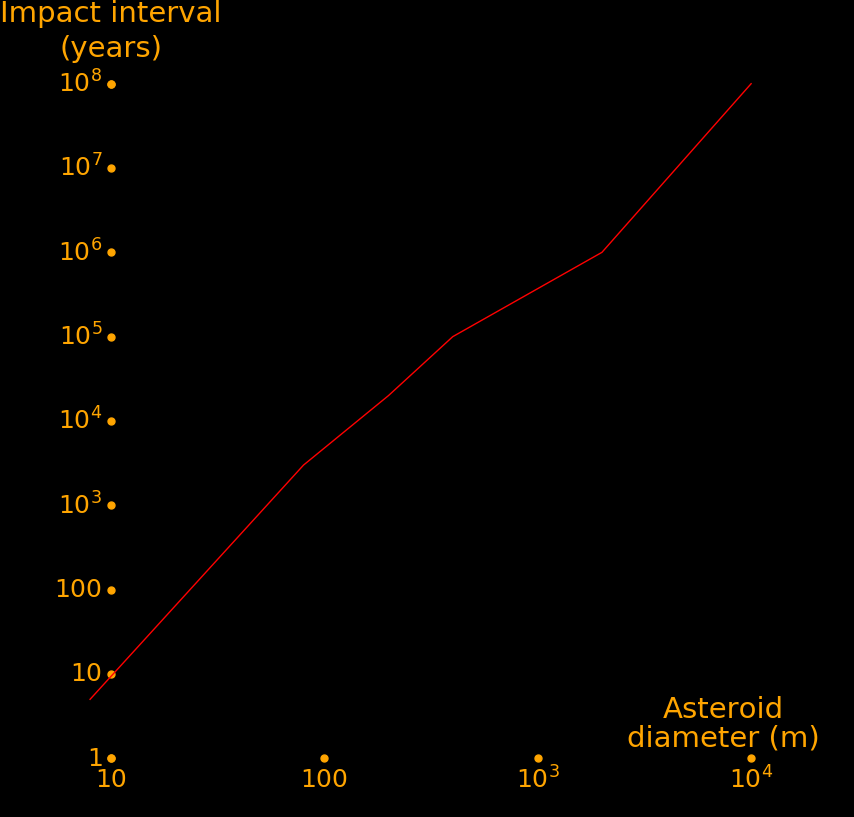
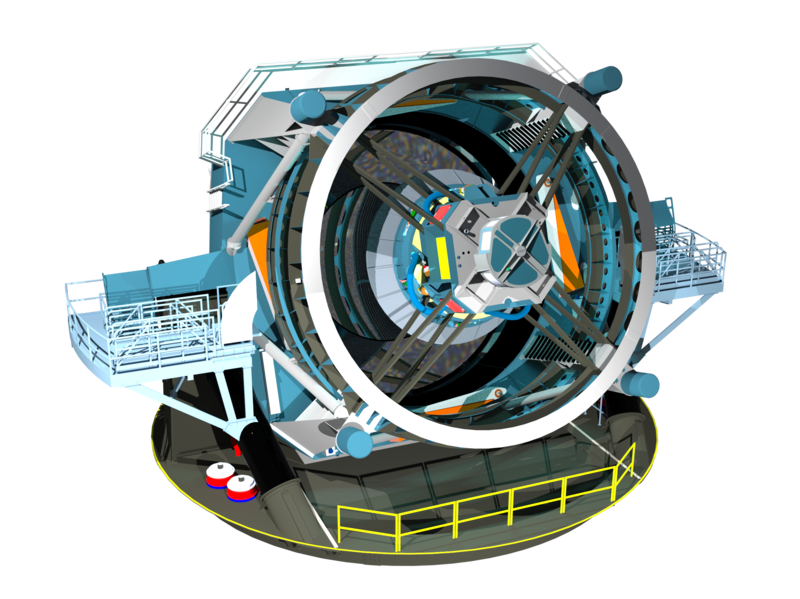
The smallest asteroid capable of penetrating the atmosphere is 50 meters. Such an asteroid has the energy of a 10 Megaton fusion bomb. The minimum for creating a megatsunami is 200 meters. The LSST telescope will find all 200 meter and larger asteroids that are in near-Earth orbits, and hydrogen bombs can redirect any that will impact the Earth. For asteroids from more distant regions of the solar system it won't find them soon enough to deflect them. For this we need more powerful telescopes.
The following table shows impact damage as a function of asteroid size.
Asteroid   Energy    Tsunami   Crater    Impact   Equivalent energy
diameter             height   diameter  interval
 meters    EJoules   meters      km      years

     8         .0001     0       0           5    Fission bomb, 25 kton TNT equivalent
    80         .100      0       1        3000    Fusion bomb, 25 Mton TNT equivalent
   200        1         10       3       20000    Krakatoa Volcano, 1883
   400       10         20       5      100000    Mag 9.5 quake. Chile, 1960.
  2000     1000        200      40     1000000    Hurricane
 10000   100000       4000     200   100000000    Asteroid that killed the dinosaurs
1 EJoule = 1018 Joules.
 |
|---|
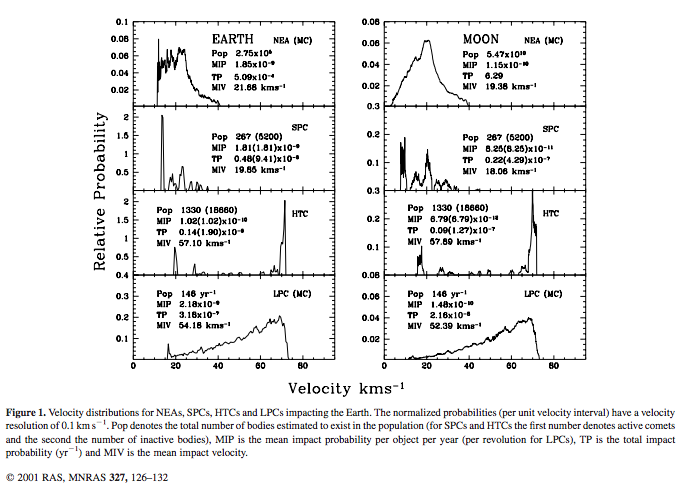
Near Earth asteroids (NEA) approach the Earth at a characteristic speed of ~ 20 km/s. Retrograde comets can approach the Earth as fast as 75 km/s.
NEA: near Earth asteroids
SPC: short period comets
HTC: Halley-type comets
LPC: long period comets
"Near-Earth object velocity distributions and consequences for the Chicxulub impactor" S. V. Jeffers, S. P. Manley, M. E. Bailey, D. J. Asher, Mon. Not. R. Astron. Soc. 327, 126–132 (2001)
 |
|---|
The Pan-STARRS telescope specializes in finding asteroids. It has a wide field of view and takes short exposures, allowing it to cover the entire sky in 8 days. The upcoming Large Synaptic Survey Telescope (LSST) will cover the sky every 2 days.
Telescope   Diameter   Field of     Exposure    Sky survey    Year
            (meters)   view (deg)   (seconds)   time (days)

Pan-STARRS    3          3.0          60           8          2010    Hawaii
LSST          8.4        3.5          15           2          2021    El Penon, Chile


             Flux limit    Magnitude
             (Watts/m2)    limit

Human eye      3e-11         7
Pan-STARRS     5e-18        24
LSST           2e-18        25
Keck 10 meter  1e-19        28
Hubble         1e-20        31
Webb           5e-22        34
The largest single-stage fusion bombs have an energy in the range of 25 ktons TNT equivalent. Larger bombs can be made with 2-stage desgins but they have similar energy/mass as a single-stage bomb.
Energy of a large fusion bomb=  E  =       =  1017 Joules  =  25 MTons TNT equivalent
Mass of a large fusion bomb  =  M  =       =4000  kg
Fusion bomb energy/mass      =  e  =  E/M  =  25   TJoules/kg   =  6 kTons TNT equivalent per kg
TNT energy/mass              =  z  =       =   4.2 MJoules/kg
Departure from the Earth is done with the Oberth maneuver, which uses the Earth to amplify a rocket impulse. The Oberth maneuver is executed by starting the rocket in an elliptical orbit with the perigee as close to the Earth as possible, and the rocket is fired at perigee. Example numbers:
Earth escape speed    =  Ve =  11.2 km/s
Rocket speed change   =  Vr =   6   km/s
Earth departure speed =  Vd = (Vr2 + 2 Vr Ve)½  =  13 km/s
A substantial fraction of an asteroid's kinetic energy goes into heating the atmosphere. An asteroid 10 km or larger heats the atmosphere enough to cause a mass extinction, such as what happened to the dinosaurs.
Heat capacity of air = 1.0 Joules/kg/Kelvin
Mass of atmosphere = 5.1 kg
Mass of asteroid Speed of asteroid
Heating ~ 40 kelvin * ---------------- * ( ----------------- )^2
10^15 kg 20 km/s
A 10 km asteroid has a mass of 1015 kg.
Q = Radius of closest approach / Radius of Earth

                  Q    Diameter  Date    Energy
                       (meters)         (Mtons TNT)
Chelyabinsk      1.0      19     2013      .44
Tunguska         1.0      50     1908    12         Flattened a forest
Arizona asteroid 1.0      50   -50000    10         1 km crater
1972 Fireball    1.0089  ~ 6     1972               Skimmed the upper atmosphere
2011-CQ1         1.87      1     2011
2008-TS26        1.96      1     2008
2011-MD          2.94     10     2011
2012-KT42        3.26    ~ 7     2004
Apophis          4.9     325     2029   510
2013-DA14        5.35     30     2013
2012-KP24        8.99     25     2004
2012-BX34       10.3       8     2012
2012-TC4        14.9      17     2012
2005-YU55       60.00    400     2005
 |
|---|