|
|---|
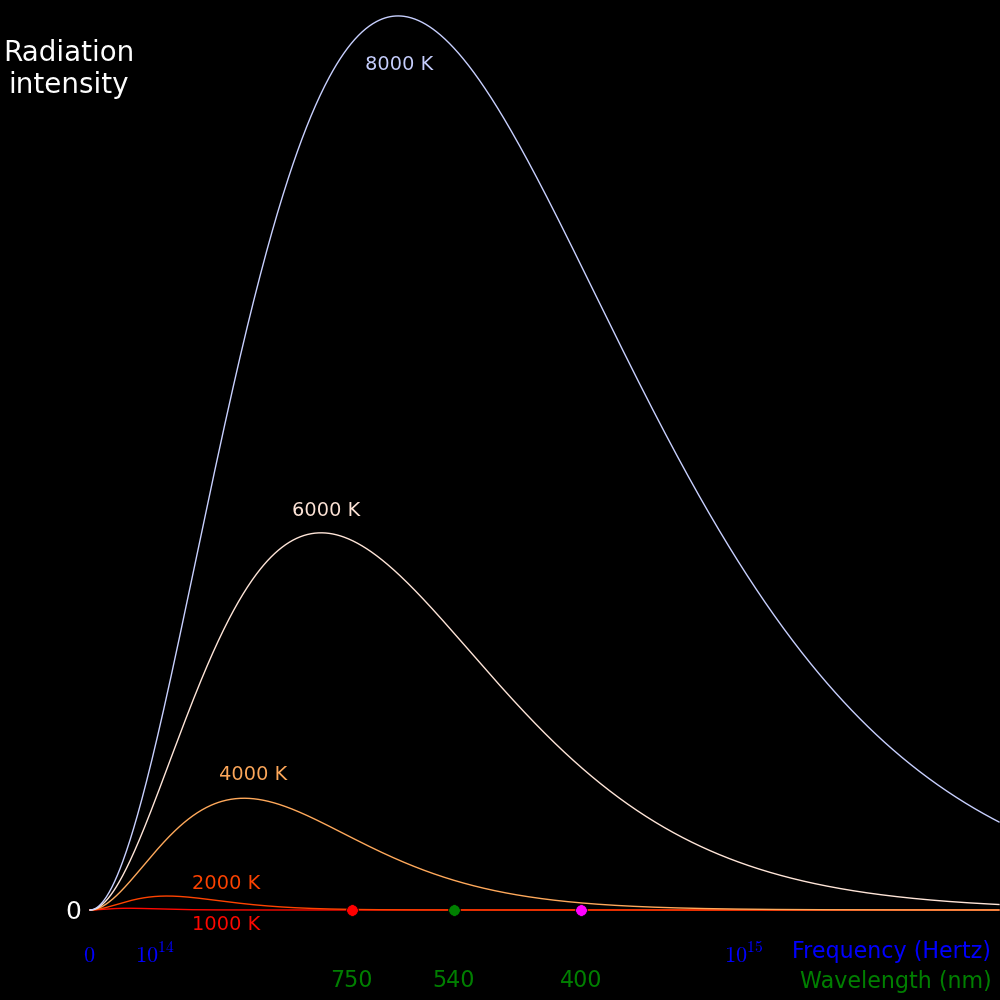
The color of each curve reflects what your eye perceives.
An ideal blackbody radiates power according to the Stefan-Boltzmann law:
Radiation Power = Temperature^4 * SurfaceArea^2 * 5.7*10^-8 Watts/K^4/m^2The radiation is centered around a characteristic wavelength given by Wein's law:
Wavelength  *  Temperature  =  2.90*10^-3  meter Kelvins

      Temperature   Radiation  Relative     Wavelength
          (K)       (meters)   intensity
Earth     287       1.0*10-5        1       Infrared
Sun      5777       5.0*10-7   164000       Visible
The "Blackbody" simulation at phet.colorado.edu shows the blackbody radiation
spectrum as a function of temperature.
 |
|---|
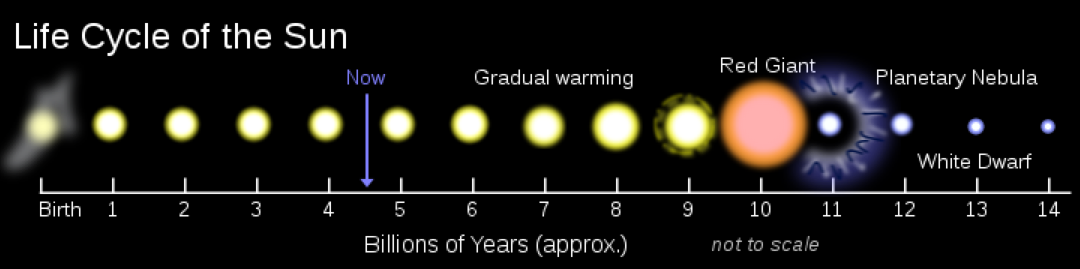
Star       Mass    Luminosity   Color  Temp     Lifetime   Death    Remnant        Size of
type      (solar    (solar            (Kelvin)  (billions                          remnant
          masses) luminosities)                 of years)

Brown Dwarf  <0.08                       1000  Immortal
Red Dwarf     0.1        .0001   Red     2000   1000      Red giant  White dwarf   Earth-size
The Sun       1         1        White   5500     10      Red giant  White dwarf   Earth-size
Blue star     10    10000        Blue   10000      0.01   Supernova  Neutron star  Manhattan
Blue giant    20   100000        Blue   20000      0.01   Supernova  Black hole    Central Park
The minimum mass for hydrogen fusion is 0.08 solar masses.
      Mass < 9     -->  Ends as a red giant and then turns into a white dwarf.
  9 < Mass         -->  Ends as a supernova
  9 < Mass < 20    -->  Remnant is a neutron star.
 20 < Mass         -->  Remnant is a black hole.
130 < Mass < 250   -->  Pair-instability supernova (if the star has low metallicity)
250 < Mass         -->  Photodisintegration supernova, producing a black hole and relativistic jets.
The Earth gains energy from the sun and loses it to blackbody radiation. The equilibrium temperature occurs when these are in balance. To estimate this temperature, assume that:
The Earth absorbs all the solar radiation falling onto it.
The Earth is at a constant temperature at all points on its surface.
Intensity of sunlight at the Earth's orbit = 1360 Watts/m^2
The Earth radiates energy as an ideal blackbody according to the Stefan-Boltzmann law.
Plugging these values in for the Earth, what temperature do you get? How about Venus and Mars?
The luminosity of a star scales with mass as
Luminosity ~ Mass^3.5
The heating power absorbed by a planet from its host star scales as
Heating_power ~ Luminosity * Distance_to_star^(-2)
Define a "Goldilocks radius" as the ideal distance for a planet to be from its host star to be at an ideal temperature for life. If we say that the Goldilocks radius for a 1 solar mass star is 1 A.U., what is the Goldilocks radius for a stars of mass {1/2, 1/4, 1/8, 0.08} solar masses?
http://en.wikipedia.org/wiki/Habitable_zone
Assume the sun shines as an ideal blackbody with a temperature of 5777 Kelvin. Using the "blackbody" simulation at phet.colorado.edu, what fraction of the sun's energy is in the ultraviolet, visible, and infrared?
What temperature would the sun have to be for the ultraviolet fraction to be 1/10th its value at 5777 Kelvin?
 |
|---|
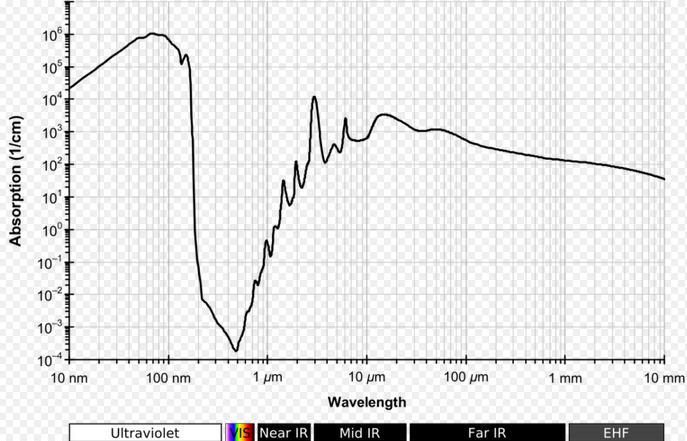
Before the Earth had an oxygen atmosphere and ozone, UV radiation was a hazard and the only safe place to be was underground or underwater. Given the above spectrum, how far underwater do you have to go to escape UV but still have visible light for photosynthesis?
 |
|---|
Using the blackbody spectrum tool and the above data, can you produce an order-of-magnitude estimate for:
Rate of photosynthesis by planets for a 4000 K star divided by rate of photosynthesis by plants for the sun.