
|
|
|
|
|
|
|---|---|---|---|---|---|
 |
 |
 |
 |
 |
 |
 |
 |
|---|---|---|---|---|---|---|---|
 |
 |
 |
 |
|---|---|---|---|
Face  Vert  Edge  Gold-  Geo-   Plat-  Archi-  Spher-  Face
                  berg   desic  onic   median  icity   type

   4    4     6            *      *            .671     3    Tetrahedron
   6    8    12                   *            .806     4    Cube
   8    6    12            *      *            .846     3    Octahedron
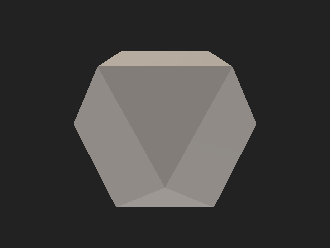
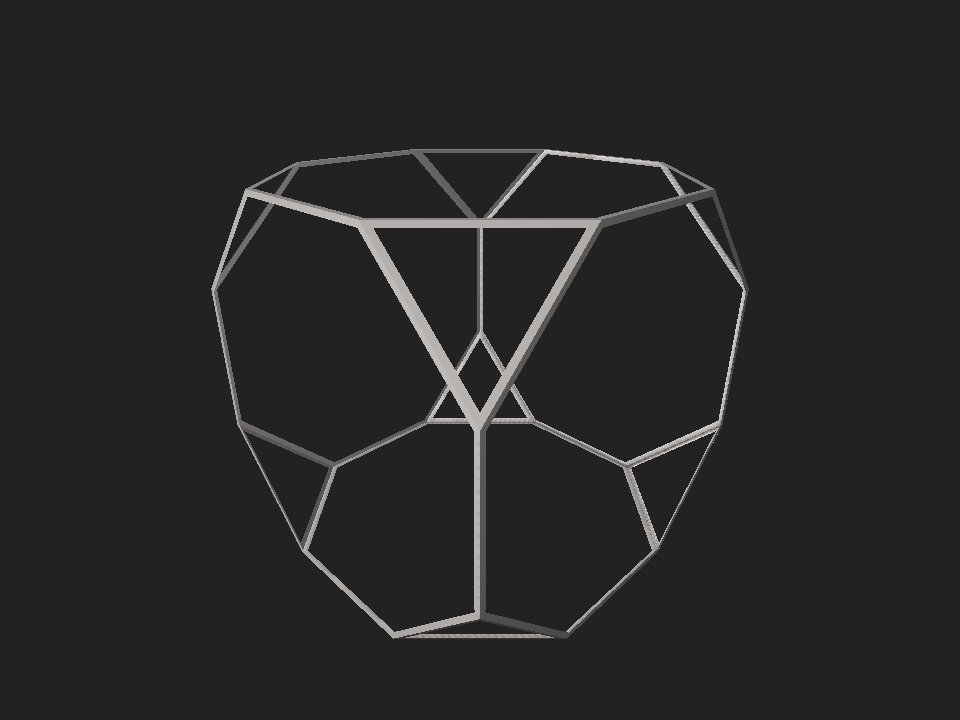
   8   12    18                          *     .775     6 3  Truncated tetrahedron
  10   16    24
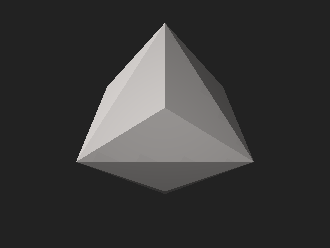
  12    8    18            *                            3    Triakistetrahedron
  12   20    30    *              *            .910     5    Dodecahedron
  14   12    24                          *     .905     3 4  Cuboctahedron +
  14   24    36                          *     .910     6 4  Truncated octahedron
  14   24    36                          *     .849          Truncated cube +
  16   10    24            *                            3
  18   32    48
  20   12    30            *      *            .939     3    Icosahedron
  20   36    54
  24   14    36            *                            3
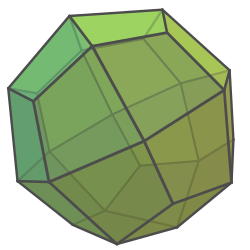
  26   24    48                          *     .954     4 3  Rhombicuboctahedron. Cantellated cube
  26   48    72                          *     .943          Truncated cuboctahedron
  30   32    60                                              Rhombic triacontahedron. Catalan solid
  32   18    48            *                            3
  32   30    60                          *     .951     5 3  Icosidodecahedron
  32   60    90                          *     .926     3 10 Truncated dodecahedron
  32   60    90
  32   90    60    *                     *     .967     6 5  Truncated icosahedron
  34   64    96
  36   20    54            *                            3
  38   24    60                          *     .965     3 4  Snub cube
  38   72   108
  42   80   120    *                                    6 5  Truncated rhombic triacontahedron
  50   96   144
  52  100   150
  60   32    90            *                            3
  62   60   120                          *     .979          Rhombicosidodecahedron
  62  120   180                          *     .970          Truncated icosidodecahedron
  64   34    96            *                            3
  92   60   150                          *     .982          Snub dodecahedron
  66  128   192
  72   38   108            *                            3
  72  140   210    *
  74  144   216
  80   42   120            *                            3    Pentakis icosidodecahedron
  92  180   270    *                                    6 5
  96   50   144            *                            3
 100   52   150            *                            3
 102  200   300    *
 122               *
 128   66   192            *                            3
 140   72   210            *                            3
 144   74   216            *                            3
 162               *

Euler formula:  Faces + Vertices - Edges = 2
|
|
|
 |
 |
 |
 |
 |
|---|---|---|---|---|---|---|---|
A Goldberg polyhedron has faces that are either pentagons or hexagons. There are always 12 pentagons. The Goldberg polyhedra with ≤162 faces are shown above.
Face  Vert  Edge  Class  Spher-
                         icity

  12   20    30     1    .910
  32   60    90     2    .967
  42   80   120     1
  72  140   210     3
  92  180   270     1
 122  240   360     2
 132  260   390     3
 162  320   480     1
 |
|---|
Shave vertices          Truncate
Shave vertices max      Truncate down to the to the midpoint of edges
Shave edges             Chamfer or bevel
Shave faces             Runcinate
Shave vertices & edges  Cantellate
Extend pyramid
Extend deltoid
Extend rhombus
Spherize vertices       Move vertices radially outward until all are on the same sphere
Spherize faces          Move face centers radially outward until all are on the same sphere
Spherize edges          Move edge centers radially outward until all are on the same sphere
Dual                    Exchange faces and vertices
Rotate face             Snub
Rotate cap
Hull, convex
Fuse 2 hedra by intersection
Fuse 2 hedra by union
Fuse 2 hedra by convex hull
Catalan solids are the duals of Archimedian solids.
 |
 |
 |
 |
 |
|---|---|---|---|---|
Platonic solids were known since antiquity. They were listed in Euclid's "Elements" in around 300 BCE. They are convex hedra with congruent faces and identical vertices.
The 13 Archimedean solids were published in 1619 by Kepler in "Harmonices Mundi". They are the convex uniform hedra other than Platonics, prisms, and antiprisms. Faces are regular polygons and vertices are transitive. Faces need not be transitive.
The duals of Archimedean solids are Catalan solids, which were published by Eugene Catalan in 1865. This cemented the concept of duality. A dual is constructed by swapping faces and vertices. Catalan solids have congruent faces and they're face-transitive.
 |
|---|
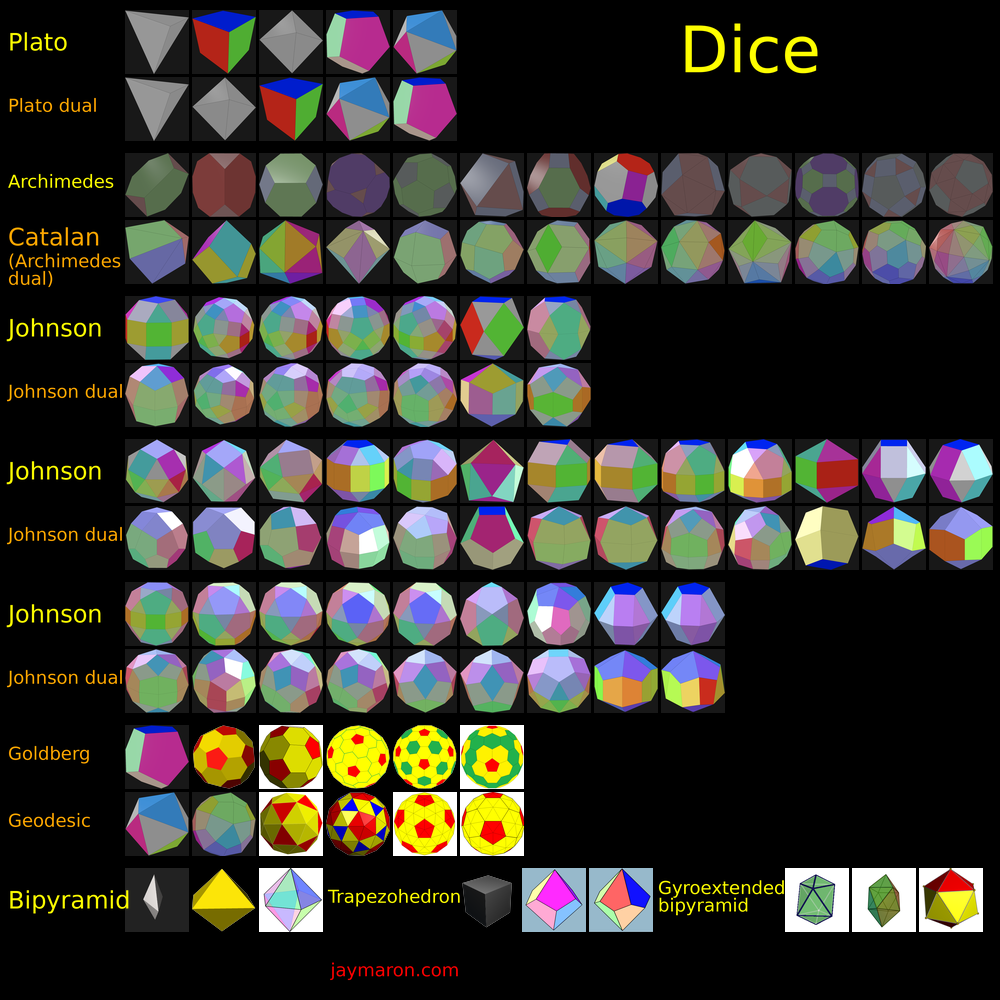
A hedron with congruent faces that are transitive is a fair dice. This includes Plato, Catalan, symmetric bipyramids, and symmetric trapezohedra. Gyroextended bipyramids are not face-transitive and are not fair dice in general.
Duals of Johnson solids can be dice. There is no name for Johnson duals so we call them "Pixies". The first row of Johnsons have cospherical vertices and the rest don't.
Solids have tiers of purity depending on how many properties they have. The following solids have regular faces. Faces with the same number of sides are congruent.
             Transitive  Equivalent  Roundoid   Dual
               faces      vertices

Platonic              Yes    Yes       Yes   Strongly balanced
Archimedean           No     Yes       Yes   Strongly balanced
Johnson, Olympian     No     No        Yes   Strongly balanced           J37 = Miller solid
Johnson, Blessed      No     No        Yes   Balanced                    J27, J34, J72, J73, J74, J75
Johnson, Elysian      No     No        Yes   Unbalanced but balanceable  J15, J17, J38, J39, J45
Johnson, Asphodelian  No     No        Yes   Not balanceable             J12, J13, J35, J36, J40, J41, J44, J51, J84
Johnson, Tartarusian  No     No        No    Not balanceable             All other Johnsons
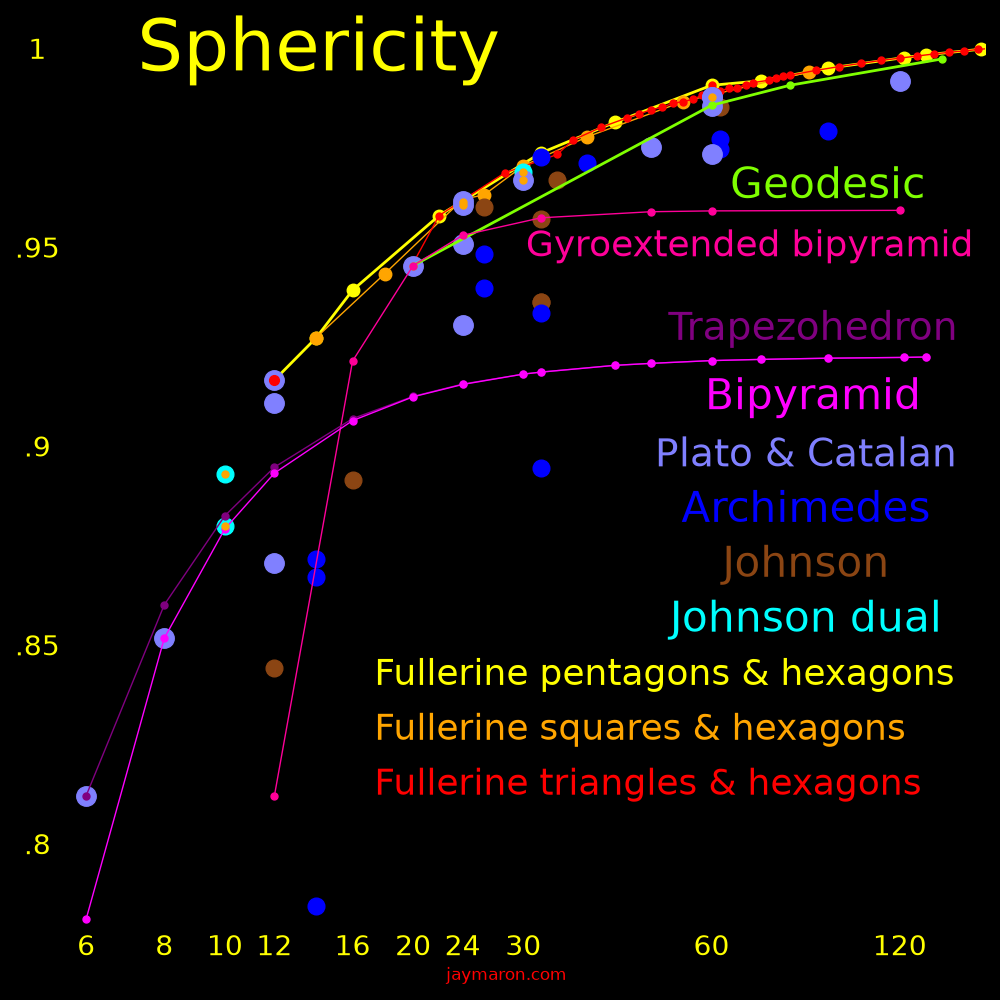
Sphericity: Ψ = Asphere / A where Asphere is the area of a sphere with the same volume as the hedron. Ψ = 1 for a sphere and is < 1 for all other hedra.
Roundoidness: ψ = N(1-Ψ), where N is the number of faces. A "roundoid" is a convex hedron with roundoidness less than or equal to 2.
A hedron is "balanced" if faces have equal area and are cospherical. It is "superbalanced" if faces are congruent. A superbalanced hedron has cospherical vertices.
A hedron is "vertex-balanced" if faces have equal area and vertices are cospherical.
Johnson #37 is the "Miller solid" and its dual is the "Demon". The Demon is the only Pixie that's superbalanced.
Some Pixies are balanced. Some Pixies are'nt balanced but they can be blacksmithed into balance while preserving combinatorial equivalence. These are "balaceable".
Most Pixies are unbanceable. They can fail by excessive prolateness, oblateness, or triaxialness. They can also fail if they're vaguely hemispherical.
We define a "fairy dice" as a dice that is "almost fair". It has faces with equal area. Face-COM distances and vertex co-sphericity are optimized for fairness. Balanceable Pixies are fairy dice.
Late 1470s–1481/82 Piero della Francesca writes Libellus de quinque corporibus regularibus, including regular solids and several truncations. *
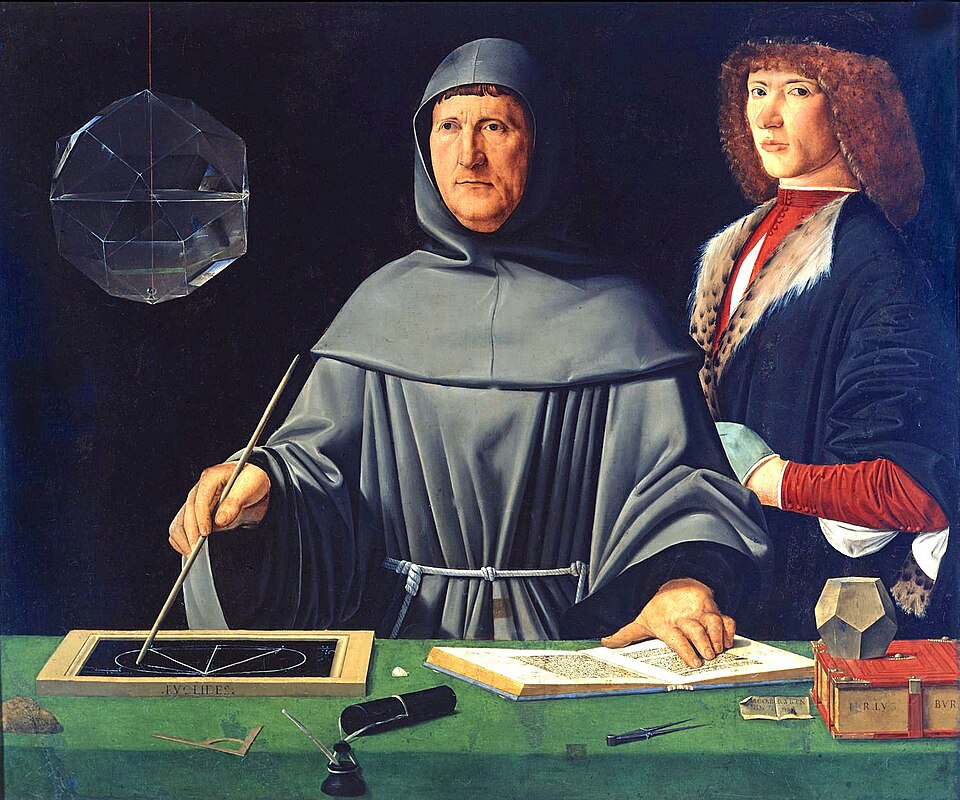
1495 A glass rhombicuboctahedron appears in "Portrait of Luca Pacioli", attributed to Jacopo de' Barbari. *
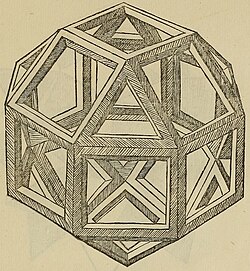
1509 da Vinci published a drawing of a rhombicuboctahedron in Pacioli's "Divina Proportione".
1611 Kepler publishes "De nive sexangula", which shows 2 solids, the rhombic dodecahedron (12 faces) and rhombic triacontahedron (30 faces). He mentions the existence of 14 Archimedes hedra but there are no drawings.
1619 All 13 Archimedean hedra are first published by Kepler in "Harmonices Mundi".
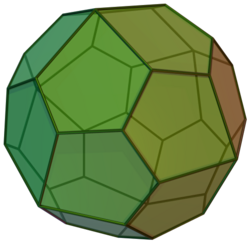
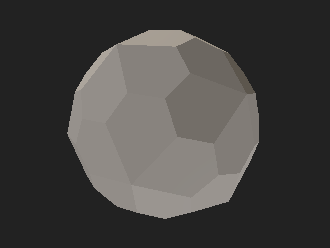
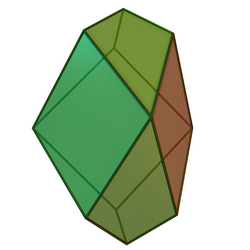
The Miller hedron is "almost Archimedean". It has congruent vertices that are not transitive. Its dual is the demonhedron, which has congruent faces that are not trasitive. It's unknown if the demonhedron is a fair dice. If it's unfair, it's probably close to fair.
The Miller hedron was discovered many times but the mathematics community failed to notice. Coxeter reported Miller's discovery in 1930; Johnson included it as J37 in his 1966 list. The earlier publication and later classification are distinct milestones. Johnson solids are the 92 convex nonuniform polyhedra with regular faces.
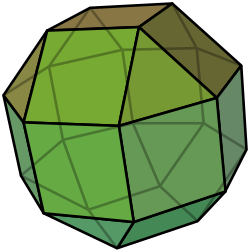
The Miller solid was initially mistaken for a rhombicuboctahedron. The Miller solid is obtained by twisting a cupola in a rhombicuboctahedron.
1905 Sommerville describes the solid now known as the Miller solid.
1930 Coxeter reports Miller's discovery of the solid.
1957 Ashkinuze independently describes the Miller solid.
1969 Zalgaller proves Johnson's conjecture that the list of 92 Johnson solids is complete.
1989 Persi Diaconis and Joseph B. Keller publish "Fair Dice" in the American Mathematical Monthly. The foundational short reference on symmetry and fair dice.
2009 The demon is analyzed by Zefiro and Ardigo.
2009 Grunbaum examines the Miller solid's history in "An enduring error".
The demon is obtained from the rhombicuboctahedron by cap gyration followed by polar duality. For any new demon, we can ask which operations generate it and whether it requires a new "prime seed".
The demon is also called a gyrate deltoidal icositetrahedron or a pseudo-deltoidal icositetrahedron. The Miller solid is also called a pseudorhombicuboctahedron or an elongated square gyrobicupola.
 |
 |
|---|---|
There are 2 Catalan hedra that aren't extensions of Platonic hedra. The faces are irregular pentagons. They are chiral, which means that the mirror image is different. For the 24-sided pentagonal hedron, we call the left-handed version the "devil" and the right-handed version the "angel". For the 60-sided pentagonal hedron, we call the left-handed version the "Evening Star" and the right-handed version the "Morning Star".
 |
 |
 |
|---|---|---|
Fairness can be tested by 3D-printing dice and rolling them. It likely depends on throwing conditions and materials properties. There are 3 things to make as equal as possible: Face area, face COM distance, and vertex co-sphericity. It' an open question as to their relative importance.
The more bouncy, the better.
Casino tables use felt to snag vertices and encourage rolling.
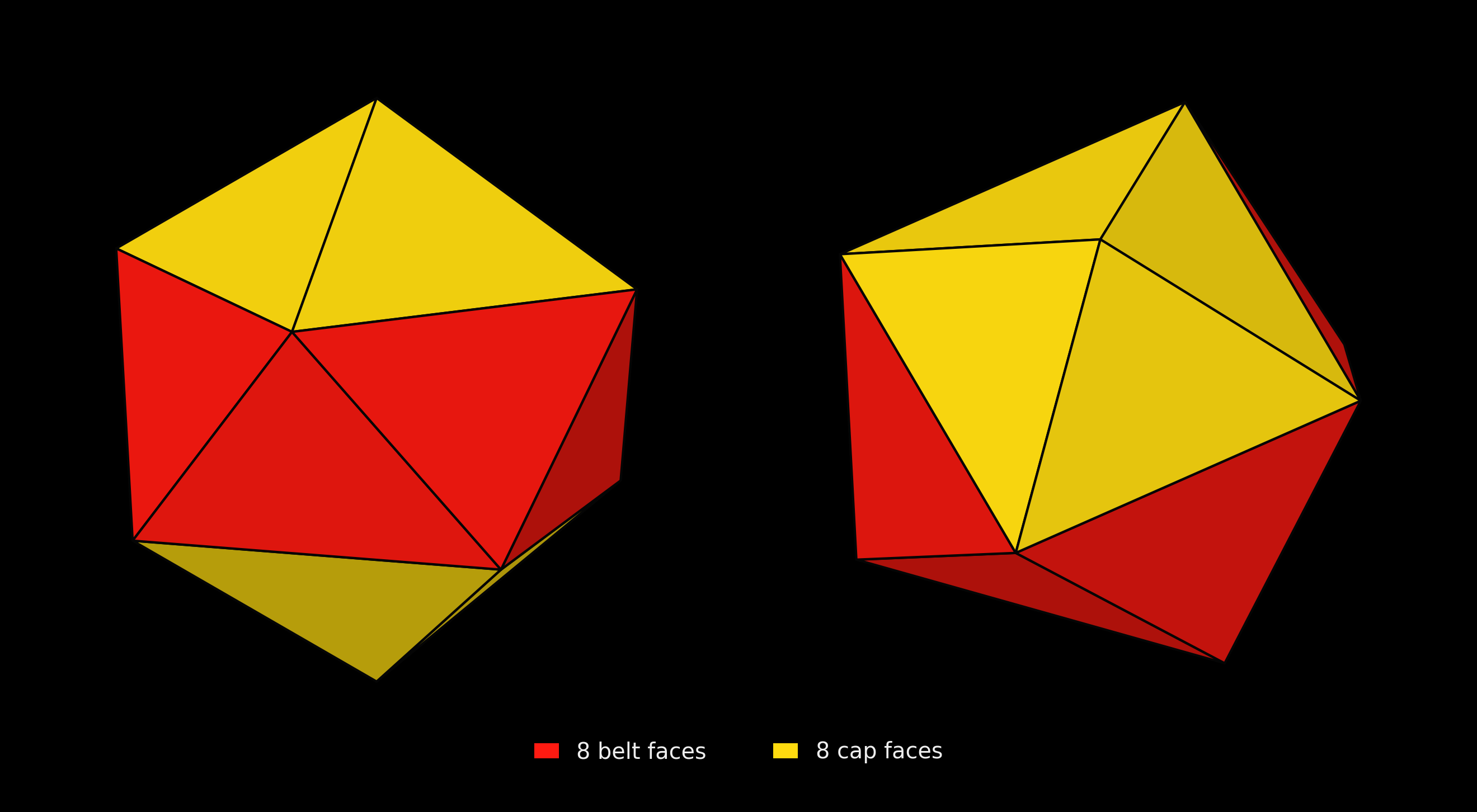
For the gyroextended bipyramid-16, there are two types of sides: cap sides and belt sides, with 8 of each. Probabilities within a type are equal but probabilities for different types are probably unequal. The experiment counts the occurrence of cap and belt sides.
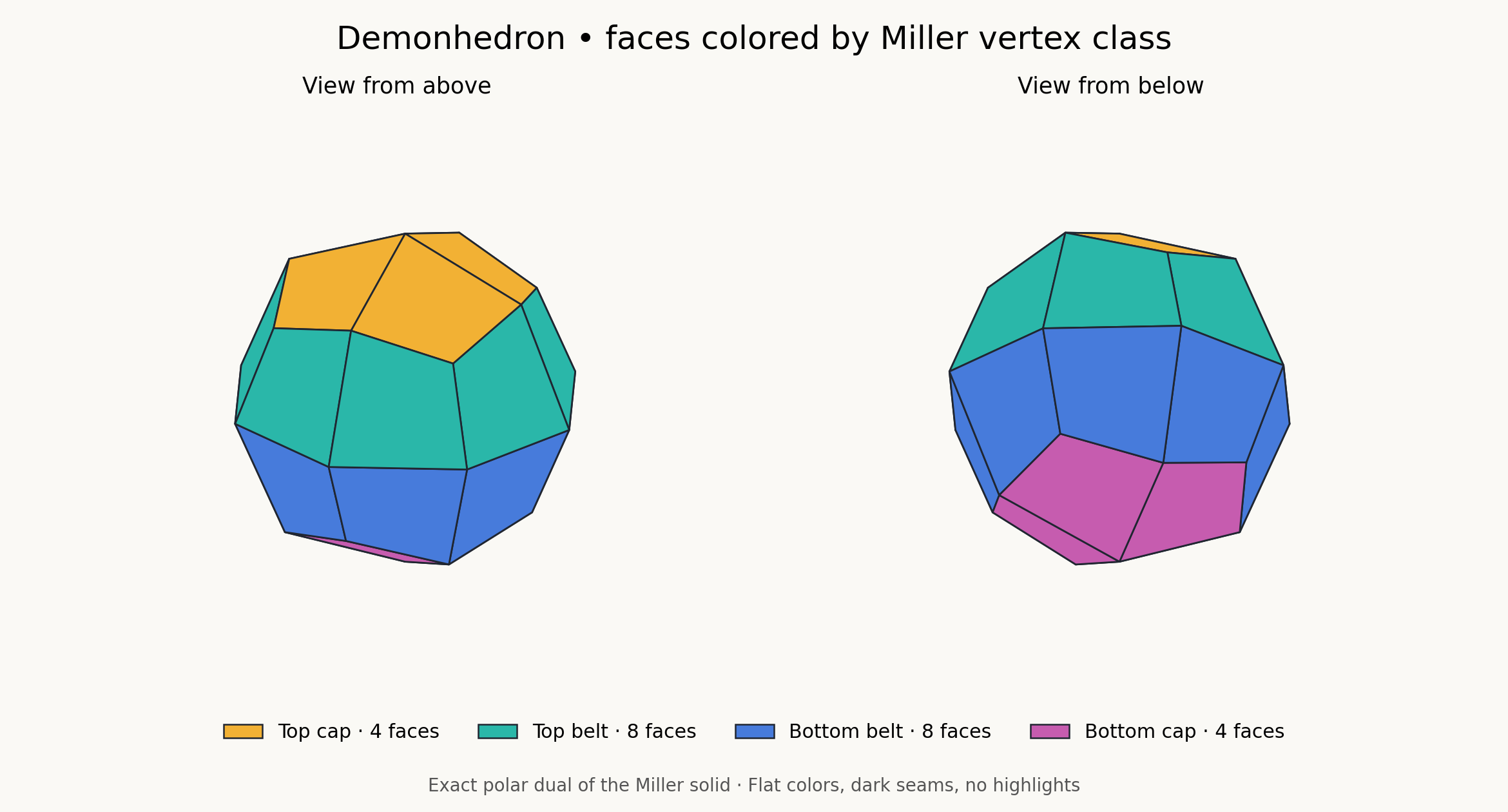
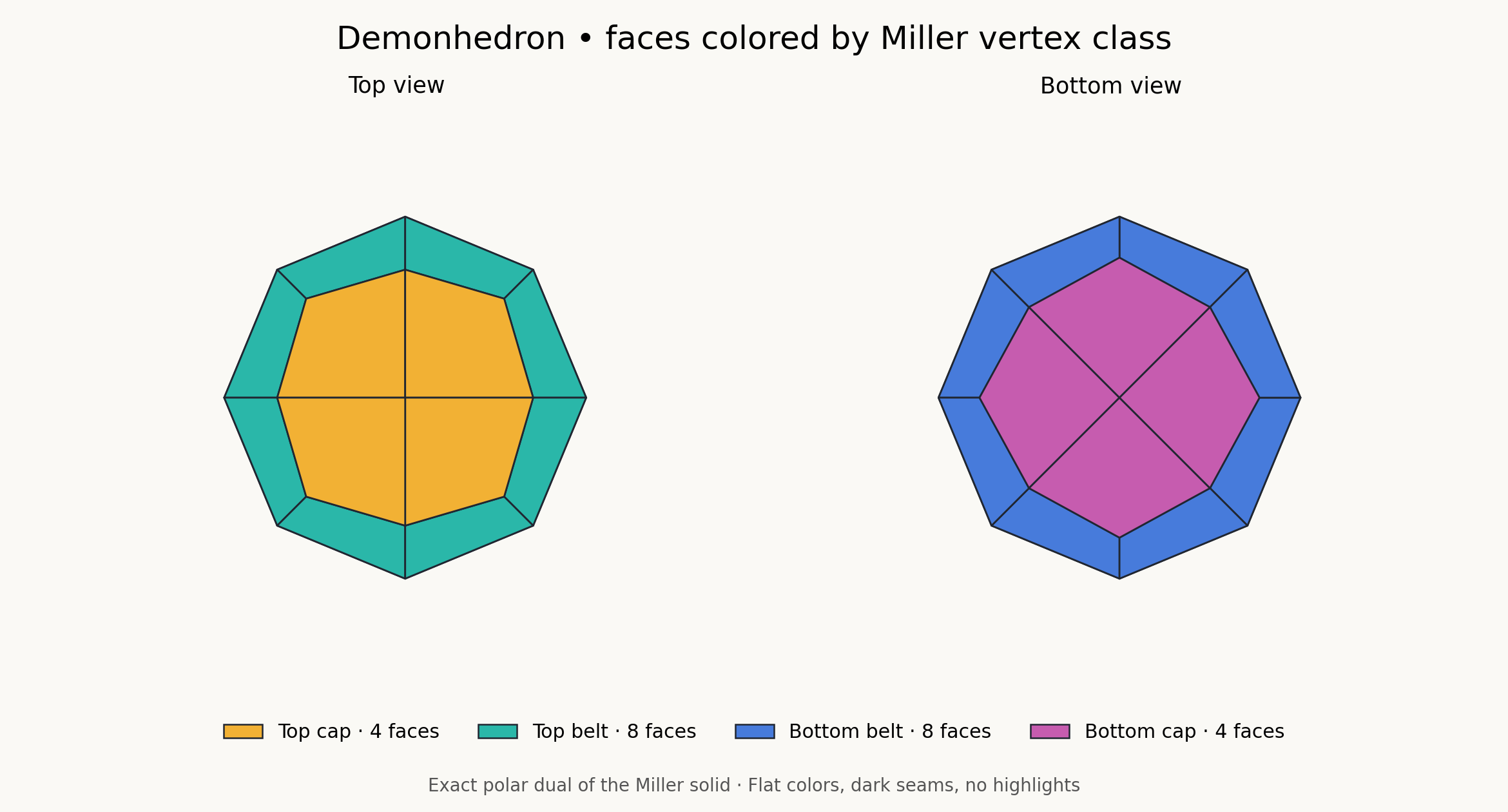
The Miller solid has 4 vertices on the top cupola, 8 vertices on the top of the belt, 8 vertices on the bottom of the belt, and 4 vertices on the bottom cupola. These correspond to faces of the demon. Under full symmetry the top and bottom classes pair up: eight cap faces and sixteen belt faces. Fair class totals are 1/3 and 2/3 under a symmetry-respecting throwing protocol. The experiment can also retain the four subcounts to detect a directional launch bias. The demon's face classes are:
The following face counts are available:
For rounded Goldbergs with all hexagonal faces, the maximum faces for pentagon-based is 60,
for square-based is 24, and for triangle-based is 12.
Goldberg-420 is the "high roller" and Goldberg-42 is "The Answer".
A Goldberg triangular solid can have 1000 faces (kilodie), 1 million faces (megadie), and 1 bilion faces (gigadie).
"Shell-equal-area" means equal-area planar faces and all vertices on a centered spherical shell.
This is a proposed geometric constraint; high sphericity does not alone bound landing bias.
Goldberg and geodesic hedra are dual to each other. They need not be weakly-balanced; particular geometries may be
pseudo-balanced into highly-spherical hedra. This gives a large number of options
for face count and the hedra can be arbitrarily large. Available face numbers include:
Faces                   4 6 8 10 12 14 16 18 20 22 24 26 28 30 32 34 35 36 38 40 42 44 46 48 50 52 54 56 58 60 62 64 66 68 70 72 76 80 92 96 104 120

Plato                   * * *     *           *
Catalan                          **                 4        *                             *                 4                                     *
Johnson dual                  **  *     *  3       **        3       **                                      4
Archimedes                  *        3                **        3           *                                  **                       *
Johnson                   *    *  *     *              *        3  *                                            4
Gyroextended bipyramid                  *     *     *
Archimedes disastereomer                               *                                                        *
Goldberg icosahedral              *                             *                 *                                            *        *
Goldberg octahedral       *          *     *                 *              *                 *     *                 *
Goldberg tetrahedral    *   *  *        *     *        *  *        *           *     *           *     *  *        *
Geodesic icosahedral                          *                                                              *                       *
Geodesic octahedral         *                       *           *                                      *                       *           *   *
Geodesic tetrahedral    *         *     *                 *              *                 *     *                 *              *
Goldberg icosahedral domed                    *              *                                *              3
Goldberg octahedral  domed  *     *                 *
Geodesic icosahedral domed                    *                                                              *
Geodesic octahedral  domed  *
Goldberg tetra domed    * *       *
Absent                                           *                                      *                               *   *

Goldberg icosahedral  12, 32, 42,  72,  92, 122, 132, 162, 212, 252, 282, 312, 362, 372, 392, 482, 492
Geodesic icosahedral  20, 60, 80, 140, 180, 240, 260, 320, 380, 420, 500
Geodesic icosahedral  1280 = 256 ⋅ 3
Geodesic tetrahedral  100, 10000, 1000000, ...
Goldberg tetrahedral  10M for M<=10, except for 108 and 1010.
Geodesic tetrahedral   2M for M > 1.

Johnson #40 dual and Johnson #41 dual have 35 sides, and they can be balanced.
 |
|---|
The following is a list of fairy dice candidates. "Asphericity" is (1-Ψ) and is quoted in percent.
Faces  Asph.%   Construction              Face type             Name                          Dual ID    Dual name

   4   32.9     Tetrahedron               Triangle, regular     Tetrahedron                              Tetrahedron
   4            Goldberg-8 tetra domed    Hexagon, regular
   6   19.4     Cube                      Square                Cube                                     Octahedron
   6            Goldberg tetra-10 domed   Hexagon, regular
   8   14.6     Trapezohedron-8           Kite                  Tetragonal trapezohedron                 Square antiprism
   8   15.4     Octahedron                Triangle, regular     Octahedron                               Cube
   8   32.67    Archimedes tetra trunc                          Truncated tetrahedron
   8            Goldberg-14 octa domed

  10   11.3     Johnson-17 dual                                 Dual of J17                        J17   Gyroelongated square bipyramid
  10   12.4     Trapezohedron-10          Kite                  Pentagonal trapezohedron
  10   12.6     Johnson-15 dual                                 Dual of J15                        J15   Elongated square bipyramid
  10   12.7     Bipyramid-10              Triangle, isosceles   Pentagonal bipyramid
  10   14.24^   Goldberg-10 tetra         Triangle & hexagon    Goldberg-10 tetrahedral

  12    8.95    Dodecahedron              Pentagon              Dodecahedron                      Arch   Icosahedron
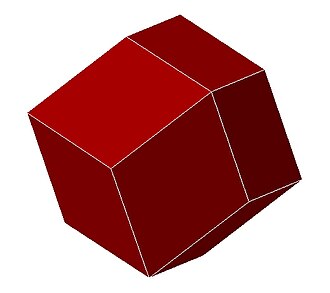
  12    9.53    Tetrahedron  + deltoid    Rhombus               Rhombic dodecahedron              Arch   Cuboctahedron
  12    9.530   Johnson-27 dual           Rhombus and Trapezoid                                    J27
  12   11.1     Trapezohedron-12          Kite                  Hexagonal trapezohedron
  12   11.3     Bipyramid-12              Triangle, isosceles   Hexagonal bipyramid
  12   13.6     Tetrahedron  + pyramid    Triangle, isosceles   Triakis tetrahedron               Arch   Truncated tetrahedron
  12   19.4     Gyroelongated bipyramid-12 Triangle, isosceles  Gyroelongated triangular bipyramid
  12            Goldberg-18 octa domed
  12            Goldberg-16 tetra domed

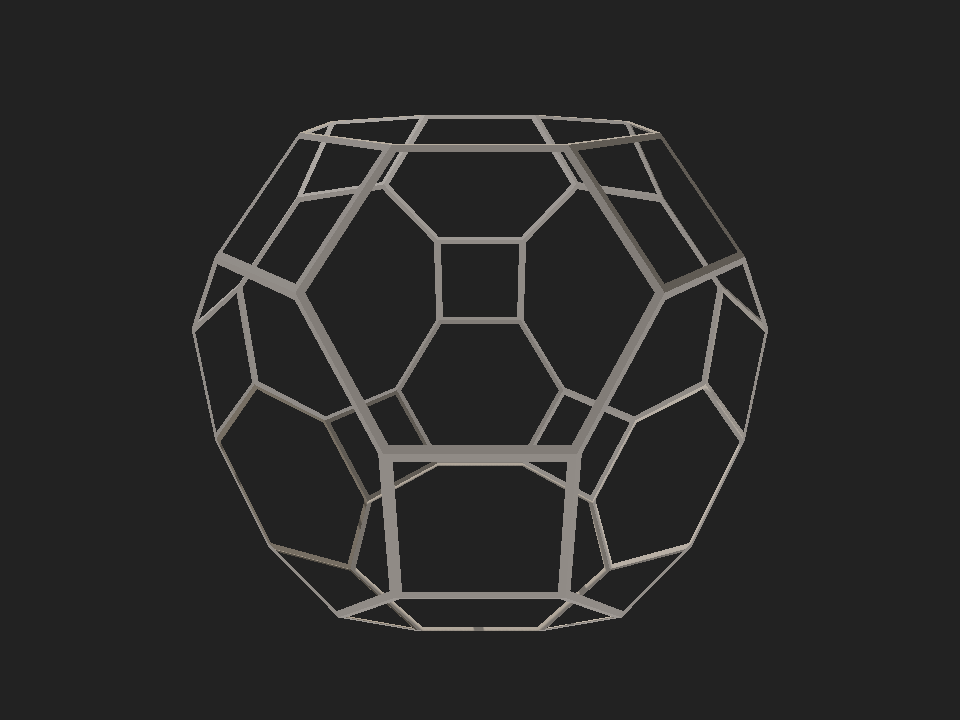
  14    7.8839  Fullerene-14 icosa        Pentagon & hexagon    Truncated hexagonal trapezohedron        Geoelogated hexagonal bipyramid
  14    7.88^   Fullerine-14 octa         Square & hexagon      Truncated octahedron [LGT Fig.5f]
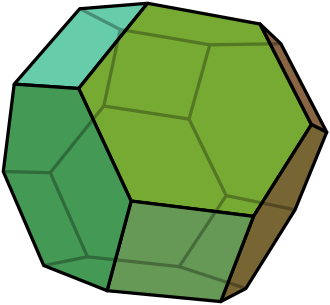
  14   13.45    Archimedes octa trunc                           Truncated octahedron
  14   13.91    Archimedes cubocta                              Cuboctahedron
  14   22.18    Archimedes cube trunc                           Truncated cube
  15            Fullerene-15 icosa        Pentagon & hexagon    Fullerene-15 icosahedral                 Fullerene-26 dual
  16    6.7^    Fullerene-16 icosa        Pentagon & hexagon    Fullerene-16 icosahedral Td              Frank-Kasper Z16 [LGT Fig.5g; modified lattice]
  16            Fullerene-16 tetra        Triangle & hexagon    Fullerene-16 tetrahedral                 Geodesic-28 tetrahedral
  16            Geodesic-16 tetra         Triangle, irregular   Dual of chamfered tetrahedron            Goldberg-10 tetrahedral
  17            Fullerene-17 icosa        Pentagon & hexagon    Fullerene-30 icosahedral C2v             Fullerene-30 C2v dual
  18            Fullerene-18 D3           Pentagon & hexagon    Fullerene-32                             Fullerene-32 D3 dual
  18    6.28^   Fullerine-18 octa         Square   & hexagon    Cube + edge chamfer / octahedral Goldberg(2,0), LGT Fig.5h
  19            Fullerene-19 icosa        Pentagon & hexagon    Fullerene-34 icosahedral C2              Fullerene-34 C2 dual
  20            Fullerene-20 icosa        Pentagon & hexagon    Fullerene-20 icosahedral D6h             Fullerene-36 dual
  20    6.01^   Fullerine-20 tetra        Triangle & hexagon    Goldberg tetrahedral(3,0), LGT Fig.5i    Geodesic-36 tetrahedral
  20    6.07    Icosahedron               Triangle, regular     Icosahedron                              Dodecahedron
  20            Goldberg-32 icosa domed
  22    4.814^  Fullerine-22 icosa        Pentagon & hexagon    Fullerine icosahedral LGT-22 Fig.5j

  24            Fullerene-24 icosa        Pentagon & hexagon    Fullerene-24 icosahedral D2              Fullerene-24 icosahedral D2 dual
  24    4.44    Devil                     Pentagon, irregular   Pentagonal icositetrahedron       Arch   Snub cube
  24    4.48    Johnson-45 dual                                 Dual of J45                        J45   Gyroelongated square bicupola
  24    4.54    Demon                     Kite                  Pseudo-deltoidal icositetrahedron  J37   Elongated square gyrobicupola
  24            Fullerine-24 octa
  24    4.54    Cube + deltoid            Kite                  Deltoidal icositetrahedron        Arch   Rhombicuboctahedron
  24    5.31    Gyroelongated bipyramid-24 Triangle, isosceles  -
  24    5.53    Cube + pyramid            Triangle, isosceles   Tetrakis hexahedron               Arch   Truncated octahedron
  24    6.2023  Geodesic-24 octa          triangle, irregular   Geodesic-24 octahedral                   Goldberg-14 octahedral
  24    7.56    Octahedron   + pyramid    Triangle, isosceles   Triakis octahedron                Arch   Truncated cube
  24    9.05    Trapezohedron-24          Kite                  Trapezohedron-24
  24    9.06    Bipyramid-24              Triangle, isosceles   Bipyramid-24
  24            Goldberg-30 octa domed

  26    4.287^  Archimedes great          Square, hex, octagon  Great rhombicuboctahedron                Catalan Cube + deltoid
* 26    4.287^  Octa trunc edge vert      Square, hex, octagon  Tangential truncated cuboctahedron       LGT-26 Fig.5k; same connectivity as Archimedean form
  26    5.79    Archimedes cubeocta trunc                       Truncated cuboctahedron
  26    6.63    Archimedes                                      Rhombicuboctahedron
  26            Fullerene-26 triangle     Triangle & hexagon    Fullerene-26 tetrahedral                 Geodesic-48 tetrahedral
  28            Fullerene-28 tetra        Triangle & hexagon    Fullerene-28 tetrahedral                 Geodesic-52 tetrahedral
  28            Geodesic-28 tetra         Triangle, irregular   Geodesic-28 tetrahedral                  Fullerene-16 triangle

  30    3.561^  Fullerine-30 octa         Square & hexagon      Goldberg octahedral(2,1), LGT Fig.5l     Geodesic-56 octahedral
  30    3.72    Johnson-38 dual                                 Dual of J38                        J38   Elongated pentagonal orthobicupola
  30    3.72    Johnson-39 dual                                 Dual of J39                        J39   Elongated pentagonal gyrobicupola
  30    3.91    Icosahedron + join        Rhombus               Rhombic triacontahedron           Arch   Icosidodecahedron
  30    3.91    Johnson-34 dual                                 Dual of J34                        J34   Pentagonal orthobirotunda     (Gyration of icosidodecahedron)
  30            Goldberg-42 icosa domed

  32    3.244^  Fullerine-32 icosa        Pentagon & hexagon    Goldberg-32 icosahedral                  Geodesic-60 [icosahedral (1,1)]
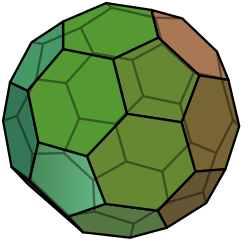
  32    3.34    Archimedes icosa trunc                          Truncated icosahedron
  32            Fullerine-32 octa         Triangle, irregular   Geodesic-32 octahedral                   Goldberg-18 octahedral
  32    7.26    Archimedes icosidodeca                          Icosidodecahedron
  32   11.16    Archimedes dodeca trunc                         Truncated dodecahedron
  34            Fullerene-34 tetra        Triangle & hexagon    Fullerene-34 triangle                    Geodesic-64 tetrahedral
  36            Geodesic-36 tetra         Triangle, irregular   Geodesic-36 tetrahedral                  Goldberg-20 tetrahedral
  38    2.831^  Fullerine-38 octa         Square & hexagon      Goldberg octahedral(3,0), LGT Fig.5n     Geodesic-72 octahedral
  38    3.48    Archimedes snub cube                            Snub cube
  40    1.913$  Johnson-42 dual                                 Johnson-42 dual                          Elongated pentagonal orthobirotunda
  40    1.913$  Johnson-43 dual                                 Johnson-43 dual                          Elongated pentagonal gyrobirotunda
  40            Fullerene-40 tetra        Triangle & hexagon    Fullerene-40 tetrahedral                 Geodesic-76 tetrahedral
  42    2.472^  Goldberg-42               Pentagon & hexagon    Goldberg-42                              Geodesic-80 [icosahedral (2,0)]
  44            Fullerene-44 tetra        Triangle & hexagon    Fullerene-44 tetrahedral                 Geodesic-84 tetrahedral
  48            Fullerene-48 icosa        Pentagon & hexagon    Fullerene-48 icosahedral T               Fullerene-92 T dual
  48    3.092   Cubemeta                  Triangle, irregular   Disdyakis dodecahedron                   Truncated cuboctahedron
  48            Geodesic-48 tetra         Triangle, irregular   Geodesic-48 tetrahedral                  Fullerene-26 triangle
  50            Fullerene-50 octa         Square   & hexagon    Fullerene-50 square                      Fullerene-50 square dual
  52            Geodesic-52 tetra         Triangle, irregular   Geodesic-52 tetrahedral                  Fullerene-28 triangle
  54            Fullerene-54 octa         Square   & hexagon    Fullerene-54 octahedral                  Fullerene-54 square dual
  56            Geodesic-56 octa          Triangle, irregular   Geodesic-56 octahedral                   Goldberg-30 octahedral
  58            Fullerene-58 tetra        Triangle & hexagon    Fullerene-58 tetrahedral                 Geodesic-112 tetrahedral

  60            Fullerene-60 icosa        Pentagon & hexagon    Fullerene-60                             Fullerene-60 dual [connectivity and metric need source]
  60    1.837   Evening Star              Pentagon, irregular   Pentagonal hexecontahedron        Arch   Snub dodecahedron
  60    1.839   Dodecahedron + deltoid    Kite                  Deltoidal hexecontahedron         Arch   Rhombicosidodecahedron
  60    1.839   Johnson-72 dual           Kite                  Gyrate deltoidal hexecontahedron   J72   Gyrate rhombicosidodecahedron
  60    1.839   Johnson-73 dual           Kite                  Parabigyrate deltoidal hexecontahedron J73  Parabigyrate rhombicosidodecahedron
  60    1.839   Johnson-74 dual           Kite                  Metabigyrate deltoidal hexecontahedron J74  Metabigyrate rhombicosidodecahedron
  60    1.839   Johnson-75 dual           Kite                  Trigyrate deltoidal hexecontahedron    J75  Trigyrate rhombicosidodecahedron
  60    2.041   Geodesic-60               Triangle, irregular   Geodesic-60                              Fullerene-32
  60    2.05    Dodecahedron + pyramid    Triangle, isosceles   Pentakis dodecahedron             Arch   Truncated icosahedron
  60    3.27    Icosahedron  + pyramid    Triangle, isosceles   Triakis icosahedron               Arch   Truncated dodecahedron
  60    4.7     Gyroelongated bipyramid-60 Triangle, isosceles  -
  60    8.46    Trapezohedron-60          Kite                  -
  60    8.46    Bipyramid-60              Triangle, isosceles   -
  60            Goldberg-72 icosa domed

* 62    1.867^  Archimedes disastereomer  Square, hex, decagon  Great rhombicosidodecahedron
  62    2.88    Archimedes icosidodeca trunc                    Truncated icosidodecahedron
  62    3.14    Archimedes                                      Rhombicosidodecahedron
  64            Fullerene-64 tetra        Triangle & hexagon    Fullerene-64 tetrahedral                 Geodesic-124 tetrahedral
  64            Geodesic-64 tetra         Triangle, irregular   Geodesic-64 tetrahedral                  Fullerene-34 triangle
  66            Fullerene-66 octa         Square   & hexagon    Fullerene-66 octahedral                  Fullerene-66 square dual
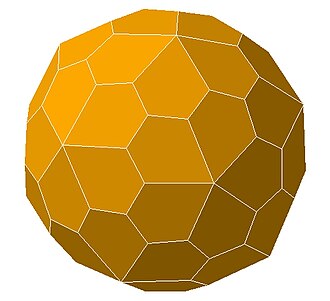
  72    1.424^  Goldberg-72               Pentagon & hexagon    Goldberg-72                              Geodesic-140 [icosahedral (2,1)]
  72            Geodesic-72 octa          Triangle, irregular   Geodesic-72 octahedral                   Fullerene-38 square
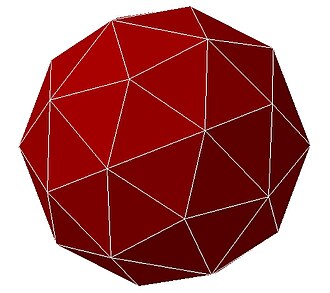
  80    1.572d  Geodesic-80               Triangle, irregular   Polar normal-mesh dual of Goldberg-42    Goldberg I(2,0)
  92    1.114^  Goldberg-92               Pentagon & hexagon    Goldberg-92                              Geodesic-180 [icosahedral (3,0)]
  92    2.69    Archimedes dodeca snub                          Snub dodecahedron
  96            Geodesic-96 octa          Triangle, irregular   Geodesic-96 octahedral                   Fullerene-50 square
 104            Geodesic-104 octa         Triangle, irregular   Geodesic-104 octahedral                  Fullerene-54 square

 120            Fullerene-236 icosa       Pentagon & hexagon    Fullerene-236                            Fullerene-236 dual
 120    1.43    Catalan                   Triangle, irregular   Disdyakis triacontahedron                Truncated icosidodecahedron

 122     .8364^ Goldberg-122 icosa        Pentagon & hexagon    Goldberg-122                             Geodesic-240 [icosahedral (2,2)]
 126            Fullerene-126 octa        Square   & hexagon    Fullerene-126 octahedral                 Fullerene-126 square dual
 128            Geodesic-128 octa         Triangle, irregular   Geodesic-128 octahedral                  Fullerene-66 square
 132     .7729^ Goldberg-132 icosa        Pentagon & hexagon    Goldberg-132                             Geodesic-260 [icosahedral (3,1)]
 140     .8762  Geodesic-140 tetra        Triangle, irregular   Geodesic-140                             Fullerene-72
 162     .6293^ Goldberg-162 icosa        Pentagon & hexagon    Goldberg-162                             Geodesic-320 [icosahedral (4,0)]
 180            Geodesic-180 tetra        Triangle, irregular   Geodesic-180                             Fullerene-92
 192     .53^   Goldberg-192 icosa        Pentagon & hexagon    Goldberg-192                             Geodesic-380 [icosahedral (3,2)]
 212     .48^   Goldberg-212 icosa        Pentagon & hexagon    Goldberg-212                             Geodesic-420 [icosahedral (4,1)]
 240            Geodesic-240 tetra        Triangle, irregular   Geodesic-240                             Fullerene-122
 252     .4036^ Goldberg-252 icosa        Pentagon & hexagon    Goldberg-252                             Geodesic-500 [icosahedral (5,0)]
 260            Geodesic-260 tetra        Triangle, irregular   Geodesic-260                             Fullerene-132
 272     .3736^ Goldberg-272 icosa        Pentagon & hexagon    Goldberg-272                             Geodesic-540 [icosahedral (3,3)]
A "Fullerine" is a Goldberg with extra hexes added. The arrangement of hexes is amorphous.
"Arch" means Archimedean.
"^": tangential, sphericity-optimized candidate without equal-face-area constraints. LGT means Lengyel, Gáspár & Tarnai (2017), Fig.5 and Table 2. LGT reports IQ = Ψ3; values above use its cube root before conversion to percent. "d": directly computed from the catalogue face-normal mesh for Goldberg(2,0), whose convex hull gives an 80-triangle shell with Ψ = 0.9842759484. The triangular areas are unequal, so this value does not populate Shell%. It is not the old unsourced 0.984617 value. Higher-face-count values for 162, 192, 212, 252, and 272 are from the extended computational catalogue, not LGT's 2017 Table 2. Unmarked values retain the supplied evaluated geometry; they are not all optimized under one constraint. A blank (--) means uncomputed or insufficiently sourced, not zero.
Shell% is a separate experiment: all vertices lie on one sphere centered at the center of mass, all planar faces have equal area, and sphericity is maximized within the specified connectivity and symmetry. The current entries marked "c" are verified feasible constructions, not proofs of unrestricted global optimality. All other shell entries remain uncomputed; feasibility itself must be checked. Neither an insphere nor a vertex shell alone imposes equal face areas.
The 14-face shell construction retains octahedral symmetry. Its vertices are all permutations and sign choices of (a,b,0), with a/b = -1 + √(3+4/√3) = 1.3042137654. The six square areas and eight hexagon areas are equal; Ψ = 0.9208983095. The 32-face construction truncates each edge of a regular icosahedron at fraction t = 0.3786881244. Its 12 pentagons and 20 hexagons have equal areas and all 60 vertices share a radius; Ψ = 0.9675205739. These are different from the regular Archimedean forms.
Fullerene Cv names count vertices (carbon sites), whereas Goldberg-N names here count faces. For a trivalent convex fullerene, N = v/2 + 2. A carbon count alone does not identify an isomer.
The table evaluates the specified balanced or weakly balanced forms. The demidemon values are not claims of global maximum sphericity; the J75 value is provisional. The evaluated gyroextended bipyramids have congruent triangular faces and vertices on a common sphere. The 12-face case reaches a degenerate boundary where pairs of triangular faces merge into cube faces.
The larger the number of sides on each face, the more spherical the hedron tends to be.
In the corresponding Catalan examples listed, the deltoidal form is more spherical than the pyramidal form.
For maximum-sphericity bipyramids and trapezohedra, the infinite-face limit is a double cone. Each cone has height √2 times its base radius, giving Ψ = 22/3/√3 ∼ .916486.
Define Q as the ratio of moments of inertia, axial over transverse. For this uniform-density double cone, Q = 6/7.
For gyrobipyramids, the limit for infinite faces is a cylinder capped by two cones, with a sphericity of 31/6/21/3 ∼ .953184. Cone height is half the cylinder height. Taking cylinder height as 1, its radius is √3/2.
The gyrobipyramid-infinity is longer than wide by a factor of 2⋅3-½ ∼ 1.155. Its overall dimensions are prolate; for uniform density, Q = 54/53.
The cylinder-and-cones limit suggests different landing behavior for belt and cap regions. This motivates testing finite gyrobipyramids, but does not prove any particular face count unfair.
Equal-volume face pyramids and equal-area shell faces are different constraints. For a face of area A_i at perpendicular distance h_i from the center, the pyramid volume is A_i h_i/3. Here "shell-equal-area" means equal face areas and vertices on a common centered sphere. Existence and fairness must be checked; high sphericity alone does not prove fairness.
Among the 24-face hedra listed, the devil has the highest sphericity, followed by the J45 dual. The demon and cube+deltoid have the same sphericity.
Among the balanced Catalan and Johnson-dual 60-face forms, the Evening Star has the highest sphericity.
The limiting sphericity for large facecount N is
Ψ ~ 1 - C/N + (2C2 + c)/N2
This near-spherical expansion requires geometric assumptions; derivation and scope.
The face coefficient C below is a local shape parameter. The finite-hedron quality N(1-Ψ) approaches it only
for an appropriate asymptotic family.
C and c are face shape parameters. C:
Circle                          1.0000
Octagon,  regular               1.002280
Heptagon, regular               1.003984
Hexagon,  regular               1.0077   =  5 π 3-5/2
Pentagon, regular    Dodeca     1.01664
Square               Cube       1.0472   =    π 3-1
Triangle, regular    Tetra      1.2092   =  2 π 3-3/2

Pentagon, irregular  Devil      1.0348
Pentagon, irregular  Evening St 1.0690          Catalan-60
Kite                 Demon      1.0669
Kite                 Cubedelt   1.0669
Kite                 Dodecadelt 1.0813
Rhombus              Tetradelt  1.1107
Rhombus              Icosajoin  1.1708          Catalan-30
Triangle, isosceles  Dodecapyr  1.2261          Catalan-60
Triangle, isosceles  Cubepyr    1.3269          Catalan-24
Triangle, scalene    Cubemeta   1.4234          Catalan-48
Triangle, scalene    Icosameta  1.5290          Catalan-120
Triangle, isosceles  Tetrapyr   1.8103          Catalan-12
Triangle, isosceles  Octapyr    1.9287          Catalan-24
Triangle, isosceles  Icosapyr   1.9846          Catalan-60
Rectagle, aspect ratio q      π 6-1 (q + q-1)      C=π/[3 sin(θ)] for interior angle θ
Rhombus,  aspect ratio q      π 6-1 (q + q-1)
Kite,     aspect ratio q>1    π 6-1 (q + q-1 + q w2/3)      w=(u-v)/L    L = Long diagonal, divided by the transverse diagonal into lengths uand v
C = 2π/Area2 ∫face |X-Xcentroid|2 dA. For a regular n-gon, C = 2π [2+cos(2π/n)]/[3n sin(2π/n)].
For 12-face Platonics and Catalans, the tetrahedron+pyramid has the lowest sphericity at .8644, and we define this to be the minimum to be a roundoid with 12 faces.
For 24-face Platonics and Catalans, the octahedron+pyramid has the lowest sphericity at .9244, and we define this to be the minimum to be a roundoid with 24 faces. This corresponds to C=1.814.
Define a hedron with more than 24 faces to be "well-rounded" if C < 2. This includes all Catalans and excludes bipyramids, trapezohedrons, and gyroextended bipyramids.
A "space dice" is a convex hedron that is fair in zero gravity, where dissipation is from air. Exterior turbulence is necessary.
Many Thomson solutions or their duals can be weakly balanced, and such hedra are denoted by a "*".
Faces  Vert   Thompson solution                Thompson dual

  4     4   * Tetrahedron                    * Tetrahedron
  6     8   * Cube                           * Octahedron
  8    10   * Tetragonal trapezohedron-8       Square antiprism
 10    16   * Square truncated trapezohedron   Gyroelongated square dipyramid
 12    20   * Dodecahedron                   * Icosahedron
 14    24   * Truncated hexagonal bipyramid  * Gyroelongated hexagonal dipyramid
 16    16     Tetrahedrally-triaugmented tetrahedron     Tetrahedrally-diminished dodecahedron
 24    38   * Devil                            Snub cube
 32    60     Truncated icosahedron          * Pentakis dodecahedron
 72   140     Goldberg(2,1)                    Geodesic sphere{3,5+}2,1
122           Goldberg(2,2)                    Geodesic sphere{3,5+}2,2
132           Goldberg(3,1)                    Geodesic sphere{3,5+}3,1
192           Goldberg(3,2)                    Geodesic sphere{3,5+}3,2
212           Goldberg(4,1)                    Geodesic sphere{3,5+}4,1
272           Goldberg(3,3)                    Geodesic sphere{3,5+}3,3
282           Goldberg(4,2)                    Geodesic sphere{3,5+}4,2
372           Goldberg(4,3)                    Geodesic sphere{3,5+}4,3
An appearance in art, a surviving mathematical description, and a proof of classification are three different historical milestones. The entries below record documented appearances; a drawing does not certify modern regularity or an optimized metric.
Antiquity: Euclid's Elements, Book XIII, constructs the five regular solids. Early-fourth-century Pappus, Collection, Book V, lists thirteen semiregular solids and attributes them to Archimedes. Archimedes' own account is lost. Greek text and translation.
Second century BCE–fourth century CE: Greek-lettered icosahedral dice survive from Egypt. The Met dates its example to this broad interval; a precise year is not known. Museum record.
Late 1470s–1481/82: Piero della Francesca's Libellus de quinque corporibus regularibus studies regular solids and several truncations. Museo Galileo identifies truncated tetrahedron, cube, dodecahedron, and icosahedron among its irregular solids, and also a 72-face construction. Manuscript description.
1495: The suspended glass rhombicuboctahedron in Portrait of Luca Pacioli, attributed to Jacopo de' Barbari, makes geometry a portrait prop. Museum record.
1509: Pacioli's Divina proportione publishes Leonardo's solid and open-framework polyhedron drawings, including the rhombicuboctahedron. The manuscript predates the printed book. Museo Galileo.
1514: Dürer's Melencolia I puts a large stone polyhedron beside the seated figure. Its precise intended geometry is debated; do not silently assign it to a modern Catalan type. The Met.
1525: Dürer's Underweysung der Messung teaches geometric construction to artists and craftspeople. It belongs in the history of making and drawing solids, rather than as evidence of a completed Catalan classification. The Met.
1567: Lorenz Stoer's Geometria et Perspectiva stages polyhedra among ruins. Its plates supplied designs for wood inlay: geometric pictures became furniture. The Met.
1568: Wenzel Jamnitzer's Perspectiva corporum regularium, engraved by Jost Amman, explores regular solids and elaborate transformations. It is an artistic construction programme, not a claim that every illustrated object is a distinct convex Catalan solid. Museum plate.
1611: Kepler's De nive sexangula discusses the rhombic dodecahedron and rhombic triacontahedron, long before the thirteen Catalan duals were collected systematically. Kepler passage.
1615: Thomas Bodley's memorial in Merton College chapel, Oxford, carries an 18-face chamfered-cube form. LGT identifies it with the connectivity of its Fig.5h candidate. A modern optimization rediscovers a Renaissance monument. LGT, discussion, p.14.
1619: Kepler's Harmonices mundi illustrates the thirteen Archimedean solids as a set. Text and historical references.
Around 1600–seventeenth century: turned-ivory objects in Dresden's Grünes Gewölbe show 32-face and 14-face polyhedral structures. LGT discusses these beside its tangential candidates in Figures 1 and 2. The resemblance concerns construction and geometry; it does not establish that the artisans solved the modern optimization problem. LGT, Figures 1–2.
1865: Catalan's Mémoire sur la théorie des polyèdres gives the systematic family of Archimedean duals. Earlier individual appearances and this systematic treatment should have separate dates. Original memoir and plates.
The optimum-spericity hedron has only been proven for N=4,5,6,7,12. Deeter did Monte-Carlo searches for N≤200. Above 200, he used more restricted construction searches, including pentagon-heptagon modifications. He cites solutions up to N=2004.
N=468 is the first best-candidate with heptagons.
N=492 is a tetrahedral candidate with twelve heptagons that beats both icosahedral Goldberg constructions.
|
|||||||
|---|---|---|---|---|---|---|---|
|
|
||||||
|
|
||||||
|
|
||||||
|
|
||||||
|
|
||||||
 |
 |
||||||
 |
 |
||||||
 |
 |
||||||
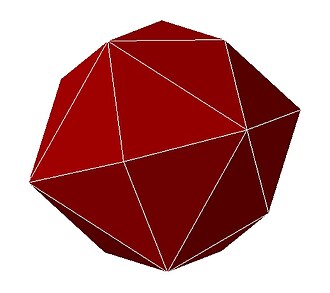 |
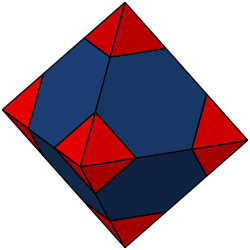 |
||||||
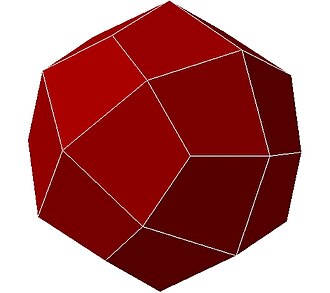 |
|
||||||
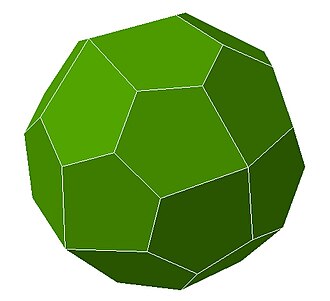 |
 |
||||||
 |
 |
||||||
 |
 |
||||||
 |
 |
||||||
 |
 |
||||||
 |
 |
||||||
 |
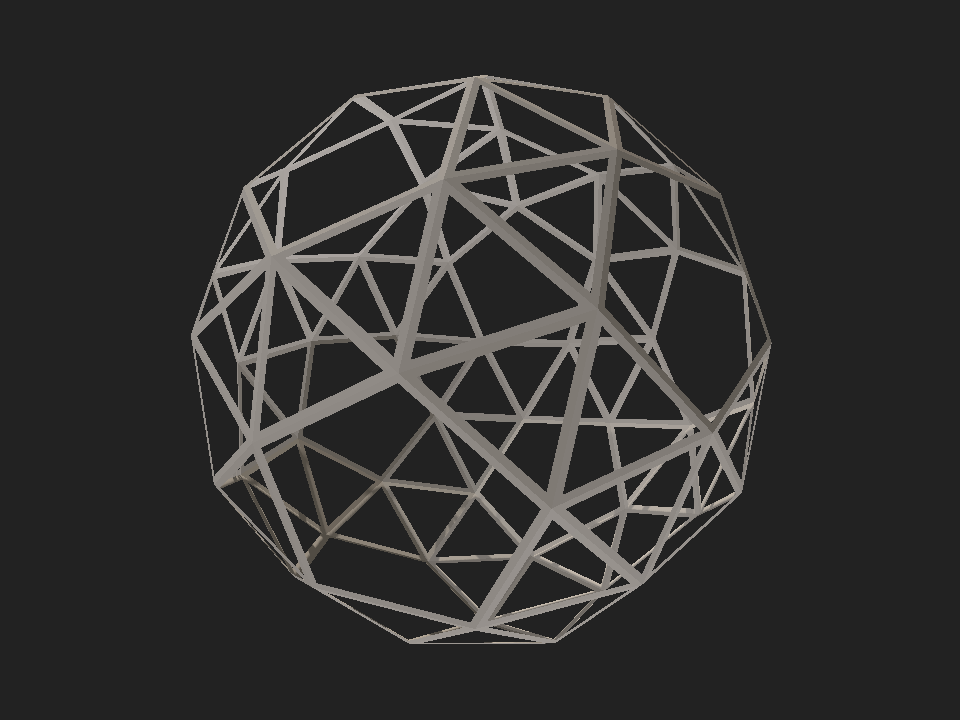 |
||||||
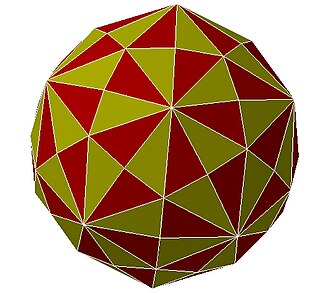 |
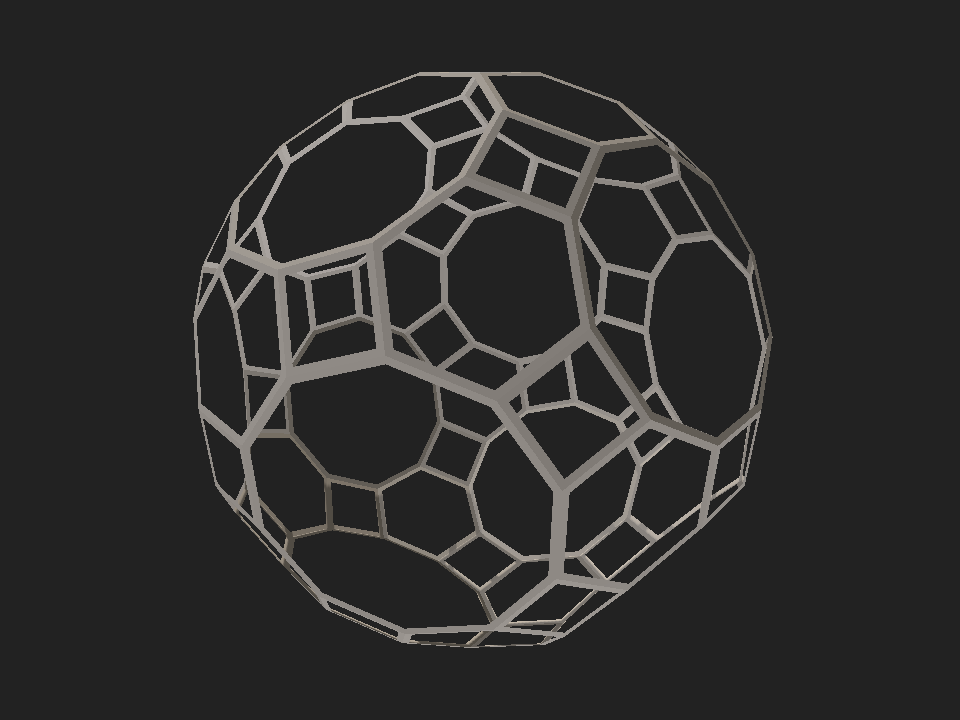 |
Catalan and Archimedes hedra have awkward names. We propose catchy names. In some cases, the hedron is named for the discoverer. The suffix "hedron" is usually unnecessary.
Euler formula: Faces + Vertices - Edges = 2
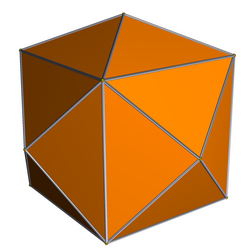
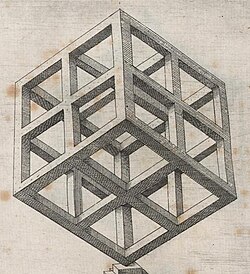
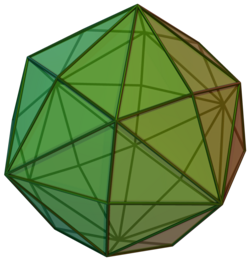
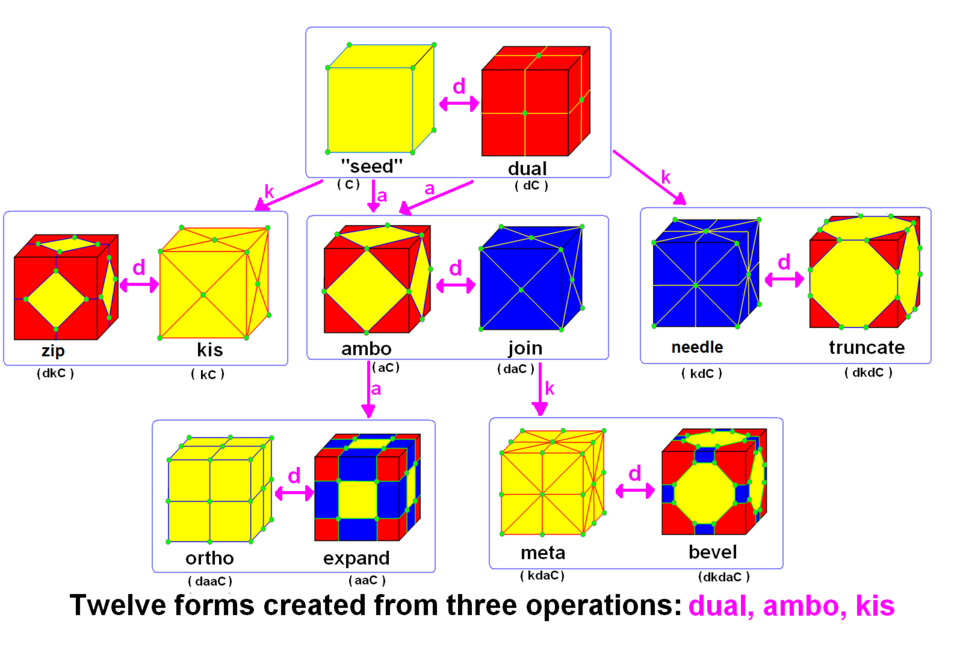
The following gallery shows cube extensions.
|
 |
 |
 |
|---|---|---|---|
 |
|---|
Tetrahedron  + deltoid   =  Cube + join
Tetrahedron  + join      =  Cube
Tetrahedron  + meta      =  Cube + pyramid
Cube         + deltoid   =  Octahedron  + deltoid
Cube         + join      =  Octahedron  + join    =  Tetrahedron  + deltoid
Cube         + meta      =  Octahedron  + meta
Cube         + pyramid  !=  Octahedron  + pyramid
Dodecahedron + deltoid   =  Icosahedron + deltoid
Dodecahedron + join      =  Icosahedron + join
Dodecahedron + meta      =  Icosahedron + meta
Dodecahedron + pyramid  !=  Icosahedron + pyramid

Meta                     =  Join, then pyramidize
The result of pyramidizing a regular triangle face is an isosceles triangle face. If you make the pyramid taller, convexity must be checked: equilateral replacement faces do not automatically give a convex hedron. If the original dice has N sides and each side has S edges, the new dice has N*S sides.
"Deltoidization" is to add a tent on each face such that the apex is above the face center, and the tent sides go to the midpoints of face sides. The result is a rhombus or kite.
Pyramidization can tune the pyramid height so that triangles fuse in pairs into a rhombus. It converts edges to faces and erases the original faces. This is the Conway "join" operation.
Among Platonic and Catalan hedra, only one is divisible by 16, the pyramid deltoidal tetrahedron, which has 48 faces. Its scalene triangular faces do not yield congruent replacement faces by the simple equal-height construction. Base 16 is a more natural base for civilization than base 10. One can imagine that aliens use base 16.
A Rhomboidal fair dice can be pyramidized into a fair dice with irregular triangle faces. The same simple construction on a general kite does not give congruent replacement triangles.
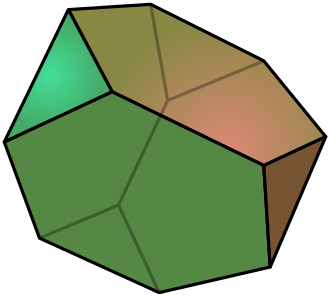
The pentagonal Catalan hedra that can't be constructed by extending Platonic solids.
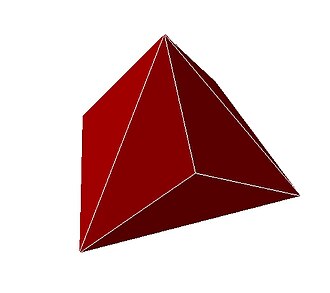
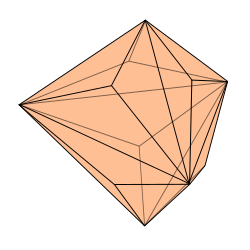
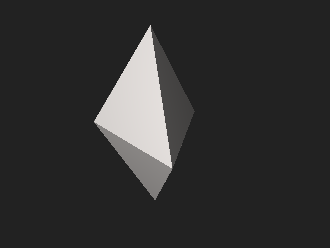
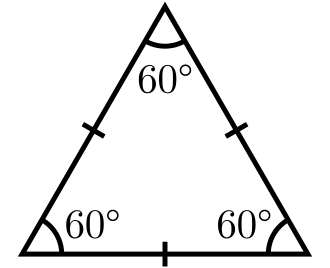
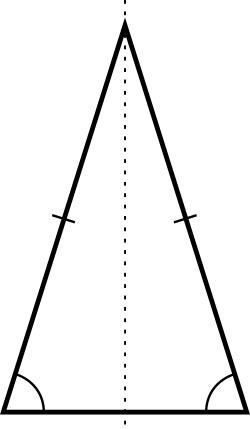
A symmetric triangular bipyramid is face-transitive. Its illustrated extensions lose face transitivity, so symmetry alone no longer guarantees fairness. The extensions are:
 |
 |
|---|---|
Goldberg, Michael (1935). "The Isoperimetric Problem for Polyhedra." Tohoku Mathematical Journal 40, 226-236.
The historical foundation for maximizing volume at fixed surface area and face count; includes conjectured optimal solids and the insphere condition.
*
Goldberg, Michael (1937). "A Class of Multi-Symmetric Polyhedra." Tohoku Mathematical Journal 43, 104-108.
The original Goldberg construction.
*
Diaconis, Persi, and Joseph B. Keller (1989). "Fair Dice." The American Mathematical Monthly 96(4), 337-339.
The foundational short reference on symmetry and fair dice.
H. S. M. Coxeter, "The Polytopes with Regular-Prismatic Vertex Figures, I,"
Philosophical Transactions of the Royal Society of London A 229 (1930),
329-425. Grunbaum identifies this as the next explicit mention of the Miller solid after the Sommerville 1905 paper
"An enduring error". Branko Grunbaum. Elemente der Mathematik 64 (2009), 89-101 *
Aravind, P. K. (2011). "How Spherical Are the Archimedean Solids and Their Duals?"
The College Mathematics Journal 42(2), 98-107. *
Sphericity calculations for Archimedean and Catalan solids.
Hart, George (2013). "Goldberg Polyhedra." In Marjorie Senechal, ed., Shaping Space: Exploring Polyhedra in Nature, Art, and the Geometrical Imagination, 2nd ed., Springer, 125-138.
An accessible construction and interpretation reference. The book gives broader context for polyhedral construction.
*
Schein, Stan, and James Maurice Gayed (2014). "Fourth class of convex equilateral polyhedron with polyhedral symmetry related to fullerenes and viruses." Proceedings of the National Academy of Sciences 111, 2920-2925.
Constructing Goldberg solids with planar faces and equal edge lengths; an important distinction from merely specifying their topology.
*
"The Roundest Polyhedra with Symmetry Constraints". Andras Lengyel, Zsolt Gaspar, & Tibor Tarnai.
Symmetry 2017, 9(3), 41; *
Eppstein, David (2021). "On Polyhedral Realization with Isosceles Triangles." Graphs and Combinatorics 37, 1247-1269.
Especially relevant to the triangular-demon question: families with congruent
isosceles faces, including twisted gyrobipyramids and biarc hulls. These
deserve examination before proposing a classification theorem.
*
Liu, Yuanpeng, Ting-Uei Lee, Anooshe Rezaee Javan, and Yi Min Xie
(2022). "Extending Goldberg's method to parametrize and control the geometry of
Goldberg polyhedra." Royal Society Open Science 9, 220675.
Controls planarity,
equal edge lengths, and placement of vertices on a sphere. Useful for choosing
which Goldberg geometry to use.
*
Liu Y, Lee TU, Rezaee Javan A, Xie YM.
"xtending Goldberg's method to parametrize and control the geometry of Goldberg polyhedra."
R Soc Open Sci. 2022 Aug 10;9(8)
*
David S. Richeson, Euler’s Gem: The Polyhedron Formula and the Birth of Topology, Princeton University Press (2008).
Euler, Leonhard. “Elementa doctrinae solidorum.”
Novi Commentarii academiae scientiarum Petropolitanae 4, pp. 109–140, published 1758.
Eneström E230. Original paper and archive record. scholarlycommons.pacific.edu
His accompanying proof appeared as E231, in the same volume, pp. 140–160.
Original and English translation. scholarlycommons.pacific.edu
The dates explain conflicting references: announced to Goldbach on 14 November 1750;
journal volume labeled 1752–53; actually published in 1758.
Deeter archive of hedron searches: * *
Complexity, sphericity, and ordering of regular and semiregular polyhedra Alexandru T. Balaban a and Danail Bonchev MATCH Commun. Math. Comput. Chem. 54 (2005) 137-152 *
Balanced hedron (balahedron): A convex hedron with congruent faces whose supporting planes have equal perpendicular distances to the center of mass.
Weakly-balanced hedron: A convex hedron with equal-area faces whose supporting planes have equal perpendicular distances to the center of mass. It does not imply equal moments of inertia or equal landing probabilities.
Natural: A hedron that is either Platonic, Catalan, bipyramid, trapezohedron, or gyrobipyramid. The demonhedron is an example outside these named families.
Sphericity: Ψ = Asphere / A, where Asphere is the area of a sphere with the same volume as the hedron. Ψ <= 1.
Roundness: ψ = N(1-Ψ), where N is the number of faces.
Roundoid: A convex hedron with a roundness parameter less than or equal to 2.
Demon: A roundoid that's not Plato or Catalan, and is balanced.
Demidemon: A roundoid that's not Plato or Catalan, and is weakly-balanced.
Platonic solid: Convex hedron whose faces are congruent regular polygons, and the same number of faces meet at each vertex.
Archimedean solid: The 13 convex uniform solids other than the Platonic solids, prisms, and antiprisms. Faces are regular polygons and vertices are transitive; faces need not be transitive.
Johnson solid: Convex polyhedron whose faces are regular polygons and that is not a uniform polyhedron.
Isohedral or face-transitive: For any two faces, a symmetry of the entire hedron maps one onto the other.
Uniform polyhedron: Faces are regular polygons. Vertices are transitive. It follows that all vertices are congruent. Uniform polyhedra may be regular (if also face- and edge-transitive), quasi-regular (if also edge-transitive but not face-transitive), or semi-regular (if neither edge- nor face-transitive).The faces and vertices don't need to be convex, so many of the uniform polyhedra are also star polyhedra.
Combinatorially equivalent: Two geometric structures are combinatorially equivalent if their face lattices are isomorphic, meaning their network of vertices, edges, and faces have the same incidence relations.
The polar dual of a convex uniform polyhedron is a Platonic solid, a Catalan solid, a bipyramid, or a trapezohedron. General gyrobipyramids lie outside these families.
Polyhedron: A three-dimensional figure with flat polygonal faces, straight edges and sharp corners or vertices.
Two hedra are "combinatorially equivalent" if their face lattices are isomorphic, meaning their network of vertices, edges, and faces have the same incidence relations. We use "prime dice" for representative connectivities. Combinatorial equivalence preserves incidence, but does not by itself preserve balance or fairness. As an example, a cube is combinatorially equivalent to a triangular trapezohedron.
Face-transitive convex hedra with a symmetric mass distribution give equal face probabilities under a throwing protocol that respects their symmetries. Platonic solids, Catalan solids, symmetric bipyramids, and symmetric trapezohedra have this property. Balance alone does not establish fairness: a balanced hedron need not be face-transitive.
Platonic hedra are face- and vertex-transitive. General face-transitive hedra need not be vertex-transitive.
Gyroextended bipyramids can be deformed into balanced forms, but they are not generally face-transitive.
For these gyrobipyramids, the cap and belt proportions must be chosen to give congruent faces and equal distances from the center of mass to their supporting planes. Putting vertices on a sphere alone does not establish balance. Fairness remains a question for experiments and simulations. The limiting form is a cylinder with cones at each end.
ChatGPT (OpenAI) made big contributions to the exposition, terminology, research leads, and calculations. The author takes responsibility for the final text.
Dan Smith provided inspiration.
 |
 |
 |
 |
|---|---|---|---|
 |
 |
|---|---|
 |
 |
 |
 |
 |
 |
|---|---|---|---|---|---|
|
|
 |
 |
|
|
 |
|---|---|---|---|---|---|---|
Goldberg and geodesic hedra are dual to each other. They need not be weakly-balanced; particular geometries may be pseudo-balanced into highly-spherical hedra. The available face numbers are:
Goldberg   Geodesic  Type
 faces      faces

     4        4      Tetrahedral  1 0
     6        8      Octahedral   1 0
     8       12      Tetrahedral  1 1
    10       16      Tetrahedral  2 0
    12       20      Icosahedral  1 0
    14       24      Octahedral   1 1
    16       28      Tetrahedral  2 1
    18       32      Octahedral   2 0
    20       36      Tetrahedral  3 0
    30       56      Octahedral   2 1
    32       60      Icosahedral  1 1
    34       64      Tetrahedral  4 0
    38       72      Octahedral   3 0
    42       80      Icosahedral  2 0
    50       96      Octahedral   2 2
    52      100      Tetrahedral  5 0
    56      108      Tetrahedral  3 3
    66      128      Octahedral   4 0
    72      140      Icosahedral  2 1
    74      144      Tetrahedral  6 0
    92      180      Icosahedral  3 0
   100      196      Tetrahedral  7 0
   102      200      Octahedral   5 0
   110      216      Octahedral   3 3
   122      240      Icosahedral  2 2
   130      256      Tetrahedral  8 0
   132      260      Icosahedral  3 1
   146      288      Octahedral   7 0
   162      320      Icosahedral  4 0
   164      324      Tetrahedral  9 0
   192      380      Icosahedral  3 2
   194      384      Octahedral   4 4
   198      392      Octahedral   8 0
   212      420      Icosahedral  4 1
   252      500      Icosahedral  5 0
   258      512      Octahedral   8 0
   ...
   502     1000      Tetrahedral       Doesn't exist
   502     1000      Octahedral        Doesn't exist
   502     1000      Icosahedral       Doesn't exist
  1000     1996      Tetrahedral 18  7
  1002     2000      Icosahedral 10  0
  4002     8000      Icosahedral 20  0
 10000    19996      Tetrahedral 62 15
100000   199996      Tetrahedral 150 107
  10^6      ...      Tetrahedral 678  55
  10^6      ...      Tetrahedral 635 127
  10^6      ...      Tetrahedral 587 198
  10^7      ...      Tetrahedral 1995 422
  10^8      ...      Does not exist
  10^9      ...      Tetrahedral 18630 6167
  10^9      ...      Tetrahedral 13423 12390
  10^10     ...      Does not exist
13423 12390
18630 6167
Geodesic faces = 2 * Goldberg faces - 4
Goldberg faces = ½ * Geodesic faces + 2
A Goldberg solid can round out its non-hexagonal faces as domes to make a dice with all hexagons, and it' fair. It requires that each hexagon has the same watershed from domes. This puts an upper limit on facecount.
Face  Vert  Sphericity

   8  12      .6733     Truncated tetrahedron
  14  12      .8609     Cuboctahedron
  14  24      .7782     Truncated cube
  14  24      .8655     Truncated octahedron
  26  24      .9337     Rhombicuboctahedron
  26  48      .9421     Truncated cuboctahedron
  32  30      .9274     Icosidodecahedron
  32  60      .8884     Truncated dodecahedron
  32  60      .9666     Truncated icosahedron
  38  24      .9652     Snub cube
  62  60      .9686     Rhombicosidodecahedron
  62 120      .9712     Truncated icosidodecahedron
  92  60      .9731     Snub dodecahedron
The list excludes Johnsons that are vaguely hemispherical. A prism should have caps on both ends.
*: The dual has face cosphericity and can be face-balanced. +: The dual doesn't have face cosphericity but can be face-balanced. D: Deltahedron. All congruent regular triangles.
Quality and conformation. Quality is C = N(1-Ψ), with Ψ = (36πV2)1/3/A. Use N = F for the Johnson and N = V for its Pixie. A larger sphericity therefore means a smaller quality number. The numerical quality entries below are retained from the survey. "Incumbent" means the best reported balanced conformation so far, not a proven global optimum.
Birth oblateness. Both new columns describe birth geometry, not the balanced incumbent. For a uniform solid, compute the volume covariance tensor about its own COM, Q = M-1∫ (x-COM)(x-COM)T dm. The inertia tensor satisfies Q = [tr(I)/2 · identity - I]/M. The equivalent uniform ellipsoid has semiaxes proportional to the square roots of the eigenvalues of Q. When two axes are equal, let q be the remaining (axial) semiaxis divided by the equal transverse semiaxis, and define
Positive means oblate (pancake), negative means prolate (football), and zero means an isotropic inertia ellipsoid. Zero does not mean a spherical surface or a fair die. A triaxial solid would be marked T rather than forced into one number; none of the rows below requires T at the stated precision. The Pixie birth geometry here is the polar dual about the parent Johnson's volume COM: a parent face n·x = h, with outward unit normal n, gives a dual vertex n/h. Uniform rescaling is irrelevant. The resulting dual is then measured about its own volume COM. Thus the choice of polarity center is explicit, including for asymmetric parents. Values are computed from the coxeter Johnson coordinates by tetrahedral volume integration, and rounded to 0.01 percentage point. These are shape measurements, not bounds on landing bias.
"Fail" for J79 records an earlier unsuccessful restricted balancing attempt, not a proof that all conformations fail.
 F   V    Johnson   Pixie    Pixie     Johnson    Pixie   Face    J#  Johnson name / dual name
          quality quality incumbent   oblate%   oblate% balance

   34   24    1.337   1.075     1.075     +7.14     -5.64     +   45
   26   24    1.193   1.102     1.090      0.00      0.00     *   37  Demon
   26   16    2.162   1.330     1.101    +32.02    -48.02     +   85  Snub square antiprism
   62   60    1.287    3.24     1.103      0.00      0.00     *   72
   62   60    1.287    3.24     1.103      0.00      0.00     *   73
   62   60    1.287    3.24     1.103      0.00      0.00     *   74
   62   60    1.287    3.24     1.103      0.00      0.00     *   75
   26   18    1.954   1.062     1.103    -34.44    +27.57     +   44  Gyroelongated triangular bicupola
   32   30    2.240   2.100     1.116    +32.21    -49.34     +   38
   32   30    2.240   2.100     1.116    +32.21    -49.34     +   39
   16   10    1.606    .548     1.130    -43.33    +31.00     +   17  Gyrolongated square bipyramid
   14   12    1.330   1.144     1.144      0.00      0.00     *   27  Triangular orthobicupola           Trapezo-rhombic dodecahedron
   32   30    1.568   1.173     1.173      0.00      0.00     *   34
   20   18    1.822   1.386     1.185    -46.01    +31.82     +   36  Elongated triangular gyrobicupola
   20   18    1.822   1.386     1.202    -46.01    +31.82     +   35  Elongated triangular orthobicupola
   37   35    1.963   1.718     1.235     +0.82     -1.52     +   40  Elongated pentagonal orthocupolarotunda
   37   35    1.963   1.718     1.236     +0.82     -1.52     +   41  Elongated pentagonal gyrocupolarotunda
   12   10    1.942    1.06     1.260    -69.76    +39.37     +   15  Elongated square bipyramid

   42   40    2.009   1.913              -28.47    +23.03     ?   42  Elongated pentagonal orthobirotunda
   42   40    2.009   1.913              -28.47    +23.03     ?   43  Elongated pentagonal gyrobirotunda
   18   16    2.021                      +34.57    -53.24     ?   29  Square gyrobicupola
   18   16    2.021                      +34.57    -53.24     ?   28  Square orthobicupola
   47   35    2.195                       +5.88     -6.37     ?   47  Gyroelongated pentagonal cupolarotunda
   52   40    2.251                      -23.38    +20.33     ?   48  Gyroelongated pentagonal birotunda
   30   25    2.857                      +29.62    -46.23     ?   33  Pentagonal gyrocupolarotunda
   30   25    2.857                      +29.62    -46.23     ?   32  Pentagonal orthocupolarotunda
   42   30    3.082                      +37.49    -59.17     ?   46  Gyroelongated pentagonal bicupola
   22   20    5.326                      +61.08   -157.40     ?   30  Pentagonal orthobicupola
   22   20    5.326                      +61.08   -157.40     ?   31  Pentagonal gyrobicupola

D  10    7    1.269                      +42.48    -72.29     ?   13  Pentagonal bipyramid               Pentagonal prism
D   6    5     1.35                      -63.30    +42.26     ?   12  Triangular bipyramid               Triangular prism
D  14    9    1.812   1.165              +22.50    -32.95     ?   51  Triaugmented triangular prism
D  12    8    1.904                      -50.69    +35.44     ?   84  Snub disphenoid
    9    8    3.055                     -157.61    +62.78         14  Elongated triangular bipyramid

   52   55                                +9.17     -5.87  Fail   79  Bigyrate diminished rhombicosidodecahedron
These are equivalences of connectivity, not necessarily equal edge lengths, face areas, or sphericity. Different geometric conformations can share the same face lattice. LGT identifies a source and an optimized geometry; it does not by itself identify a new family.
Faces

  6     Cube   = triangular trapezohedron
  8     Octahedron = square bipyramid
 10     LGT-10 = Tetrachamfer = chamfered tetrahedron = tetrahedral Goldberg(2,0)
 14     LGT-14 = Octatrunc = truncated octahedron = octahedral Goldberg(1,1)
 18     LGT-18 = chamfered cube = octahedral Goldberg(2,0)
 20     LGT-20 = tetrahedral Goldberg(3,0)
 26     LGT-26 = truncated cuboctahedron = great rhombicuboctahedron
 30     LGT-30 = octahedral Goldberg(2,1)
 32     Truncated icosahedron = icosahedral Goldberg(1,1)
 38     LGT-38 = octahedral Goldberg(3,0)
 62     LGT-62 = truncated icosidodecahedron = great rhombicosidodecahedron
 92     LGT-92 = icosahedral Goldberg(3,0)
132     LGT-132 = icosahedral Goldberg(3,1)
LGT-26 and LGT-62 retain the connectivities of the truncated cuboctahedron and truncated icosidodecahedron, respectively, while changing their geometry.
The "great" names hide a distinction. The small rhombicuboctahedron has 26 faces and 24 vertices; the great rhombicuboctahedron (truncated cuboctahedron) has 26 faces and 48 vertices. They are not equivalent. Likewise, the small rhombicosidodecahedron has 12 pentagons, 20 triangles, and 30 squares; the great form has 12 decagons, 20 hexagons, and 30 squares. Both have 62 faces, but different connectivity. The LGT-26 and LGT-62 conformations have the latter connectivities; their four-sided faces need not remain squares. A face-adjacency graph-isomorphism check on their isodistant constructions confirms these two identifications.
Equal counts do not establish equivalence. Pixie27 and the rhombic dodecahedron both have 12 faces, 14 vertices, and 24 edges, and their birth sphericities agree, but their connectivities differ. Similarly, Pixie34 is not a conformation of the rhombic triacontahedron, despite their common counts (30 faces, 32 vertices, 60 edges). Their parents J34 and the icosidodecahedron differ because J34 has triangle-triangle and pentagon-pentagon adjacencies. Face-adjacency graph checks distinguish both pairs.
Pixie44 and octahedral Goldberg-18 are also different: Pixie44 has 6 quadrilaterals and 12 pentagons, whereas Goldberg-18 has 6 quadrilaterals and 12 hexagons.
The Goldberg labels and LGT constructions follow Lengyel, Gáspár, and Tarnai (2017) and the coordinate catalogue. The modified-lattice cases LGT-16 and LGT-22 are not ordinary unmodified Goldberg parameter pairs.
LGT-16 and LGT-22 use modified lattice constructions; their parameters in LGT's Table 2 must not be read as ordinary unmodified Goldberg parameters. LGT-16 has 12 pentagons and four hexagons; LGT-22 has 12 pentagons and ten hexagons. These face inventories were checked against the catalogue OFF meshes. The second 20-face entry has a different connectivity: truncating the three-valent vertices of the rhombic dodecahedron gives eight triangles and twelve hexagons, whereas tetrahedral Goldberg(3,0) has four triangles and sixteen hexagons.
This is a catalogue assembled from the sources cited, not a classification theorem. A complete pairwise face-incidence graph-isomorphism check is still pending for the remaining named fullerene isomers, Johnson-dual deformations, and geodesic realizations. In particular, the 14-face J-bipyramid dual and the C24 fullerene may be duplicate connectivities and remain flagged pending an incidence comparison. The 16-face row previously named "Chamfered tetrahedron" is relabeled as its triangular dual, tetrahedral geodesic-16. The ordinary chamfered tetrahedron has ten faces.
The J34 dual has the same counts {30 faces, 32 vertices, 60 edges} as the rhombic triacontahedron, but different connectivity: J34 has triangle-triangle and pentagon-pentagon adjacencies, whereas every icosidodecahedron edge separates a triangle from a pentagon. Their duals therefore differ combinatorially.
The hard constraint is equal face area. Equal face-COM distances and a common vertex shell are possible additional objectives; neither is imposed by the definition of blacksmithing used here.
Let A be total area, Ai a face area, N the face count, and
For a small planar face, define its centroidal polar area moment Ji = ∫face i|x-xcentroid,i|2 dA and its scale-independent shape coefficient Ci = 2πJi/Ai2. The near-spherical derivation below gives, when the tangent points are the face centroids,
To isolate the effect of areas, compare a hypothetical equal-area conformation (ai = 1) with the birth conformation, holding the normalized face-shape coefficients approximately fixed. Subtract their leading deficits:
This is the blacksmith formula. A face's moment scales as its area squared, which is the origin of ai2. If all Ci = C0, the linear terms cancel because ∑(ai-1) = 0, leaving
Thus equalizing areas removes a variance penalty in this fixed-shape local model. For differing Ci, the weighted sum need not be positive: the unconstrained minimizer of ∑Ciai2 at fixed ∑ai has ai proportional to 1/Ci.
Scope. This is an asymptotic estimate, not an exact blacksmithing theorem. Actual warping changes the Ci, face positions, and sometimes global elongation. Those effects can outweigh area equalization, especially at small N. If tangent points and centroids differ, their offsets add a moment term as described below. Consequently an actual balanced conformation can have either greater or smaller sphericity than birth. Equal face areas alone neither force an insphere nor establish fairness.
Model. Consider a convex polyhedron circumscribed about a sphere of radius r, with small faces of bounded aspect ratio. First suppose each face touches the sphere at its planar centroid. This is a local near-spherical model; it does not assert that every equal-area Pixie satisfies these hypotheses. The face pyramids give V = rA/3, so, on putting x = A/(4πr2),
Let ρ be in-plane distance from a face's tangent point. Its solid angle is
Expand (1+u)-3/2 = 1 - 3u/2 + 15u2/8 + O(u3), and define Ji = ∫ρ2 dA and Ki = ∫ρ4 dA. Summing the solid angles gives
Write Ci = 2πJi/Ai2, ki = Ki/Ai3, and ai = NAi/A. Define the dimensionless averages
Substitution yields
Solving this series gives x = 1 + 3B/N + (18B2-30π2H)/N2 + O(N-3). Finally expand x-1/3:
For equal-area faces with common normalized moments C and k, B = C and H = k. Thus the notation used above,
has c = 10π2k - 6C2 in this model. The second-order coefficient depends on the fourth moment; it is not determined by C alone. If the face shapes vary along the sequence, B and H also vary with N and must be retained.
Centroid offsets. If a tangent point is displaced by ti from the face centroid, the parallel-axis identity gives Ji,tangent = Ji,centroid + Ai|ti|2. Use this tangent-point moment (and its corresponding fourth moment) in the solid-angle expansion. The centroidal C values in the face-shape table omit this extra placement penalty. For faces not tangent to a common sphere, the exact starting identities are V = ∑Aihi/3 and Ωi = ∫hi(hi2+ρ2)-3/2 dA; variations in hi must also be included rather than silently using the common-r formula.
Regular polygon coefficient. For a regular n-gon of circumradius R and θ = 2π/n, Af = nR2sin(θ)/2. Dividing it into n center-to-edge triangles gives J = AfR2[2+cos(θ)]/6. Consequently
Here n counts sides of one face; N counts faces of the hedron. The circle limit is C = 1, with C3 = 1.20920, C4 = 1.04720, and C5 = 1.01664. The common-insphere volume identity is also discussed by Lengyel, Gáspár, and Tarnai; the expansion above states explicitly the additional small-face assumptions used here.
Let "q" be the axis ratio for an ellipsoid. q=1 is spherical.
q > 1 is prolate. Define e = (1-q-2)½ Ψ = 2q2/3 / (1 + q/e arcsin e)
q < 1 is oblate. Define e = (1-q2)½ Ψ = 2q2/3 / (1 + q2/e arctanh e)
For q close to 1,
1-Φ ~ 8 (1-q)2 / 45
See Combinatorial equivalences for the connectivity identifications.
Define bias: B = Maxi|N Pi - 1|
Model bias as B = F N-α
The fairness coefficient is F = limN→∞ (Nα B(N)
A "fairy hedron" is a convex hedron with equal-area faces that are not transitive, it's not face-transitive.
For a given hedron, it may be possible to link C, F, and α asymptotically.
There may exist a property that fairy hedron can have enables a proof of fairness. Such a property is currently unknown.
 |
|---|