|
|---|
 |
|---|
             Charge
Proton         +1
Neutron         0
Electron       -1
Antineutrino    0
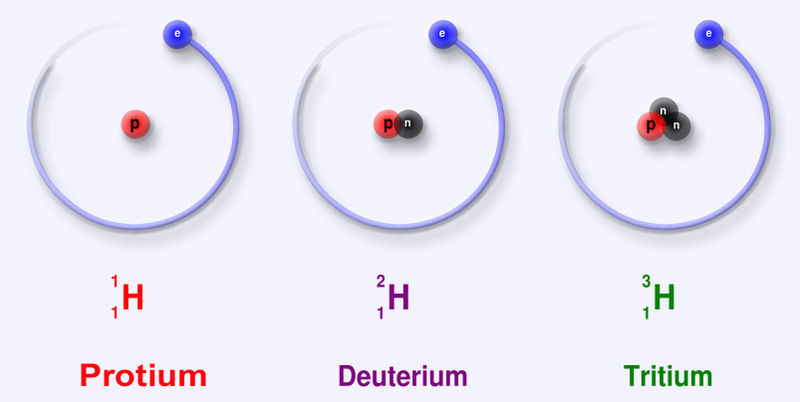
Isotopes:
           Symbol  Protons  Neutrons   Half life

Electron      e       0        0       stable
Neutron       N       0        1       886 seconds
Proton        P       1        0       stable
Deuterium     D       1        1       stable
Tritium       T       1        2       12.3 years
Helium-3     He3      2        1       stable
Helium-4     He4      2        2       stable
Lithium-6    Li6      3        3       stable
Lithium-7    Li7      3        4       stable
Carbon-12    C12      6        6       stable
Oxygen-16    O16      8        8       stable
 |
|---|
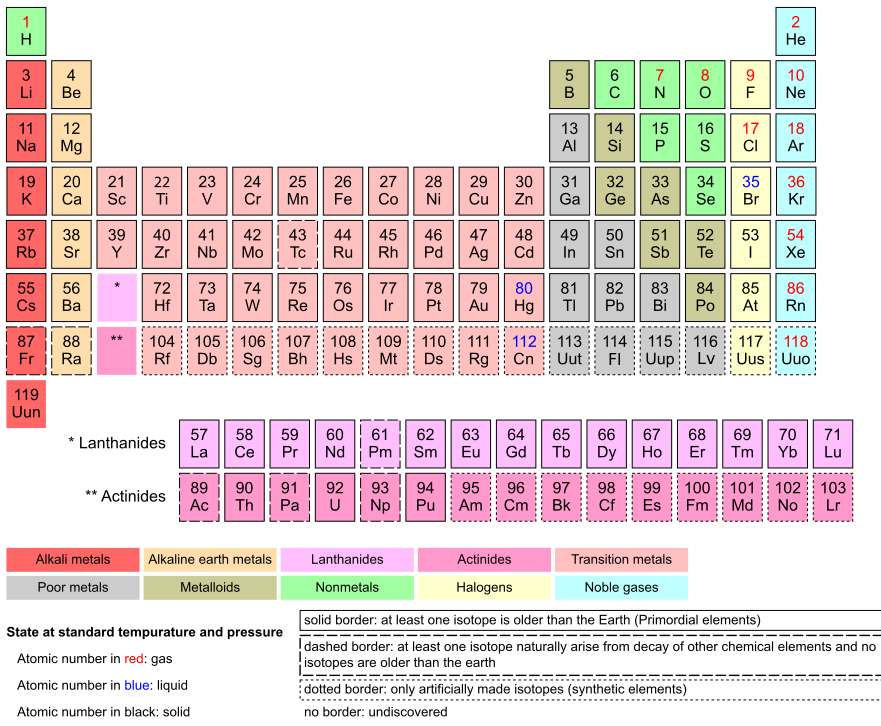
Each number corresponds to the number of protons.
Teaching simulation for isotopes at phet.colorado.edu
 |
|---|
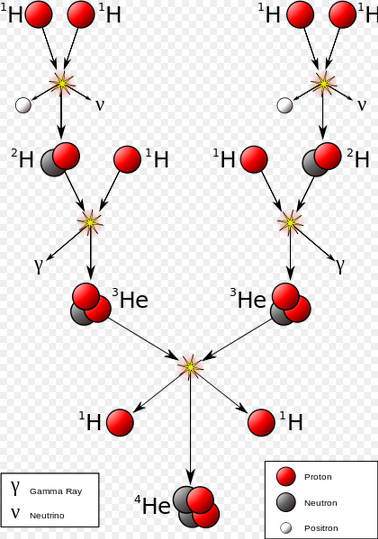
Hydrogen fusion requires a temperature of at least 4 million Kelvin, which requires an object with at least 0.08 solar masses. This is the minimum mass to be a star.
P    + P    -->  D    +  Positron + Neutrino +   .42 MeV
P    + D    -->  He3  +  Photon              +  5.49 MeV
He3  + He3  -->  He4  +  P   +  P            + 12.86 MeV

1 MeV = 106 eV  =  1.602*10-13 Joules
 |
|---|
As the core of a star star runs out of hydrogen it contracts and heats, and helium fusion begins when the temperature reaches 10 million Kelvin
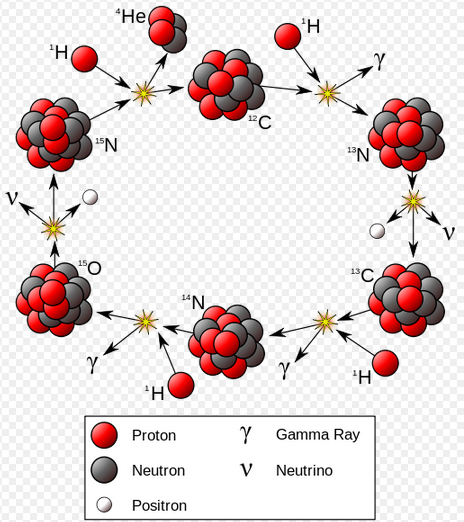
At temperatures above 17 million Kelvin, carbon-catalyzed fusion happens faster than proton-proton fusion. This occurs in stars more massive than 1.3 solar masses.
 |
|---|
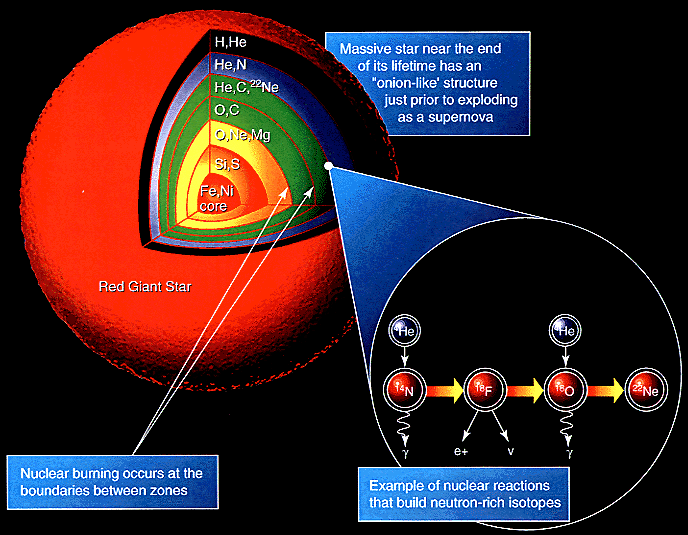
A heavy star continues to fuse elements until it reaches Iron-56. Beyond this, fusion absorbs energy rather than releasing it, triggering a runaway core collapse that fuses elements up to Uranium. If the star explodes as a supernova then these elements are ejected into interstellar space.
Star type    Mass   Luminosity    Color   Temp   Lifetime   Death      Remnant       Size of      Output
            (solar   (solar             (Kelvin) (billions                           remnant
            masses) luminosities)                 of years)

Brown Dwarf  <0.08                        1000  immortal
Red Dwarf     0.1         .0001   red     2000   1000      red giant   white dwarf  Earth-size
The Sun       1          1        white   5500     10      red giant   white dwarf  Earth-size    light elements
Blue star     10     10000        blue   10000      0.01   supernova   neutron star Manhattan     heavy elements
Blue giant    20    100000        blue   20000      0.01   supernova   black hole   Central Park  heavy elements
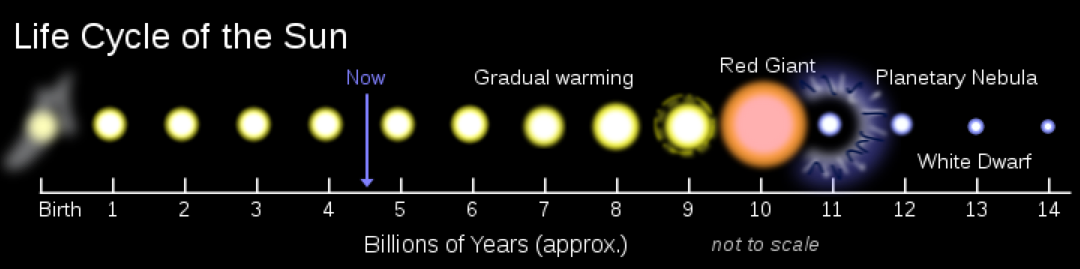
Fate of stars, with mass in solar masses:
       Mass <   9   -->  End as red giants and then turn white dwarf.
  9 <  Mass         -->  End as supernova
  9 <  Mass <  20   -->  Remnant is a neutron star.
 20 <  Mass         -->  Remnant is a black hole.
130 <  Mass < 250   -->  Pair-instability supernova (if the star has low metallicity)
250 <  Mass         -->  Photodisintegration supernova, producing a black hole and relativistic jets.
 |
 |
|---|---|
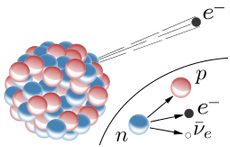
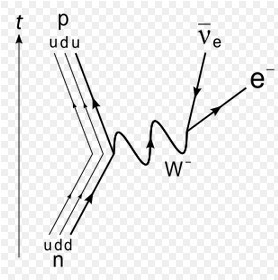
The weak force can convert a neutron into a proton.
From the point of view of nucleons:          Neutron     -->  Proton   + electron + antineutrino

From the point of view of quarks:            Down quark  -->  Up quark + electron + antineutrino
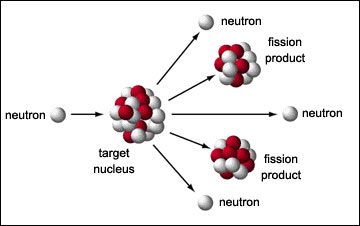
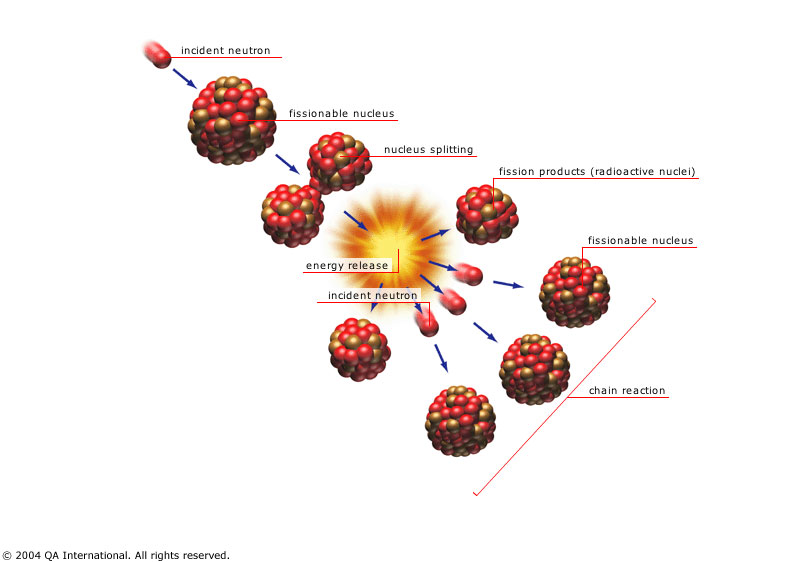
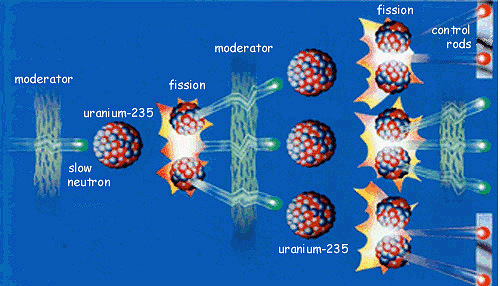
A neutron triggers the fission of Uranium-235 and plutonium-239, releasing energy and more neutrons.
 |
 |
|---|---|
 |
 |
|---|---|
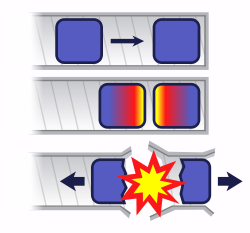
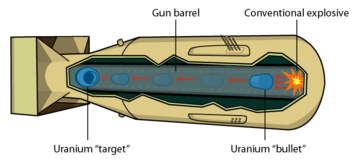
Two pieces of uranium, each with less than a critical mass, are brought together in a cannon barrel.
If the uranium is brought together too slowly, the bomb fizzles.
 |
 |
|---|---|
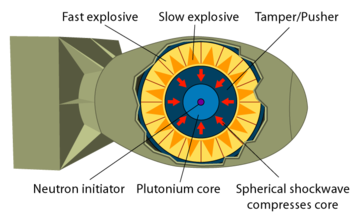
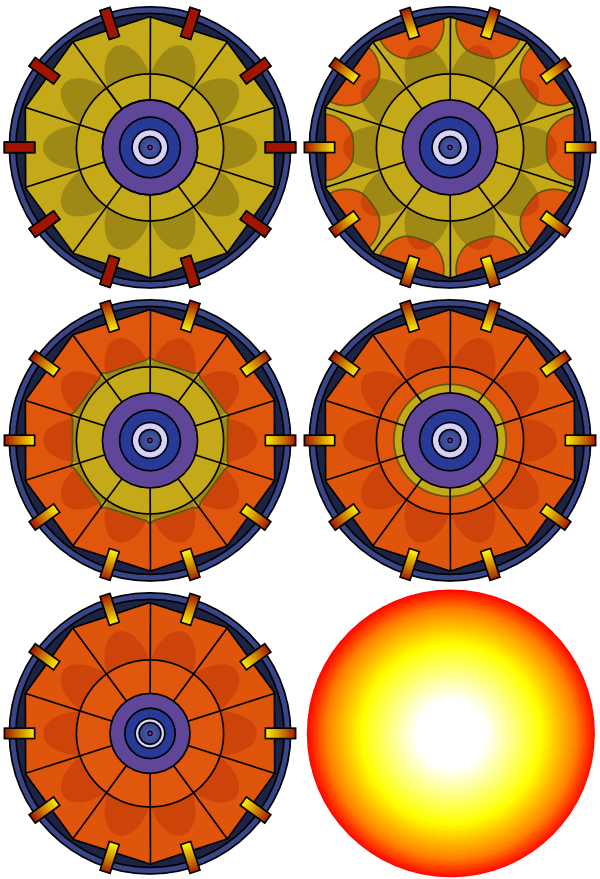
Plutonium is more difficult to detonate than uranium. Plutonium detonation requires a spherical implosion.
 |
|---|
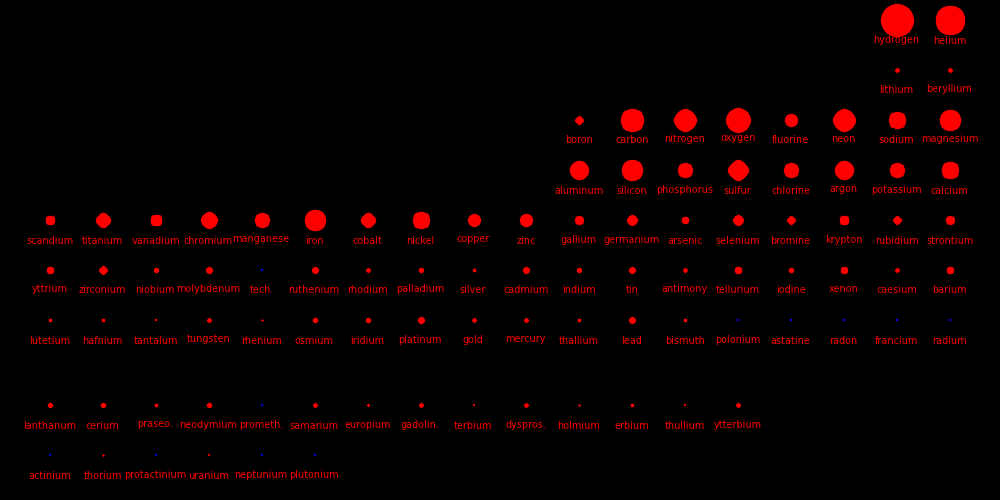
Blue elements are unstable with a half life much less than the age of the solar system.
The only elements heavier than Bismuth that can be found on the Earth are Thorium and Uranium, and these are the only elements that can be tapped for fission energy.
Natural Thorium is 100% Thorium-232
Natural Uranium is .72% Uranium-235 and 99.3% Uranium-238.
Plutonium doesn't exist in nature.
           Protons  Neutrons  Halflife   Critical   Isotope
                              (10^6 yr)  mass (kg)  fraction

Thorium-232    90    142      14000          -       1.00     Absorbs neutron -> U-233
Uranium-233    92    141           .160     16        -       Fission chain reaction
Uranium-235    92    143        700         52        .0072   Fission chain reaction
Uranium-238    92    146       4500          -        .9927   Absorbs neutron -> Pu-239
Plutonium-238  94    144           .000088   -        -       Produces power from radioactive heat
Plutonium-239  94    145           .020     10        -       Fission chain reaction
The elements that can be used for fission energy are the ones with a critical
mass. These are Uranium-233, Uranium-235, and Plutonium-239.
Uranium-233 and Plutonium-239 can be created in a breeder reactor.
Thorium-232  +  Neutron  ->  Uranium-233
Uranium-238  +  Neutron  ->  Plutonium-239
The "Fission" simulation at phet.colorado.edu illustrates the concept of a chain reaction.
Natural uranium is composed of .7% Uranium-235 and the rest is Uranium-238. Uranium-235 can be separated from U-238 using centrifuges, calutrons, or gas diffusion chambers. Uranium-235 is easy to detonate. A cannon and gunpowder gets it done.
Plutonium-239 is difficult to detonate, requiring a perfect spherical implosion. This technology is beyond the reach of most rogue states.
Uranium-233 cannot be used for a bomb and is hence not a proliferation risk.
Plutonium-238 emits alpha particles, which can power a radioisotope thermoelectric generator (RTG). RTGs based on Plutonium-238 generate 540 Watts/kg and are used to power spacecraft.
Creating Plutonium-239 and Uranium-233:
Uranium-238 + Neutron  ->  Plutonium-239
Thorium-232 + Neutron  ->  Uranium-233

Detail:

Uranium-238 + Neutron  ->  Uranium-239
Uranium-239            ->  Neptunium-239 + Electron + Antineutrino    Halflife = 23 mins
Neptunium-239          ->  Plutonium-239 + Electron + Antineutrino    Halflife = 2.4 days

Thorium-232 + Neutron  ->  Thorium-233
Thorium-233            ->  Protactinium-233 + Electron + Antineutrino   Halflife = 22 mins
Protactinium-233       ->  Uranium-233      + Electron + Antineutrino   Halflife =
1885       Rontgen discovers X-rays
1899       Rutherford discovers alpha and beta rays
1903       Rutherford discovers gamma rays
1905       E=mc^2. Matter is equivalent to energy
1909       Nucleus discovered by the Rutherford scattering experiment
1932       Neutron discovered
1933       Nuclear fission chain reaction envisioned by Szilard
1934       Fermi bombards uranium with neutrons and creates Plutonium. First
           successful example of alchemy
1938       Fission discovered by Hahn and Meitner
1938       Bohr delivers news of fission to Princeton and Columbia
1939       Fermi constructs the first nuclear reactor in the basement of Columbia
1939       Szilard and Einstein write a letter to President Roosevelt advising
           him to consider nuclear fission
1942       Manhattan project started
1942-1945  German nuclear bomb project goes nowhere
1945       Two nuclear devices deployed by the United States
1 ton of TNT                  4*10^9  Joules
1 ton of gasoline             4*10^10 Joules
North Korea fission device    0.5 kilotons TNT
10 kg uranium fission bomb    10  kilotons TNT
10 kg hydrogen fusion bomb    10  megatons TNT
Tunguska asteroid strike      15  megatons TNT        50 meter asteroid
Chixulub dinosaur extinction  100 trillion tons TNT   10 km asteroid
A tokamak fusion reactor uses magnetic fields to confine a hot plasma so that fusion can occur in the plasma.
 |
 |
|---|---|
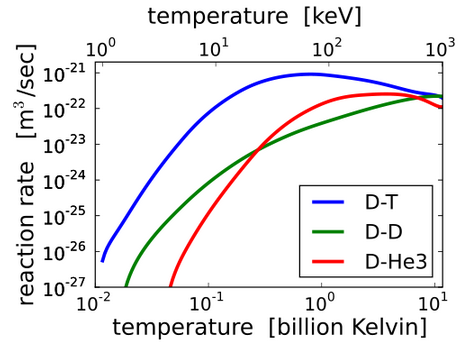
The fusion reaction that occurs at the lowest temperature and has the highest reaction rate is
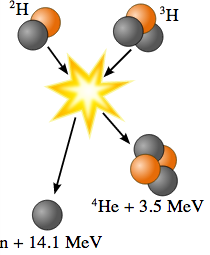
Deuterium + Tritium --> Helium-4 + Neutron + 17.590 MeVbut the neutrons it produces are a nuisance to the reactor.
A potential fix is to have "liquid walls" absorb the neutrons (imagine a waterfall of neutron-absorbing liquid lithium cascading down the walls of the reactor).
The fusion reactions that don't produce neutrons are
                                 Energy  Coulomb
                                 yield   energy
                                 (MeV)

P   + P    ->  D   + Positron     .42      1   Slow because requires the weak force
P   + D    ->  He3 + Photon      5.49      1   Slow because requires the electromagnetic force
D   + He3  ->  He4 + P          18.353     2   D+D side reactions produce neutrons
P   + Li6  ->  He4 + He3         4.0       3
P   + Li7  ->  He4 + He4        17.2       3
D   + Li6  ->  He4 + He4        22.4       3   D+D side reactions produce neutrons
He3 + He3  ->  He4 + P   + P    12.860     4   He3 is rare
P   + B11  ->  He4 + He4 + He4   8.7       5
He3 + Li6  ->  He4 + He4 + P    16.9       6
P   + N15  ->  C12 + He4         5.0       7
"Coulomb energy" is the product of the charges of the two reactants, in units
of proton charge. The lower the energy, the easier it is to fuse the nuclei.
This can be seen with
the Rutherford
scattering simulation.Helium-3 is rare on the Earth and abundant on the moon.
A nuclear fusion bomb contains deuterium and lithium-6 and the reaction is catalyzed by a neutron.
N + Li6  ->  He4 + T +  4.87 MeV
T + D    ->  He4 + N + 17.56 MeV

Total energy released  =  22.43 MeV
Nucleons               = 8
Energy / Nucleon       = 22.434 / 8  =  2.80
A rocket ideally produces as much energy per mass as possible, which is reflected in the fusion "energy per nucleon". The reactions that have the best energy per nucleon are
                               Energy   Energy per
                               yield    nucleon
                               (MeV)    (MeV)

D   + He3  ->  He4 + P         18.353    3.67
D   + T    ->  He4 + N         17.590    3.52
D   + Li6  ->  He4 + He4       22.4      2.80
T   + He3  ->  He4 + D         14.320    2.39   41%
P   + Li7  ->  He4 + He4       17.2      2.15
He3 + He3  ->  He4 + P   + P   12.860    2.14
T   + He3  ->  He4 + P   + N   12.096    2.02   59%
The best choice is D + He3 and the next best choice is D + T.
                                     Energy   Energy per
                                     yield    nucleon
                                     (MeV)    (MeV)
P    + P    ->  D    +  Positron     .42      .21
P    + D    ->  He3  +  Photon      5.49     1.83
P    + T    ->  He3  +  N           -.764
P    + Li6  ->  He4  +  He3         4.0       .57
P    + Li7  ->  He4  +  He4        17.2      2.15
P    + B11  ->  He4  +  He4  + He4  8.7       .72


D    + D    ->  T    +  P           4.033    1.01   50%
            ->  He3  +  N           3.269     .81   50%
D    + T    ->  He4  +  N          17.590    3.52
D    + He3  ->  He4  +  P          18.353    3.67
D    + Li6  ->  He4  +  He4        22.4      2.80
T    + T    ->  He4  +  N   +  N   11.332    1.89
T    + He3  ->  He4  +  P   +  N   12.096    2.02   59%
            ->  He4  +  D          14.320    2.39   41%
He3  + He3  ->  He4  +  P   +  P   12.860    2.14
He3  + Li6  ->  He4  +  He4 +  P   16.9      1.88
N    + Li6  ->  T    +  He4         4.784     .68
N    + Li7  ->  T    +  He4 +  N   -2.467


           Mass of nucleus  Mass of atom   Half life     Binding energy
                (AMU)         (AMU)                      per nucleon (MeV)
Electron      .00054858
Neutron      1.00866492                    886 seconds     0
Proton       1.00727647                                    0
Hydrogen     1.00727647     1.00782504                     0
Deuterium    2.01355321     2.01410178                     1.11226
Tritium      3.01550071     3.01604928     12.3 years      2.82727
Helium-3     3.01493173     3.0160293                      2.57269
Helium-4     4.00150485     4.002602                       7.07392
Lithium-6    6.01347537     6.01512280                     5.33257
Lithium-7    7.01435712     7.01600455                     5.60637
Beryllium-8                                7*10^−17 s      7.06244
Beryllium-9                                                6.46278
Boron-10                                                   6.47508
Boron-11                                                   6.92771
Carbon-12                                                  7.68015
Carbon-13                                                  7.46986
Carbon-14                                  5730 years      7.52033
Oxygen-16                                                  7.97622
Oxygen-17                                                  7.75075
Oxygen-18                                                  7.76707
Iron-56                                                    8.79
Uranium-235                                                7.59
Uranium-238                                                7.57

1 MeV = 10^6 eV  = 1.602*10^-13 Joules
If no half-life is given, the nucleus is stable
1 atomic mass unit (AMU) = 1.660538921*10^-27 kg = 931.494061 MeV
               Parts    Halflife     Decay    Neutron   Result of      Halflife
                per     (thousand    energy   absorb    neutron        (thousand
              thousand  years)       (MeV)    (barns)   absorption     years)

Caesium-135     69      1500          .27       8.3     Barium-136
Caesium-137     63          .030    1.2          .11    Barium-138
Technetium-99   61       210         .29       20       Ruthenium-100  stable
Zirconium-93    55      1500          .091      2.7     Niobium-94     20.3
Strontium-90    45          .029    2.8          .90    Zirconium-91   stable
Palladium-107   12.5    6500          .033      1.8     Silver-108     .418
Iodine-129       8.4   15700          .194     18       Xenon-130      ?
Samarium-151     5.3        .097     .077   15200       Europium-152   .0135
Krypton-85       2.2        .011     .69        1.7
Tin-126          1.1     230        4.0        < .1
Selenium-79       .447   330         .15       < .1
Europium-155      .80       .0048    .25     3950
Cadmium-113       .008      .014     .32    20600
Tin-121           .0005     .044     .39        ?
"Neutron absorption" is the cross section for a nucleus to capture a thermal
neutron.
All of the radioactive fission products decay by beta decay.
If the neutron cross section is 8 barnes or higher then the nucleus can potentially be transmuted into a nonradioactive nucleus.
Strontium-90 is ideal for Radioisotope Thermoelectric Generators (RTGs). www.jaymaron.com/rockets/rockets.html
The most troublesome fission products are the ones that can't be transmuted. Chief among these are Caesium-137, Zirconium-93, Niobium-94, Strontium-90, Zirconium-91, and Palladium-107.
           Fission Fusion

U.S.A.       1945  1954
Germany                  Attempted fission in 1944 & failed
Russia       1949  1953
Britain      1952  1957
France       1960  1968
China        1964  1967
India        1974        Uranium
Israel       1979   ?    Undeclared. Has both fission and fusion weapons
South Africa 1980        Dismantled in 1991
Iran         1981        Osirak reactor to create Plutonium. Reactor destroyed by Israel
Pakistan     1990        Centrifuge enrichment of Uranium. Tested in 1998
                         Built centrifuges from stolen designs
Iraq         1993        Magnetic enrichment of Uranium. Dismantled after Gulf War 1
Iraq         2003        Alleged by the United States. Proved to be untrue.
North Korea  2006        Obtained plutonium from a nuclear reactor. Detonation test fizzled
                         Also acquired centrifuges from Pakistan
                         Also attempting to purify Uranium with centrifuges
Syria        2007        Nuclear reactor destroyed by Israel
Iran         2009?       Attempting centrifuge enrichment of Uranium.
Libya         --         Attempted centrifuge enrichment of Uranium.  Dismantled before completion.
                         Cooperated in the investigation that identified
                         Pakistan as the proliferator of Centrifuge designs.
Libya        2010        Squabbling over nuclear material
Libya        2011        Civil war
Fusion bombs use the reaction
Deuterium + Lithium6 --> Helium4 + Helium4 + EnergyUsing the "Isotopes and Atomic Mass" simulation at phet.colorado.edu, you can look up the mass of each nucleus. What fraction of the mass is converted to energy?
Z = Joules per kg generated by the fusion reaction
W = Joules per nucleon generated by the fusion reaction
Deuterium has 2 nucleons and Lithium6 has 6 nucleons, for a total of 8. What is Z and W?
Suppose a spaceship uses a rocket nozzle to channel the fusion products into a uni-directional flow. The maximum possible flow speed is
Z = .5 V^2What is V?
The maximum speed of a rocket is proportional to the exhaust velocity. If a rocket is moving at speed V, what is the time dilation factor?
Time dilation = (1-V^2/C^2)^(-1/2)Alpha Centauri is 4.4 light years away. How long would it take the rocket to get there?
A fusion rocket using Deuterium+Lithium6 is within our technological grasp. The only fusion reaction that delivers more energy is
Deuterium + Helium3 --> Helium4 + ProtonHelium3 is rare on the Earth but it can be found on the moon. An advanced civilizaton could potentially generate Helium3 through the reaction
Proton + Lithium6 --> Helium3 + Helium4Suppose a rocket uses the fission of Uranium-235. Using data from the web, what is W, Z, and V?