Particle physics
Helium atom
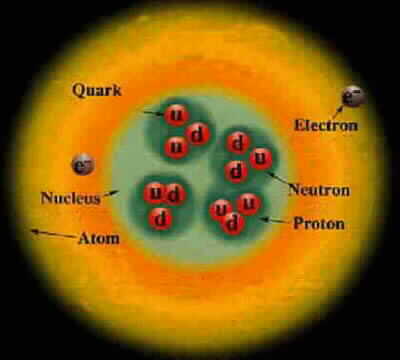 Particle Charge Constituents
Proton +1 2 up quarks & 1 down quark
Neutron 0 1 up quark & 2 down quarks
electron -1
Up quark +2/3
Down quark -1/3
Photon 0
Particle Charge Constituents
Proton +1 2 up quarks & 1 down quark
Neutron 0 1 up quark & 2 down quarks
electron -1
Up quark +2/3
Down quark -1/3
Photon 0
Particles and forces
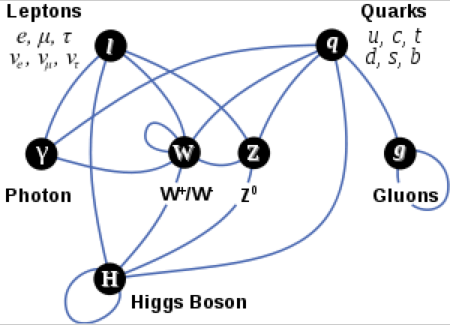 Charge Strong Weak
force force
Up quark +2/3 * *
Charm quark +2/3 * *
Top quark +2/3 * *
Down quark -1/3 * *
Strange quark -1/3 * *
Bottom quark -1/3 * *
Electron -1 *
Muon -1 *
Tau -1 *
Photon 0 *
Gluon 0 *
Graviton 0
Electron neutrino 0 *
Muon neutrino 0 *
Tau neutrio 0 *
W boson +1 *
Z boson 0 *
Higgs Boson 0 *
Force-carrying particles
Electromagnetic Photon
Weak W and Z bosons
Strong Gluon
Gravity Graviton
All particles feel the gravitational force
Charge Strong Weak
force force
Up quark +2/3 * *
Charm quark +2/3 * *
Top quark +2/3 * *
Down quark -1/3 * *
Strange quark -1/3 * *
Bottom quark -1/3 * *
Electron -1 *
Muon -1 *
Tau -1 *
Photon 0 *
Gluon 0 *
Graviton 0
Electron neutrino 0 *
Muon neutrino 0 *
Tau neutrio 0 *
W boson +1 *
Z boson 0 *
Higgs Boson 0 *
Force-carrying particles
Electromagnetic Photon
Weak W and Z bosons
Strong Gluon
Gravity Graviton
All particles feel the gravitational force
History
1687 Newton discovers the laws of motion and the gravitational force law
1785 Coulomb discovers the electric force law
1862 Maxwell unifies electricity, magnetism, and light
1905 Einstein develops special relativity
1909 Rutherford discovers the nucleus
1915 Einstein develops general relativity
1926 Schroedinger discovers the "Schroedinger formula" for quantum mechanics
1928 Dirac unifies quantum mechanics and special relativity
1939 Uranium fission discovered
1948 Quantum electrodynamics developed
1967 Weak force and quantum electrodynamics unified as the "electroweak force"
1970-3 "Standard Model" developed for the electroweak and strong forces
Unifications
1862 Electric force + Magnetic force --> Maxwell's equations of electromagnetism
1905 Special relativity resolves the paradoxes of electromagnetism
1915 Gravity + Special relativity --> General relativity
1928 Quantum mechanics + Special relativity --> Dirac equation
1967 Electromagnetism + Weak force --> Electroweak force
A unification of the strong and electroweak forces would be a "Grand Unified Theory".
(not yet developed)
A unification of quantum mechanics and general relativity would be a theory of "Quantum Gravity".
(not yet developed)
Particles
Mass Stable
Electron neutrino < 1 eV
Muon neutrino < 2 eV
Green photon 2.33 eV *
Electron .51 MeV *
Up quark 1.9 MeV *
Down quark 4.4 MeV *
Strange quark 87 MeV
Muon 105.7 MeV
Neutral pion 135 MeV
Positive pion 140 MeV
Proton .9383 GeV *?
Neutron .9396 GeV
Charm quark 1.32 GeV Discovered at SLAC
Tau 1.78 GeV Discovered at SLAC
Bottom quark 4.24 GeV Discovered at Fermilab
45 GeV Limit of the Stanford Linear Accelerator
W boson 80 GeV Discovered at the Super Proton Synchrotron
Z boson 91 GeV Discovered at the Super Proton Synchrotron
Higgs Boson 125 GeV Discovered at the LHC and Fermilab
Top quark 173 GeV Discovered at Fermilab
~200 GeV Limit of the Fermilab accelerator
~700 GeV Limit of the Large Hadron Collider
Cosmic rays 10^12 GeV Highest-energy events observed
Planck energy 10^19 GeV Quantum gravity scale
1 electron Volt (eV) = 1.602e-19 Joules ~ kT at 11,000 Kelvin
Planck energy = 1.22e28 eV = 1.956e9 Joules
Particle accelerators
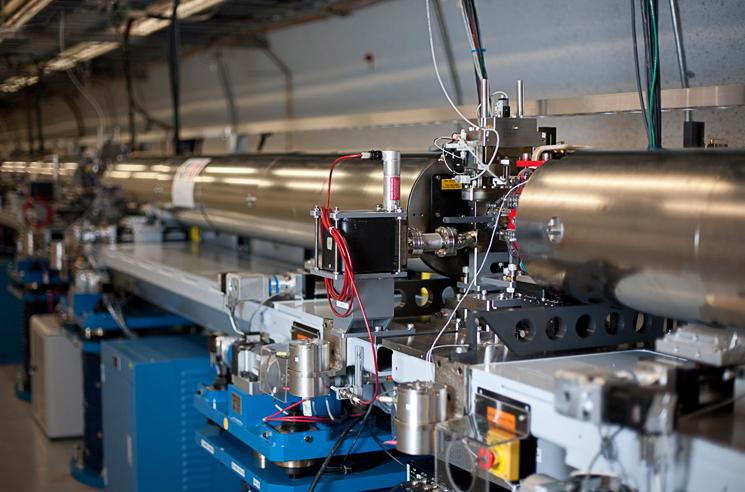 |
| Stanford Linear Collider (SLAC) |
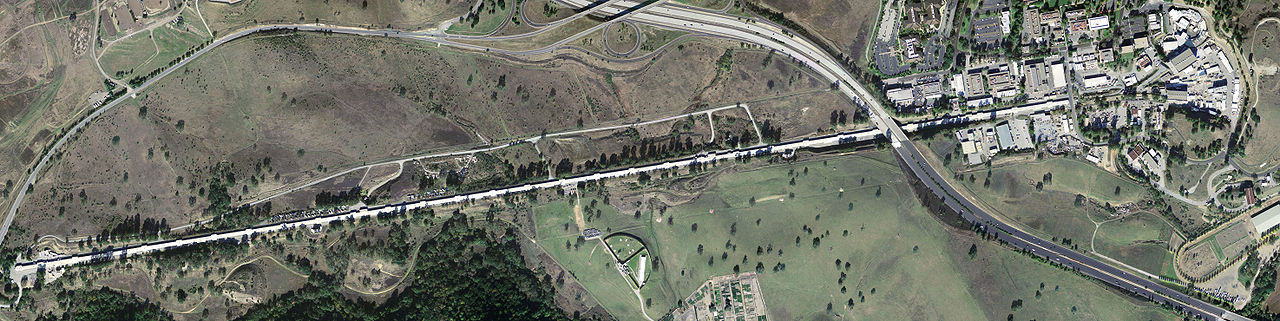 |
| Stanford Linear Collider (SLAC) |
 |
 |
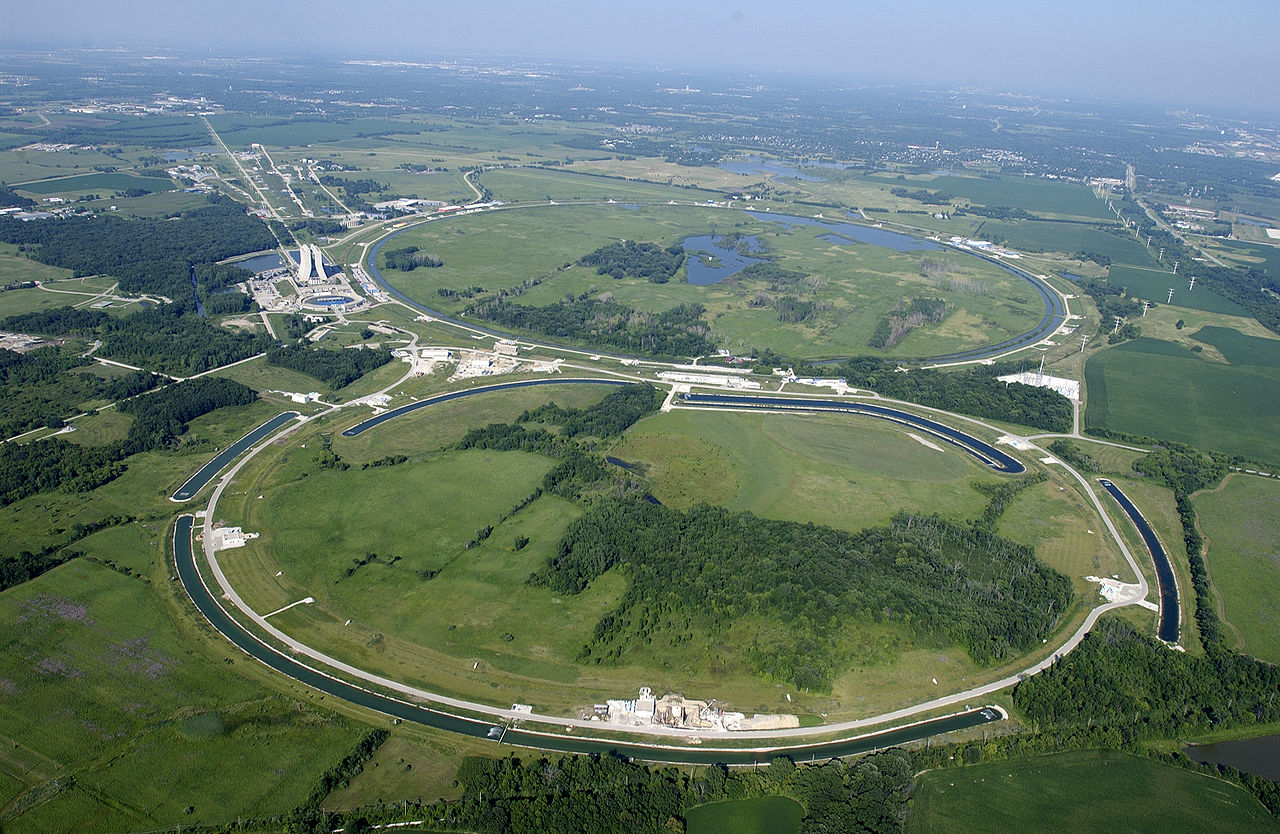
| Fermilab |
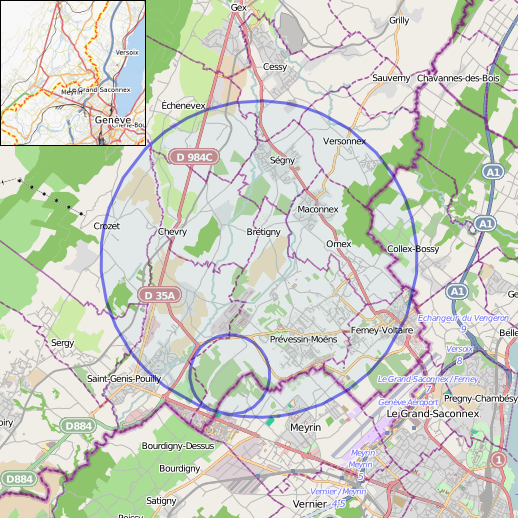
Large Hadron Collider (LHC) at CERN |
Accelerator Particle Particle Type Size (km) Year
energy (GeV) (circumf)
Stanford Linear Accelerator SLAC Electron 45 Linear 3.2 1966
Super Proton Synchrotron SPS Proton 400 Ring 6.9 1976
Fermilab Proton 1000 Ring 6.3 1983
Large Electron Positron collider LEP Electron 104 Ring 27 1989
Large Hadron Collider LHC Proton 7000 Ring 27 2011
Superconducting Supercollider SSC Proton 20000 proton 87 Cancelled
International Linear Collider ILC Electron ~1000 Linear Proposed
Compact Linear Collider CLIC Electron ~5000 Linear Proposed
Muon collider Muon Proposed
Electron ring colliders are limited by synchrotron radiation. The Large Electron Positron collider
represents the maximum practical energy for an electron ring collider.
Muons have a mass of 105.7 MeV and a half life of 2.197e-6 seconds
Mass of Muon / Mass of Proton ~ 0.11