

|
|
|
|
|
|
|---|---|---|---|---|---|
 |
 |
 |
|
 |
|
 |
|
 |
|---|---|---|---|---|---|---|---|---|
 |
|
 |
|
 |
|
 |
|
 |
|
 |
|
 |
|
|||
|---|---|---|---|---|---|---|---|---|---|---|---|---|---|---|---|---|
|
|
|
|
|
|
|
|
 |
|
 |
|
 |
|
 |
|
 |
|
 |
|---|---|---|---|---|---|---|---|---|---|---|
 |
|
 |
|
 |
|
 |
|
 |
|
|
|---|---|---|---|---|---|---|---|---|---|---|
 |
|---|
 |
|---|
|
|---|
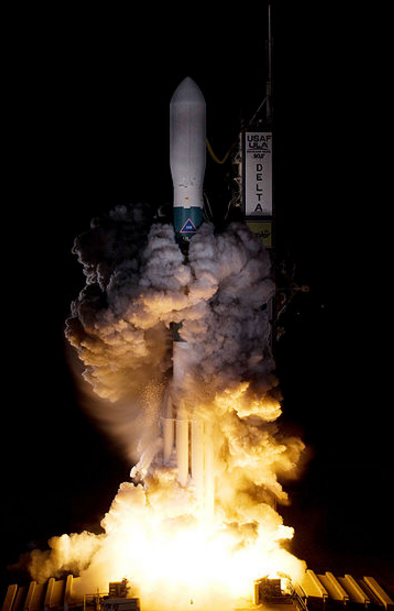
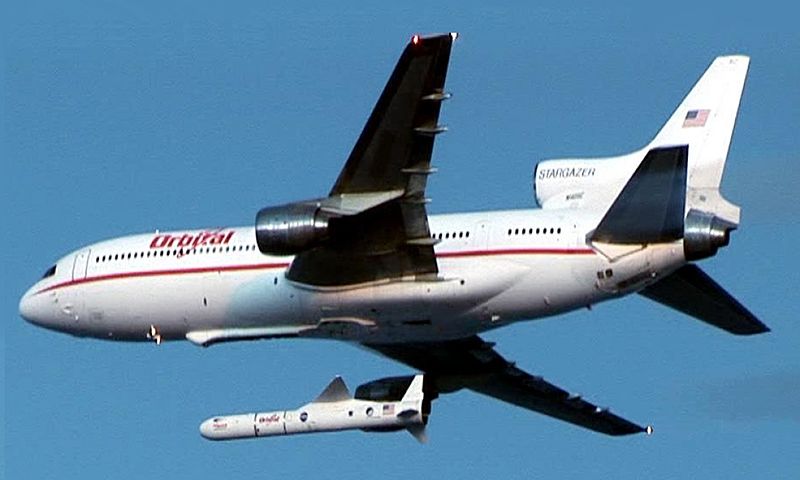
The future of rocket launch is air launch, giving the rocket a speed boost from the aircraft. Launching at high altitude also reduces air drag. Launch cost is presently $2000/kg and air launch will reduce this. Article.
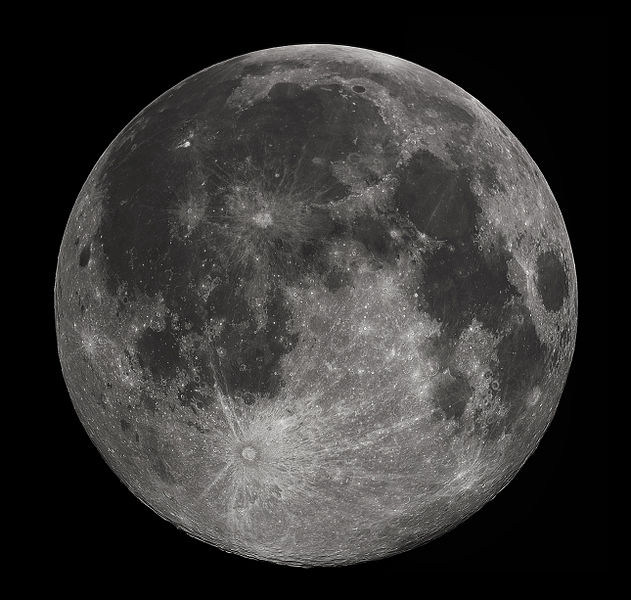
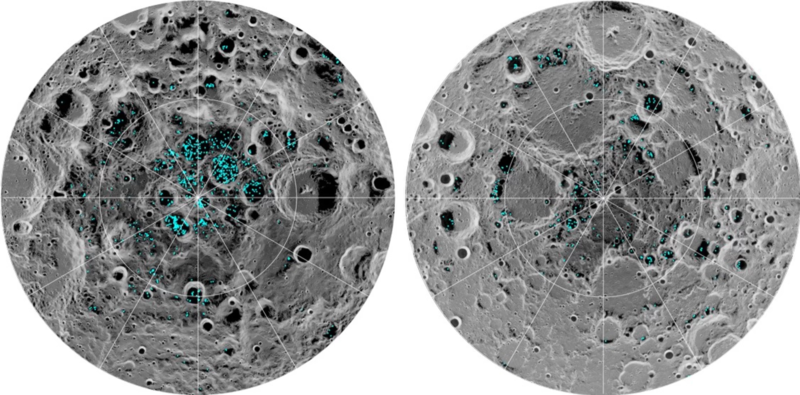
The moon has metal asteroid craters, which are primarily iron, nickel, and cobalt, and these can be used for space megastructures. They also have platinum-group elements. Article.
 |
|---|
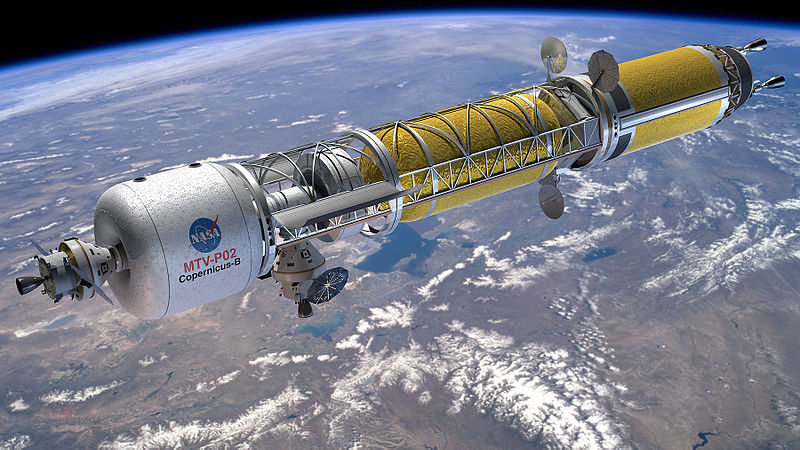
In the future, interplanetary travel will be dominated by fission thermal hydrogen rockets, which have a faster exhaust speed than chemical rockets. In a thermal hydrogen rocket, a nuclear reactor or a solar mirror heats hydrogen exhaust. Article.
 |
|---|
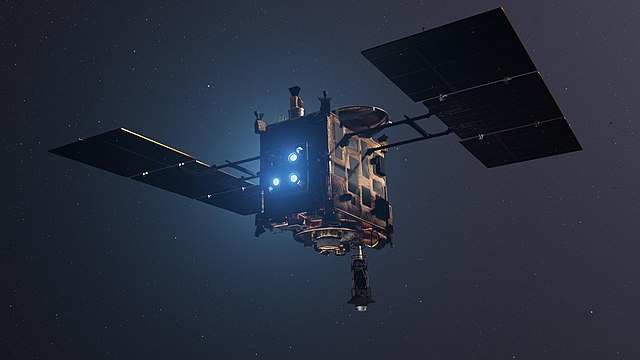
Ion drives use electricity to accelerate ions, with electricity coming from nuclear power. Article.
 |
|
|---|---|
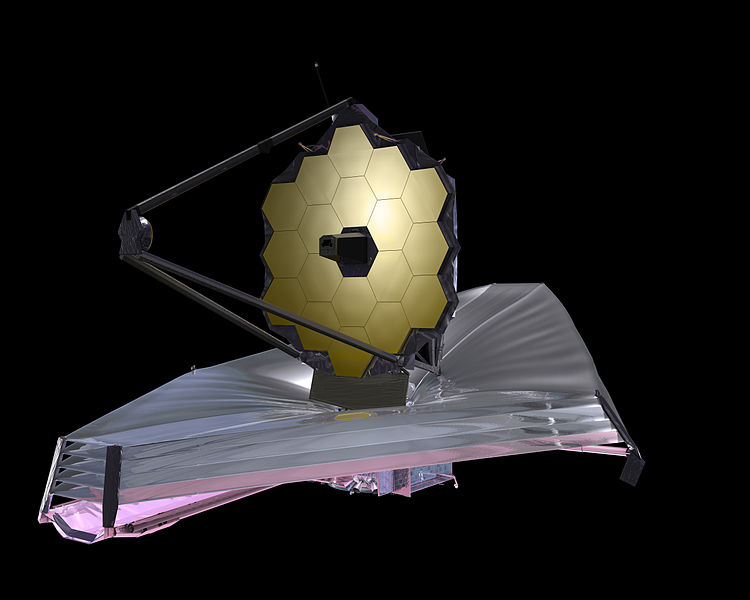
The best place for telescopes is the Lagrange point L2. A manned base should be built here so that colossal telescopes can be assembled on site. Lunar ice supports the station. Article.
 |
|
|---|---|
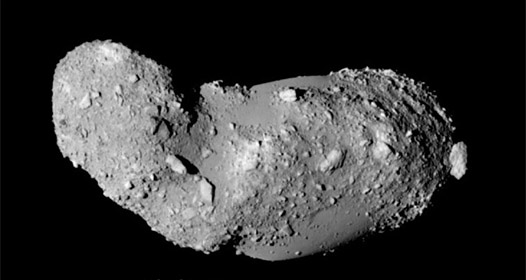
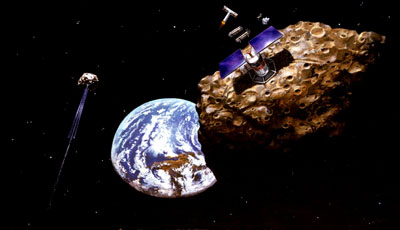
Metallic asteroids contain trillions of dollars of platinum group metals. They can be mined and moved with hydrogen bombs or space mirrors. Article.
|
|
 |
|
 |
|
|
|
|
|
|
|
|
|---|---|---|---|---|---|---|---|---|---|---|---|---|
The rockets that are possible with current technology are:
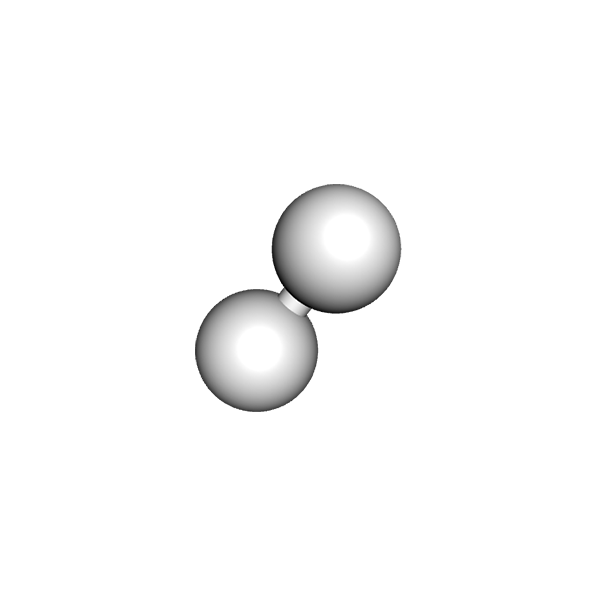
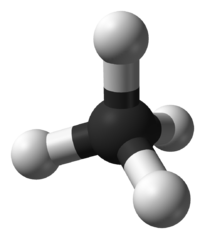
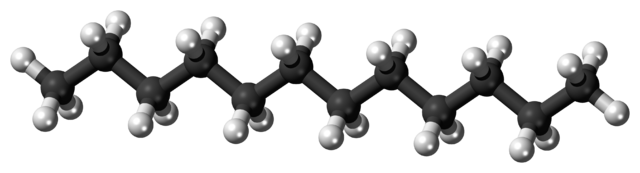
Chemical             React chemicals, for example hydrogen + oxygen
Thermal hydrogen     Hydrogen exhaust is heated with nuclear or solar power
Ion rocket           Accelerate ions, powered by electricity from nuclear or solar
Fusion bomb rocket   Can move large objects like asteroids
Fission afterburner  Neutrons trigger fission in the exhaust
Alpha rocket         A radioisotope emits alpha particles as exhaust
 |
|---|
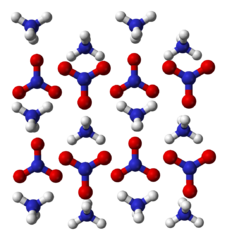
Chemical        H2+O2, Kerosene+O2, or solid fuel (Al+NH4NO3)
Fission         Uranium-235, Plutonium-239, Americium-242m, Beryllium-7
Radioactivity   Plutonium-238, Cobalt-60, Lead-210
Solar           Photovoltaic cells or solar mirror heat
Fusion          A fusion bomb using Deuterium + Lithium-6
The maximum exhaust speed is given by the energy/mass of the energy source.
Exhaust speed   =  V
Energy/Mass     =  e  =  ½ V2
This is the "perfect" exhaust speed. In practice the exhaust speed is less.
Energy                      Practical   Perfect   Energy/Mass
source                       exhaust    exhaust
                              speed      speed
                              km/s       km/s      MJoule/kg

Fusion       Deuterium+Li6    6900      23000   270000000
Fission      Uranium-235      4000      12000    74000000
Fission      Plutonium-239    4000      12000    76000000
Radioactive  Plutonium-238      50       2100     2300000
Chemical     H2+Li+F2            5.32
Chemical     Be + O2             5.3                   23.2
Chemical     Hydrogen+O2         4.4        5.1        13.2
Chemical     Methane +O2         3.7        4.7        11.1
Chemical     Kerosene+O2         3.3        4.5        10.3
Chemical     Al+NH4NO3           2.7        3.7         6.9
 |
|---|
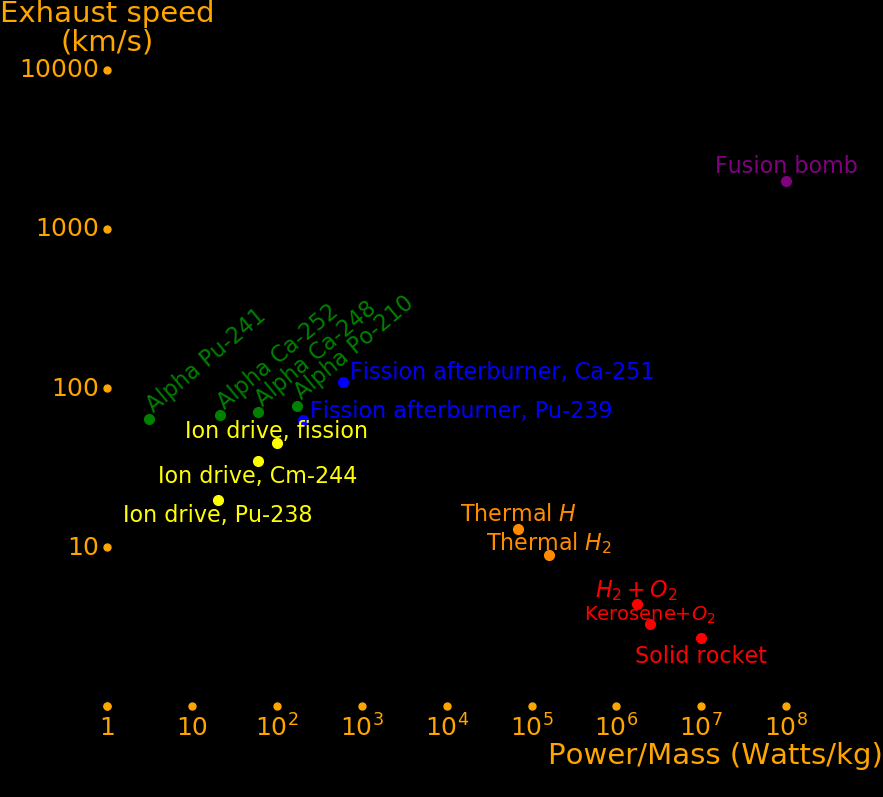
The relationship between rocket quantities is:
Exhaust speed       =  V
Exhaust energy/mass =  e  =  ½V2
Exhaust power/mass  =  p  =  ½V2/T  =  e/T
Burn time           =  T
Acceleration        =  A  =  2p/V  =  V/T
"Burn time" is the time for a rocket to expel its own mass of propellant. The shorter the burn time the better.
For ion drives the exhaust speed is customizable. The power/mass is fixed and there is a tradeoff between exhaust speed and acceleration. In the table below we choose a burn time of 107 seconds (3 months) for ion rockets.
It is difficult to make a rocket with both large power/mass and large exhaust speed. Fusion bombs qualify but they can only be used to move large objects like asteroids.
Rocket type               Exhaust  Power/Mass  Acceleration   Burn time
                           km/s     Watts/kg    meters/s/s     seconds

Chemical, Hydrogen+O2           4.4   1700000    770                5.6
Chemical, Methane +O2           3.7   2500000   1350                2.7
Chemical, Kerosene+O2           3.3   5000000   3030                1.1
Chemical, Al+NH4NO3             2.5   9000000   7200                 .3   Solid fuel

Fission thermal H2              9      160000     36              253     A fission reactor heats H2
Fission thermal H              13       70000     11             1200     A fission reactor heats atomic hydrogen

Ion drive                      45         100       .0045    10000000

Fission afterburner, Am-242m   93         200       .0043    22000000
Fission afterburner, Pu-239    30         200       .013      2200000
Fission afterburner, Be-7     134         200       .0030    45000000
Fission afterburner, He-3      40         200       .010      4000000
Fission afterburner, Li-6      31         200       .013      2400000
Fission afterburner, B-10      35         200       .011      3100000

Alpha, Po-210                  77         171       .0016    12000000     Half life   .38   years
Alpha, Ca-248                  71          60       .002     28700000     Half life   .91   years
Alpha, Ca-252                  68          19       .00019   82000000     Half life  2.6    years
Alpha, Pb-210                  77           2.9     .000075 730000000     Half life 22.3    years
Alpha, U-230                  200        7000                             Half life   .0554 years
Alpha, Th-228                 180         170       .0019    62000000     Half life  1.91   years
Alpha, Ra-228                 180          57       .00063  190000000     Half life  5.75   years
Alpha, Ac-227                 180          15       .00017  710000000     Half life 21.8    years
Alpha, U-232                  200           5.7                           Half life 68.9    years

Fission bomb                Large       Large   Large           Short
Fusion bomb                 Large       Large   Large           Short       Deuterium + Lithium-6

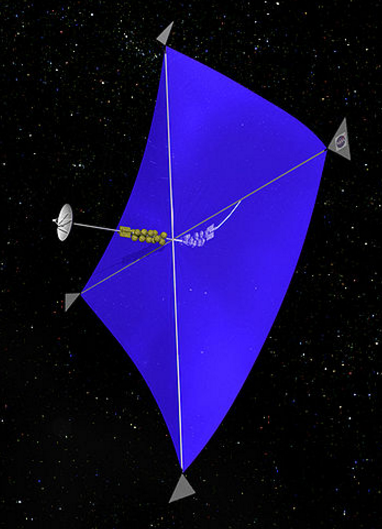
Solar sail                 300000      228000       .00152
 |
 |
 |
 |
 |
|---|---|---|---|---|
The chemical rocket with the fastest exhaust is hydrogen+oxygen (HOX). It is the most expensive chemical rocket because hydrogen has to be liquefied at 20 Kelvin. Because the liquid hydrogen has low density, HOX can't be used for the first stage of a ground rocket, but it can be used for upper stages. HOX is easy in space.
Kerosene is often used because it's liquid at room temperature. Methane is slightly better than kerosene but it must be stored as a liquid at 112 Kelvin.
Solid fuel is cheap, simple, and reliable, and is often used for the first stage.
Fuel     Exhaust    Fuel    Fuel boiling
          speed    density     point
         (km/s)   (g/cm3)      (K)

Hydrogen    4.4     .07       20     Complex because of the low boiling point of hydrogen
Methane     3.7     .42      112     New technology pioneered by SpaceX
Kerosene    3.3     .80      410     Simple because kerosene is a liquid at room temperature
Solid fuel  2.7    1.2         -     Simple and cheap.  Often Aluminum + NH4NO3
 |
|
 |
 |
 |
 |
|---|---|---|---|---|---|
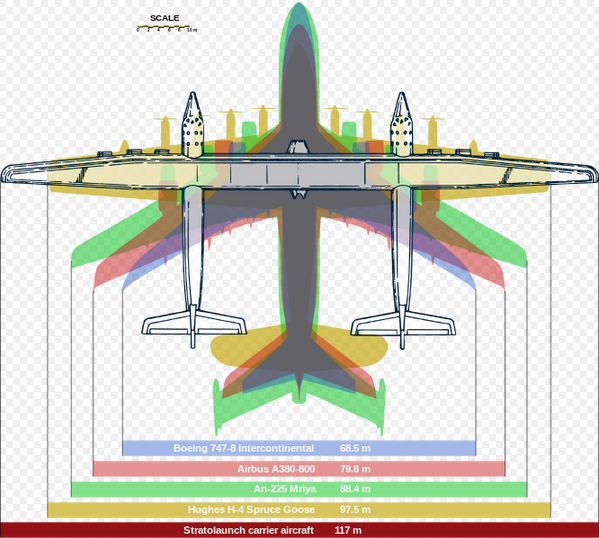
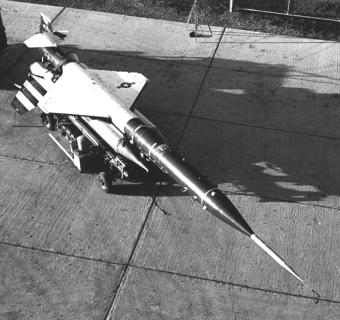
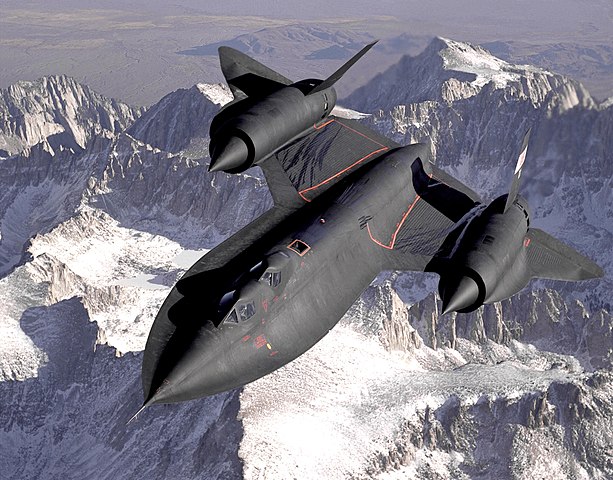
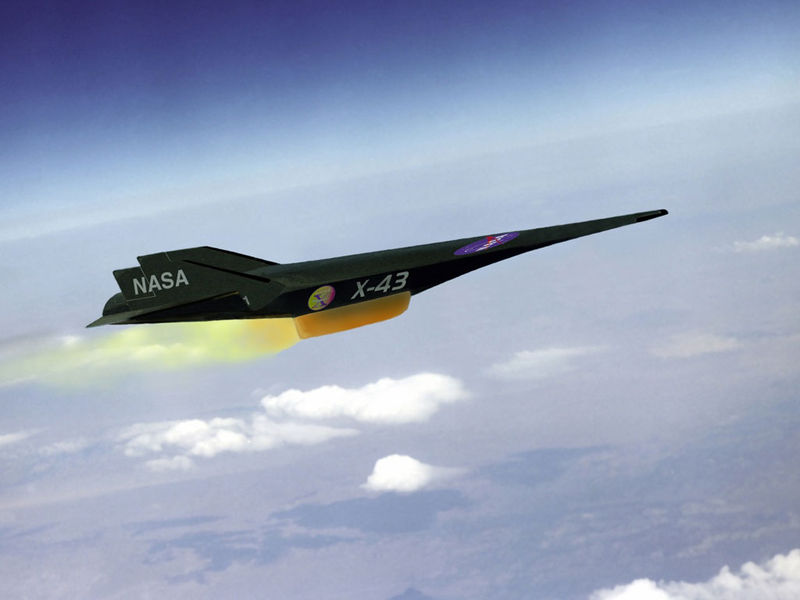
In air launch, an aircraft launches a rocket at high altitude. Air launch has advantages over ground launch, such as:
*) The aircraft speed adds to the rocket speed.
*) Less air drag. Air at 15 km has 1/4 the density of air at sea level.
*) The rocket can be launched at the equator so that the Earth's equatorial speed adds to the rocket speed.
*) Ramjet launch makes it possible to reach orbit with cheap solid rockets.
                              Speed    Speed
                              (km/s)   (Mach)

Earth rotation at equator        .46   1.6
Turbofan aircraft                .27     .9
Ramjet aircraft                 1.5     5
Scramjet aircraft              >1.5    >5
Solid rocket exhaust            2.7     9
Kerosene rocket exhaust         3.3    11
Hydrogen+Oxygen rocket exhaust  4.4    15
low Earth orbit                 7.8    26.4
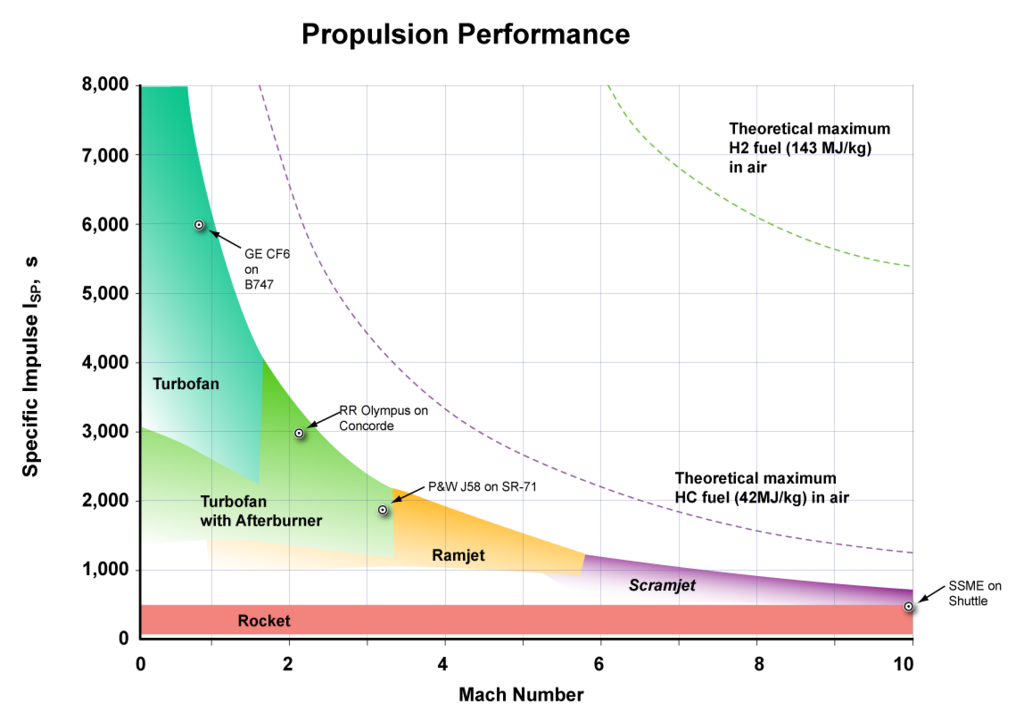
At present, turbofan aircraft are being built for launching rockets, and in the near future ramjet aircraft will be used. For ramjet launch:
Stage   Type           Speed increase   End speed
                            km/s           km/s

  0     Equator motion        .45          .45
  1     Ramjet               1.55         2.0
  2     Solid rocket         4.0          6.0
  3     HOX                  2.0          8.0       Orbit speed
 |
|---|
|
 |
|---|---|
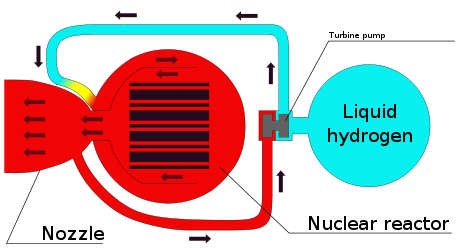
A fission thermal hydrogen rocket uses fission to heat hydrogen propellant. It has a higher exhaust speed than chemical rockets (13 km/s vs. 4 km/s).
In a chemical rocket the energy comes from a chemical reaction and this puts an upper limit on the exhaust speed. Reacting hydrogen and oxygen gives an exhaust speed of 4.4 km/s. Nuclear power can reach higher exhaust speed.
Rocket type               Exhaust speed (km/s)

Nuclear    Fission thermal H         13
Nuclear    Fission thermal H2         9
Chemical   Hydrogen + Oxygen          4.4
Chemical   Methane  + Oxygen          3.7
Chemical   Kerosene + Oxygen          3.3
Chemical   Solid fuel                 2.7
Hydrogen is used for its low mass. The lower the mass of the propellant molecule, the higher the exhaust speed.
Exhaust speed is determined by temperature. For a temperature of 2750 Kelvin, the speed of monatomic hydrogen propellant is 13 km/s.
Monatomic hydrogen mass=  M  =1.66⋅10-27 kg
Temperature            =  T  =     2750 Kelvin
Exhaust speed          =  V  =       13 km/s
Boltzmann constant     =  k  =1.38⋅10-23 Joules/Kelvin
Exhaust constant       =  K  =  ½ M V2 / (1.5 k T)  =  2.46
At 2750 Kelvin,
Molecule   Mass  Exhaust speed
           AMU       km/s

H            1        13.0
H2           2         9.2
H2O         18         3.1
H2 dissociates into atomic H at high temperature and low density. A thermal rocket has two modes: use H2, which has high pressure and high power/mass, or use H, which has low pressure and low power/mass. The low-pressure mode still has enough power/mass to propel humans to the outer planets.
In a mirror rocket, a space mirror focuses sunlight onto hydrogen propellant.
The fission material with the highest melting point is uranium oxide, which melts at 3138 Kelvin. Achieving a higher temperature requires liquid fission fuel that's embedded in a material with a higher melting point. The materials with the highest melting points are:
                         Melt    Boil
                        Kelvin  Kelvin

  HfCN                   4400
  Ta4HfC5                4263
  Hafnium carbide HfC    4201
  Tantalum carbide TaC   4150
  Niobium carbide NbC    3881
  Zirconium carbide ZrC  3805    5370
  Carbon (graphite)      3800
  Tungsten               3695    6203
|
|---|
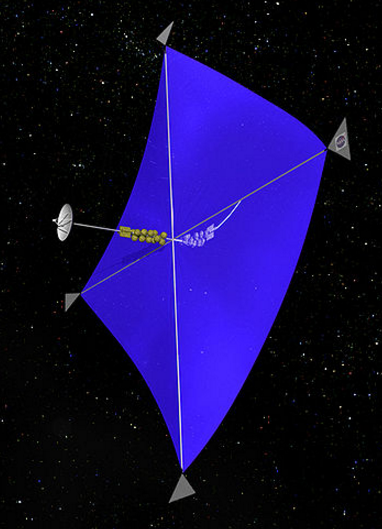
A thin film mirror can focus sunlight and heat hydrogen. The power/mass of the rocket is limited by the power/mass of the mirror. JPL designed a mirror with the goal of minimizing mass/area.
Solar flux        =  f         =  1365  Watts/meter2
Mirror mass/area  =  d         =  .006  kg/meter2
Mirror power/mass =  p  = f/d  =228000  Watts/kg
The mirror consists of mylar coated with aluminum.
Mylar density      =  1.39 g/cm3
Aluminum density   =  2.70 g/cm3
Mylar thickness    =  .025 mm
Aluminum thickness =  .010 mm
 |
|---|
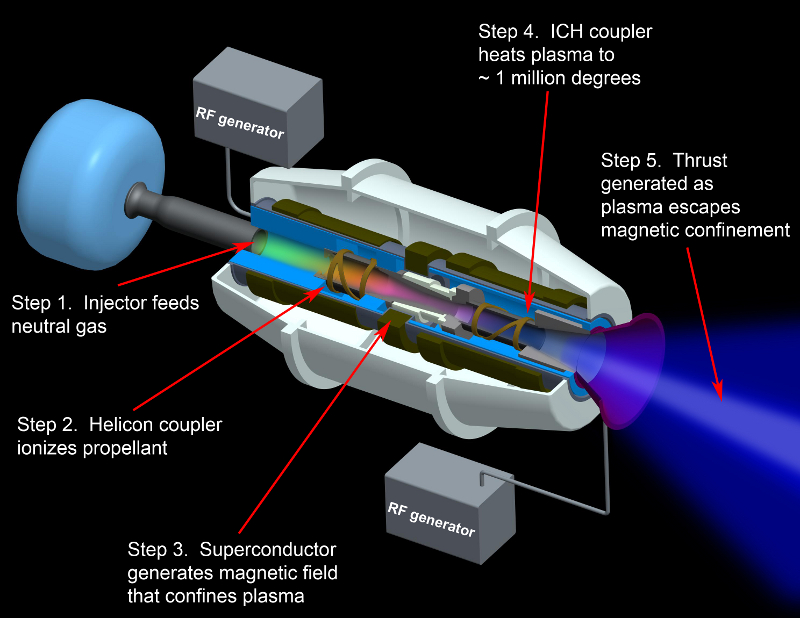
An ion drive uses electric power to accelerate ions. Electric power can come from nuclear fission, radioactivity, or solar cells. The ion speed is customizable. It should be at least as large as 20 km/s otherwise you might as well use a chemical or thermal rocket. The upper limit is given by the mission duration. We calculate the ion speed assuming a Plutonium-238 heat source and a burn time of 107 seconds.
Heat source Power/Mass =  P           =   567    Watts/kg     Plutonium-238
Electrical efficiency  =  D           =      .05              Convert heat to electricity
Drive efficiency       =  d           =      .6               Convert electricity to ion energy
Electric Power/Mass    =  p  = edP    =    28    Watts/kg
Burn time              =  T           =    10    Million seconds  =  3 months
Ion speed              =  V  = (2pT)½ =    24    km/s
Ion Energy/Mass        =  e  = pT     =   280    MJoules/kg
Power in space is usually limited by cooling. For an electric generator that is closed-cycle and doesn't expel mass, cooling is limited by blackbody radiation and the maximum power/mass is determined by temperature. An example of an open-cycle system is a thermal hydrogen rocket, where the expelled mass serves as coolant and the power/mass can be much higher than for a closed-cycle system.
 |
|---|
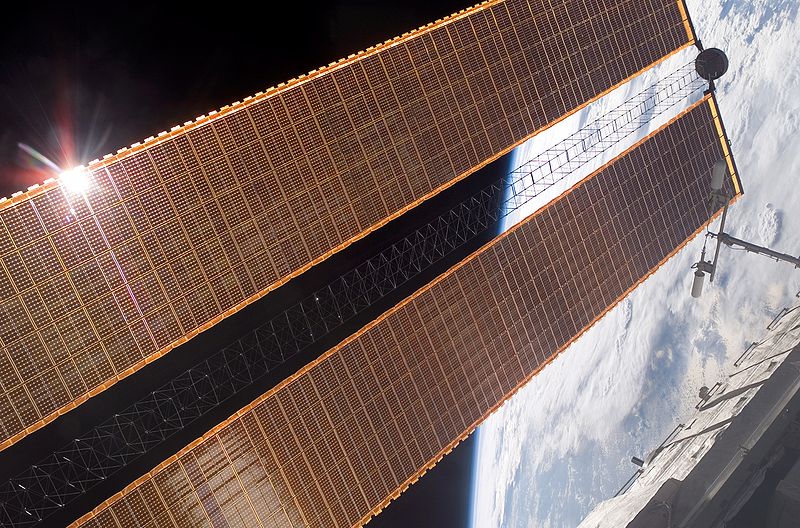
The power/mass of solar cells depends on distance from the sun. At the Earth, solar cells have similar power/mass as nuclear, and beyond the Earth, solar cells are worse than nuclear.
Location   Power/Mass   Distance from sun
            Watts/kg          AU

Earth         100           1
Mars           43           1.52
Ceres          13           2.77
Jupiter         3.7         5.2
 |
 |
 |
 |
|---|---|---|---|
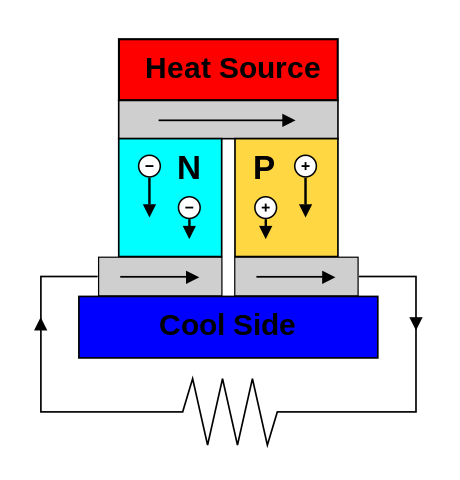
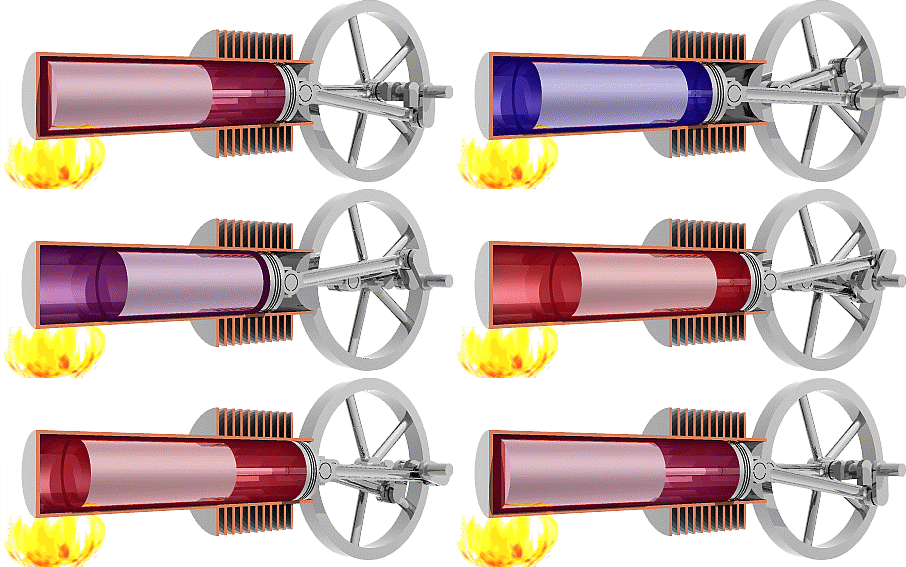
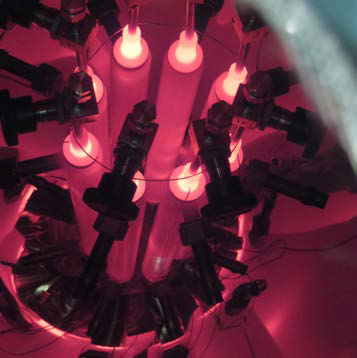
Heat can be converted to electricity with a Stirling engine, a thermoelectric generator, or photovoltaics. Usually the generator and cooling system have more mass than the heat source. Heat comes from fission or radioactivity.
Examples of existing space generators:
Heat source    Generator   Electricity  Heat source   Electric     Fuel      Total
                            Watts/kg     Watts/kg    efficiency  fraction  efficiency

Uranium-235    Brayton         195                    .25                          SAFE-400 reactor
Uranium-235    Stirling         44        991         .23        .193     .044     Kilopower reactor
Plutonium-238  Thermoelectric    5.3      567         .068       .137     .0093    GPHS-RTG. Galileo and Cassini
Plutonium-238  Thermoelectric    4.2      567         .062       .119     .0074    Voyager 1 and Voyager 2
Plutonium-238  Thermoelectric    2.8      567                             .049     MMRTG. Curiosity rover
Features of the Kilopower reactor:
*) Fuel cast as Uranium-Molybdenum alloy. Molybdenum has a melting point of 2896 Kelvin.
*) Beryllium oxide moderator, which has a melting point of 2780 Kelvin.
*) Boron carbide control rods, with a melting point of 3036 Kelvin.
*) Passive cooling with liquid sodium coolant, which melts at 371 Kelvin and boils at 1156 Kelvin.
*) Cannot melt down because the reaction rate decreases with increasing temperature.
*) Stirling engine to convert heat to electricity.
|
 |
|---|---|
 |
 |
|---|---|
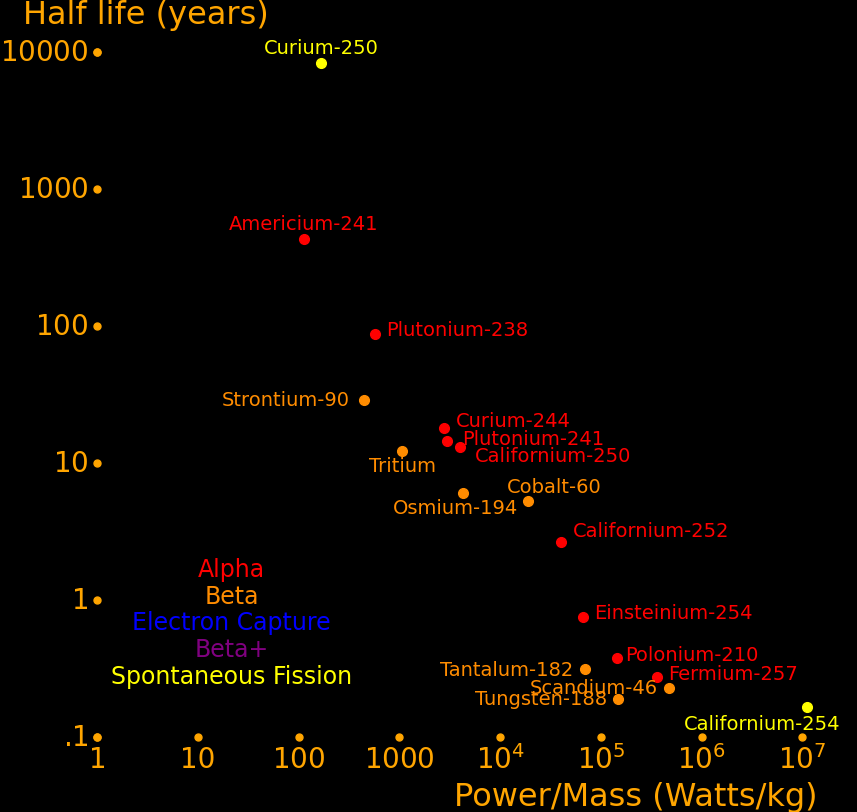
The most important radioactive isotopes for power are:
Plutonium-241     Good balance of power/mass and half life.  Easy to produce.
Curium-244        Good balance of power/mass and half life.
Strontium-90      Abundant because it's present in burnt fission fuel.
Polonium-210      Alpha rocket
Lead-210          Alpha rocket
Thorium-228       Alpha rocket
Caesium-137       Abundant because it's present in burnt fission fuel.
Plutonium-238     Outperforms Strontium-90. Has to be bred in a reactor.
Cobalt-60         Larger power/mass than plutonium-238. Easily produced with neutron transmutation.
Scandium-46       Ludicrously high power/mass, and easily produced by neutron transmutation.
Californium-252   Superlatively large power/mass. Capable of powering an Iron Man suit.
Curium-252        Decays by spontaneous fission 3% of the time
Curium-254        Decays primarily by spontaneous fission
                  Half life    Heat      Decay      Decay    Obtainable by
                    year      Watt/kg                MeV     neutron transmutation

 Californium-254       .166 11200000    Fission      207      *
 Scandium-46           .229   485000    β              2.366  *
 Polonium-210          .379   144000    α              5.41   *
 Ruthenium-106        1.023    71200    2β             3.584  *
 Californium-252      2.64     41400    α or Fission  12.33   *   α 96.9% (6.12 Mev). Fission 3.09% (207 MeV)
 Cobalt-60            5.27     19300    β              2.82   *
 Osmium-194           6.02      4313    2β             2.330  *
 Lead-210            22.3       2907    α              9.100  *
 Plutonium-238       87.7        578    α              5.59   *
 Americium-242m     141          725    2α            12.33   *
 Curium-250        8300          170    Fission      148      *   Fission 74%, Alpha 18%, Beta 8%

 Beryllium-7           .146  1822000    EC              .547
 Sodium-22            2.6      68700    β+ or EC       2.842

 Uranium-230           .0554 9280000    6α+2&beta
 Thorium-228          1.912   235000    5α+2&beta         34.784
 Radium-228           5.75     90660    5α+4&beta         40.198
 Polonium-208         2.898             α
 Actinium-227        21.8      21600    5α+3&beta         36.18
 Uranium-232         68.9       7545    6α+2&beta         40.79
 Radium-226        1599          286    5α+4&betz         34.958
 Thorium-229       7917           57.7  5α+3&beta         35.366
 Protactinium-231 32600           16.2  6α+3&beta         41.3
For a heat engine, the higher the temperature, the more efficient. High temperature also means higher radiative cooling power. Isotopes with a high boiling point are:
              Half life     Heat      Decay  Decay energy   Melt    Boil    Obtainable by
                year       Watt/kg               MeV       Kelvin  Kelvin   neutron transmutation

Uranium-230           .0554 9280000    6α                    1405    4404
Tungsten-188          .191   148700    2Beta                 3695    6203    *
Tantalum-182          .313    68866    Beta                  3290    5731    *
Tungsten-181          .332    59200    EC        1.732       3695    6203    *
Iridium-194m          .468    50400    Gamma     2.229       2719    4403    *
Rhodium-102           .557    67000    Beta+                 2237    3968
Ruthenium-106        1.023    71200    2Beta     3.584       2607    4423    *
Hafnium-172          1.87     11700    EC        1.835       2506    4876
Thorium-228          1.912   235000    5α       34.784       2023    5061
Rhodium-101          4.07      9890    EC        1.980       2237    3968
Osmium-194           6.02      4313    2Beta     2.33        3306    5285    *
Actinium-227        21.8      12000    5α       36.18        1500    3500
Uranium-232         68.9       7545    6α       40.79        1405    4404
Thorium-229       7917           57.7  5α+3&beta         35.366     2023   5061
Protactinium-231 32600           16.2  6α+3&beta         41.33      1841   4300
 |
|---|
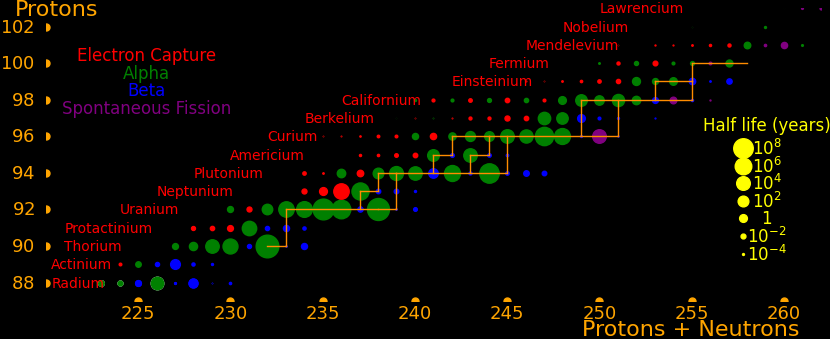
Neutron capture transmutes an isotope one space to the right and beta decay transmutes an isotope one space up.
The most massive nuclei that exist naturally are thorium-232, uranium-235, or uranium-238. All are unstable but have half lives larger than 700 million years. The road starts with these isotopes and then adding neutrons transmutes them according to the orange lines. The road forks at beta isotopes, which can either beta decay or capture a neutron.
The end of the road is fermium. Neutrons can't further increase the proton number because no fermium isotopes on the road beta decay. The road goes as far as fermium-258, which has a half life of .00037 seconds and spontaneously fissions. Producing heavier isotopes requires an accelerator or an extreme neutron flux (such as occurs in a fission bomb).
.svg.png) |
 |
|---|---|
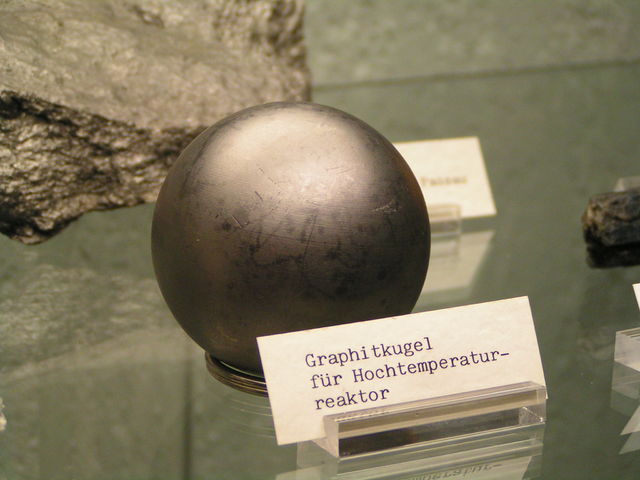
A TRIGA reactor doesn't melt down if the cooling system fails because it's engineered to turn off if it overheats. It's also designed so that adding and removing fuel elements is easy. The reactor is easy to build and can be operated in space.
 |
|---|
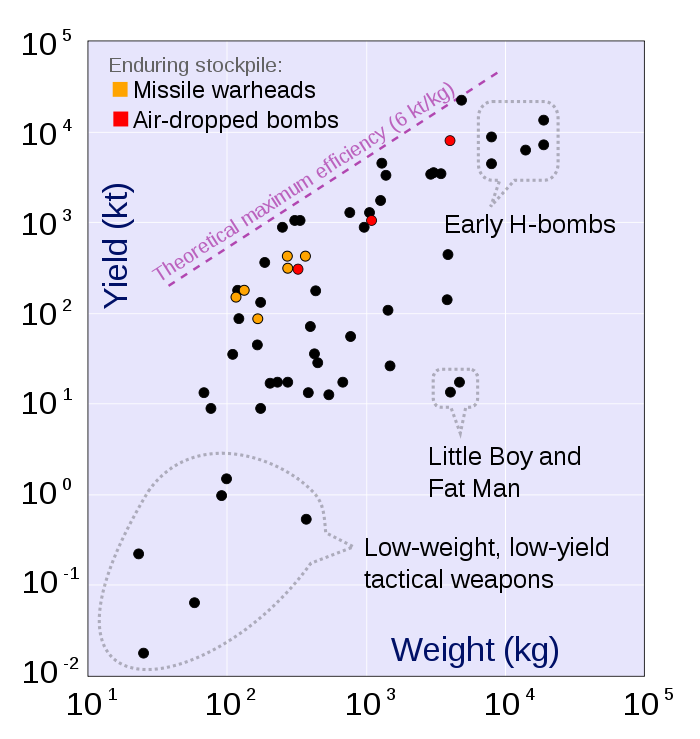
Fusion bomb maximum practical yield =     =  e           = 21700  GJoules/kg
Mass fraction converted to energy   =  f  =  e/C2  =.00072
Exhaust speed                       =  V  =  (2e)½ =  6588  km/s
Mass is usually added to the bomb to increase momentum and decrease exhaust speed. Or, the bomb is detonated underground in an asteroid, which adds mass.
|
 |
|---|---|
Alpha particles can be used as exhaust. An alpha emitter is coated on a mylar sail, with the coating thin enough so that most of the alphas escape into space. This rocket is simple and can be made arbitrarily small.
The recoil momentum of the nucleus is absorbed by the sail and the recoil speed of the nucleus is the effective exhaust speed. For example, polonium-208 alpha decays to lead-204 and the recoil speed of lead-204 is:
Alpha mass             =  m           =    4 AMU  =  6.64⋅10-27 kg
lead-204 mass          =  M           =  204 AMU
Alpha energy           =  e  = ½ m v2 = 5.22 MeV       The alpha gets almost all the kinetic energy
Alpha speed            =  v  = (2e/m)½=15871 km/s
lead-204 recoil speed  =  V  = vm/M   =  311 km/s
The speed calculated is for the most fortunate case where the alpha goes directly aft of the spacecraft. Calculating the average recoil speed involves integrating over all emission directions and accounting for absorption by the emitting material. In the ideal case, all particles emitted in the aft hemisphere escape and all particles emitted in the forward hemisphere are absorbed, in which case the effective recoil speed is 1/4 the fortunate speed. For polonium-208 the effective recoil speed is 78 km/s.
To calculate the power/mass of an alpha rocket,
Speed of projectile                =  v
Speed of emitter (recoil)          =  V
Mass of projectile                 =  m =   4 AMU
Mass of emitter                    =  M = 204 AMU
Energy of projectile               =  e = ½mv2
Energy of emitter                  =  E = ½MV2
Momentum of projectile             =  q
Perfect exhaust speed              =  S = q/M
Effective exhaust speed            =  s = S/4
Effective exhaust energy           =  g = ½Ms2
Exhaust energy / Decay energy      =  r = g/e = 16-1 m/M
For a polonium-208 alpha rocket, the power/mass and energy/mass are:
Effective recoil speed  =  V         =  78 km/s
Energy/Mass             =  e  = ½V2  =3042 MJoules/kg
Half life               =  T         =2.90 years
Power/Mass              =  p  = e/t  =  33 Watts/kg
The lighter the isotope the larger the recoil speed. Almost all alpha emitters are actinides, the only exceptions being gadolinium-148, polonium-208, polonium-209, and polonium-210. Alpha rockets using actinides have an average recoil speed of ~75 km/s.
The best alpha-emitting isotopes are:
               Half life  Power/Mass  Decay   Energy   Neutron transmutable
                  year     Watts/kg            MeV

Polonium-210          .379   144000    α       5.41     *
Einsteinium-254       .755   105432    α       6.616    *
Californium-248       .91     59760    α       6.36
Californium-252      2.64     21640    α       6.12     *
Polonium-208         2.898             α
Californium-250    13.1        5779    α       6.02     *
Curium-244         18.1        4014    α       5.80     *
Curium-243         29.1        1885    α
Lead-210           22.3        2907    α       9.100    *
Gadolinium-148     70.9         952    α       3.18
Plutonium-238      87.7         578    α       5.59     *
Americium-242m    141           725    2α      12.33    *

Thorium-227           .0512 9194000    6α+2β   36.14
Uranium-230           .0554 9280000    6α+2β
Thorium-228          1.912   235000    5α+2β   34.784
Radium-228           5.75     90660    5α+4β   40.198
Actinium-227        21.8      21600    5α+3β   36.18
Uranium-232         68.9       7545    6α+2β   40.79
Radium-226        1599          286    5α+4β   34.958
Thorium-229       7917           57.7  5α+3β   35.366
Protactinium-231 32600           16.2  6α+3β   41.33
A charged particle passing through matter loses energy from collisions with electrons, with the energy loss rate given by the Bethe formula. For an alpha particle passing through water,
Particle energy            =  E              =      6  MeV
Particle mass              =  M              =      4  AMU
Particle charge            =  Z              =      2  Proton charges
Material density           =  D              =   1000  g/cm2
Stopping distance          =  X = EZ-2M-1D-1C =   .049  meters      (Inputs in MeV, AMU, and g/cm3. Output in meters)
Material stopping constant =  C              =.000131
Stopping power             =  S              = 778000  MeV meter2
Mass/Area                  =  m = DX         =   .049  kg/meter2
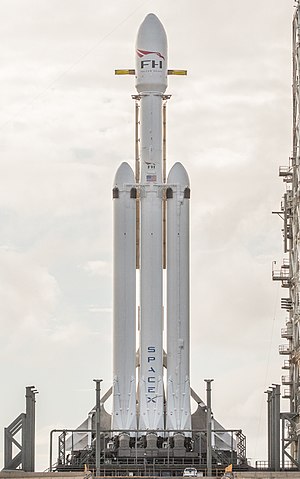
SpaceX has the world's lowest launch cost at $2300, and they lead the world for material launched to orbit.
SpaceX pioneered the methane engine, which has a higher exhaust speed (3.7 km/s) than traditional kerosene engines (3.1 km/s). The SpaceX methane engine also has a mighty thrust/weight of 200, the highest of any rocket. This means fewer engines are needed, saving on cost.
SpaceX pioneered recycling the engines in the first rocket. The engines are 35% of the rocket cost and hence worth saving.
SpaceX once teamed up with Stratolaunch to do air launch, but then SpaceX backed out. Stratolaunch has yet to produce a working launch platform.
 |
 |
 |
 |
|---|---|---|---|
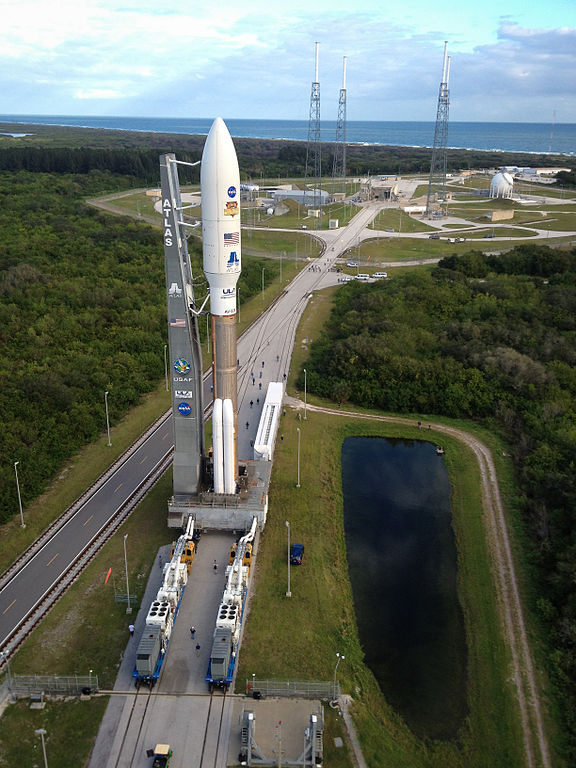
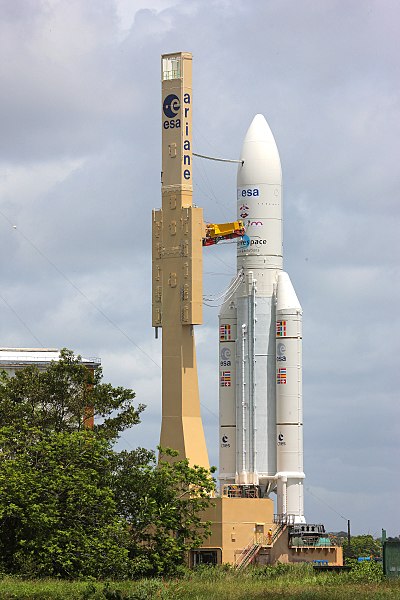
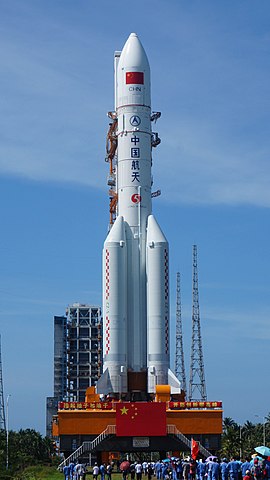
SpaceX has the world's lowest launch cost at $2300, and they lead the world for material launched to orbit. The table shows the total payload launched to orbit in 2020. SpaceX outlaunches NASA and China. SpaceX also has no fails from 2020.
                    Payload  Successes  Fails
                     tons

America  SpaceX       286       26        0    Elon Musk
China    CNSA         242       31        2
America  NASA         103       10        0
Russia   Roscosmos     80       16        0
Europe   ESA           27        4        1
Japan    JAXA           8        4        0
America  Orbital        7        2        0
India    ISRO           2        2        0
Canada   CSA            1        3        0
America  Rocket Lab      .7      6        1    Peter Beck
America  Blue Origin    0        0        0    Jeff Bezos
America  Stratolaunch   0        0        0    Paul Allen and Burt Rutan
S Korea  KARI           0        0        0
America  Virgin Orbit   0        0        0    Richard Branson
SpaceX pioneered the methane engine, which has higher exhaust speed than kerosene.
For the SpaceX Falcon 9 rocket, the engines are 35% of the cost and hence worth saving. SpaceX pioneered recyling the first rocket stage. For a Falcon 9 rocket,
|
|---|
A fission afterburner uses fission fuel as exhaust, with fission triggered by neutrons from a reactor.
The reactor operates in pulse mode. The reactor produces a pulse of neutrons that trigger fission in the fuel, and then the fuel is expelled. The reactor then has to cool down before generating another pulse.
A TRIGA-style reactor can produce millisecond neutron pulses. The pulse is initiated by neutrons from spallation, where high-energy protons from an accelerator strike a tungsten target and eject neutrons from tungsten nuclei. Fuel can be confined magnetically for the duration of the pulse.
Fission fuel should have a large fission cross section for thermal neutrons, and the best isotopes are:
              Half life   Fission   Energy   Quality  Exhaust   Neutron capture
                year       barn      MeV              meter/s   output

Americium-242m       141       7024   195       5640    93      Daughter nuclei + Neutrons
Californium-251      900       4801   207       3940    78      Daughter nuclei + Neutrons
Curium-245          8500       2161   198       1740    52      Daughter nuclei + Neutrons
Plutonium-239      14100        748   189        590    30      Daughter nuclei + Neutrons
Uranium-235    704000000        538   181        410    25      Daughter nuclei + Neutrons

Beryllium-7             .146  56800     1.644  11670   134      Lithium-7 + Proton
Helium-3          Stable       5333      .764   1020    40      Tritium + Proton
Boron-10          Stable       3835     2.34     820    35      Lithium-7 + Alpha
Lithium-6         Stable        940     4.783    640    31      Alpha + Tritium
Fuel quality is given by:
Neutron capture cross section  =  A                  meter2       At 300 Kelvin
Fission energy                 =  E                  Joule
Mass                           =  M                  kg          Mass of target + mass of neutron
Fuel quality                   =  Q  = AE/M
Neutrons are chilled to liquid helium temperature before encountering the fuel, to increase the neutron capture cross section. Cross sections in the table are for 300 Kelvin.
The exhaust speed is:
Room temperature                           =  T            = 300    Kelvin
Helium boiling point                       =  t            =   4.2  Kelvin
Neutron chill factor                       =  C  = (T/t)½  =   8    Dimensionless
Neutron capture cross section at 300 Kelvin=  A                     meter2
Neutron capture cross section at 4 Kelvin  =  CA                    meter2
Neutron number density                     =  n            = 1019   neutrons/meter2
Target number density                      =  N  =  1/A             Nuclei/meter2      Number density of fuel nuclei
Fraction of targets that capture neutrons  =  F  =  n/N
Exhaust energy/mass                        =  e  = CFE/M = CnAE/M
Exhaust speed                              =  V  = (2e)½
The fuel number density should be large enough to capture most of the neutrons, and not larger, and this corresponds to "tA=1". At this density, most neutrons are captured. Only a small fraction of targets get neutrons. There are never enough neutrons to fission all the fuel, hence the goal is to maximize neutron density.
The fission reactor produces a neutron pulse with a density of order 1019 neutrons/meter2 and timescale of order 1 millisecond. During the pulse, the uranium in the reactor heats up by of order 3500 Kelvin. We assume 1 ton of uranium. The reactor pulse is initiated by a pulse of neutrons from spallation.
Uranium melting point               =     1405  Kelvin
Uranium boiling point               =     4404  Kelvin
Uranium melt energy                 =    38900  Joule/kg
Uranium heat capacity               =      118  Joule/kg

Uranium temperature change          =     3500  Kelvin
Uranium heat energy change per mass =     .413  MJoule/kg
Uranium heat per neutron            =      200  MeV/neutron
Neutrons per kg of uranium          =   2.6e16  Neutrons/kg

Uranium mass                        =     1000  kg
Neutrons in the pulse               =   2.6e19  Neutrons

Uranium density               =  D  =    17300  kg/meter3    (liquid)
Uranium radius                      =      .24  meter          Inner sphere
Reactor radius                      =      .4   meter          Includes an outer shell of moderator
Neutron density                     =   1.3e19  Neutrons/meter3
The rocket consists of concentric spherical shells, with shell 1 the innermost.
Shell 1: Contains the nuclear reactor that generates neutrons.
Shell 2: Beryllium oxide moderator to slow neutrons to room temperature.
Shell 3: Liquid helium moderator to further slow the neutrons
Shell 4: Pressure vessel containing the fission fuel and exhaust gas
Shell 5: Liquid helium moderator to return neutrons back to shell 3.
The more compact the reactor and moderator, the better. The moderator with the largest hydrogen density is TaD5.
The stopping length of a neutron in Americium-242m is:
Cross section           =  A           =      6686  barns
Atomic mass unit        =  u           = 1.660e-27  kg
Nucleons                =  q           =       242
Nucleus mass            =  M           =  4.02e-25  kg
Atom density            =  N  =  D/u   =   2.99e28  atoms/meter3
Density                 =  D  = N u q  =     12000  kg/meter3
Neutron stopping length =  X  = 1/(AN) =   5.00e-5  meters
Americium-242m mass/Area=  m  = D X    =        .6  kg/meter2
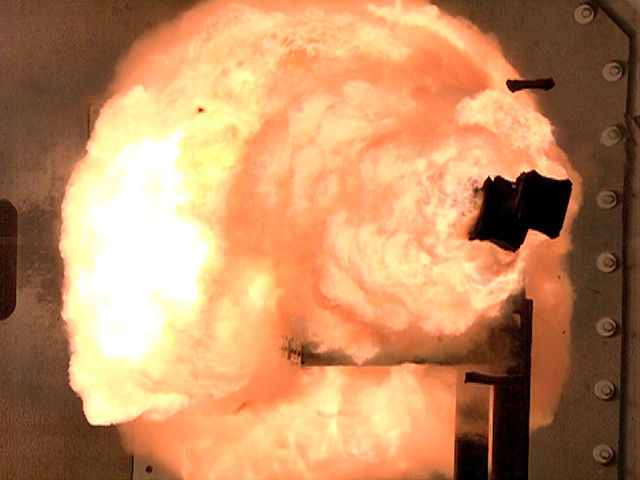
A steel gun can achieve a chamber pressure of 4⋅108 Pascals and a
tungsten gun can achieve a chamber pressure of 109 Pascals.
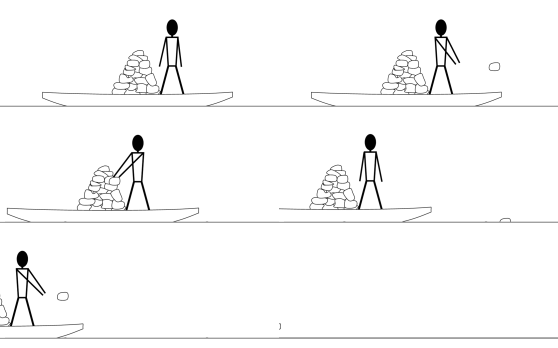
A solar sail gains momentum from reflecting sunlight. For a solar sail at Earth orbit:
 Solar brightness               = B        =   1365  Watt/meter
 Speed of light                 = C        = 2.99e8  meter/second
 Energy delivered in 1 second   = E        =   1365  Joule
 Momentum delivered in 1 second = Q =2E/C  = 9.1e-6  kg meter/second
 Mirror mass/area               = D        =   .006  kg/meter2
 Acceleration                   = A = Q/M  = .00152  meter/second2
 Speed after 1 year                        =  49600  meter/second
 Power/mass                     = P = B/D  = 228000  Watt/kg
 |
 |
|---|---|
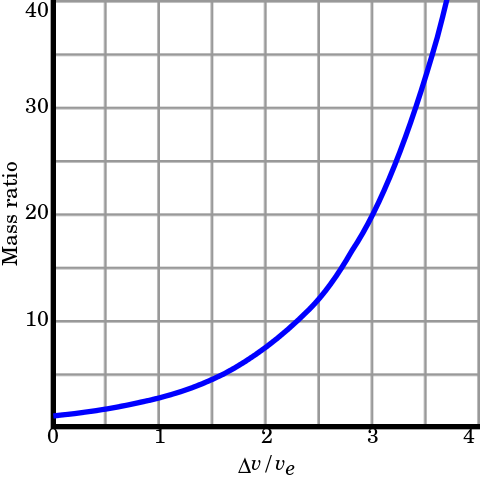
As a rocket burns through fuel it gets lighter. The "Tsoilkovsky rocket equation" relates the final rocket speed to the exhaust speed.
T   =  Time
M(T)=  Mass of rocket as a function of time
Mi  =  Initial mass of rocket
Mf  =  Final mass of rocket after burning its fuel
Ve  =  Rocket exhaust speed
V(T)=  Rocket speed as a function of time.  V(0)=0.
Vf  =  Final rocket speed after burning its fuel
F   =  Force generated by the rocket
    =  - Ve dM/dT

dV/dT =  F/M  =  -(Ve/M) * dM/dT
V(T)  =  V ln(Mi/M)
Vf    =  V ln(Mi/Mf)        Tsoilkovsky rocket equation
 |
 |
 |
 |
 |
|---|---|---|---|---|
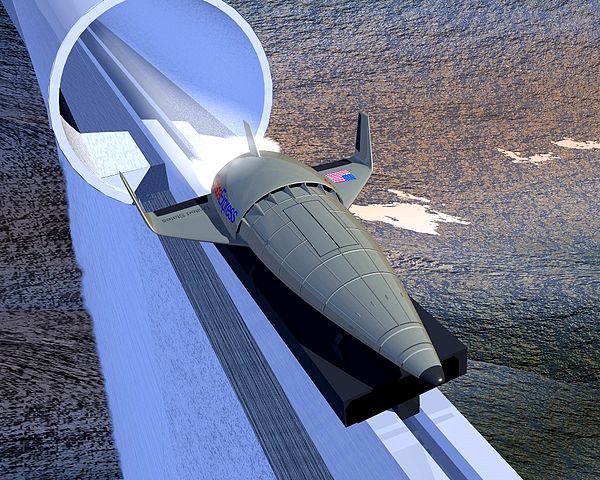
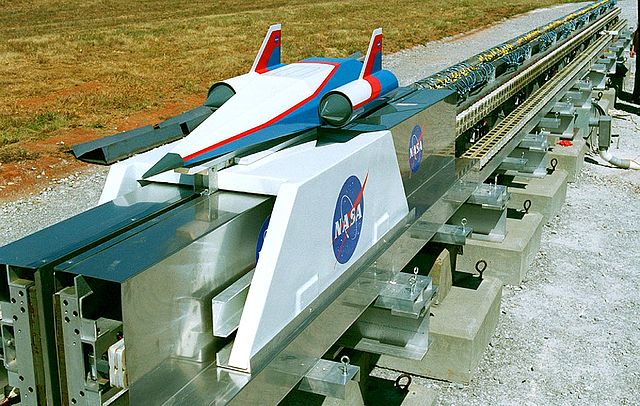
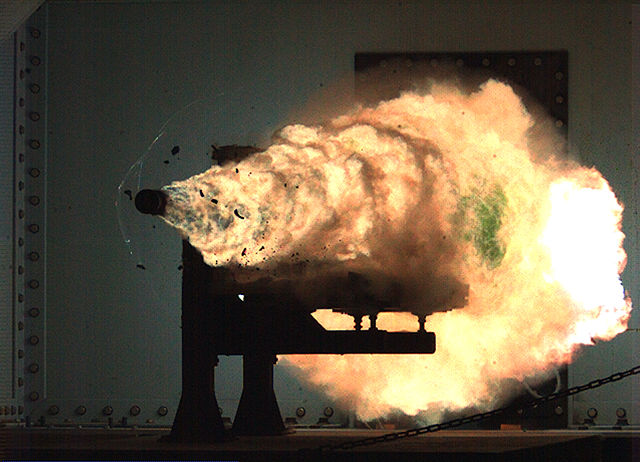
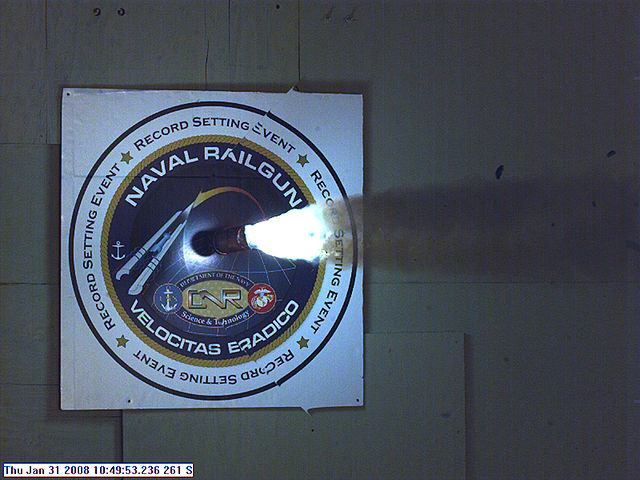
An electomagnetic launch sled rides on rails like a roller coaster and can reach a speed of 3 km/s. The sled releases a rocket which accelerates to orbit. The cost of the electricity is negligible compared to the cost of the rocket and hence sled launch reduces launch cost compared to ground launch.
If energy were the only contributor to launch cost then launch cost would be tiny. It costs typically 2000 $/kg to launch material into space with rockets. If the kinetic energy comes from electricity then the electricity cost is $1.
Orbit speed           =  V  =  7.8  km/s
Cost of electricity   =  q  =   36  MJoules/$
Orbit energy/mass     =  e  =   30  MJoules/kg  =  ½ V2
Electricity cost/mass =  c  =  .85  $/kg  =  e/q
Typical launch cost         = 2000  $/kg       Typical cost to use rockets to launch material to orbit
Launch sleds are best suited for inanimate cargo that can handle large acceleration. If an acceleration low enough for humans is used then the track is excessively long. If we use a human-friendly acceleration of 5 g's,
Sled acceleration    =  A  =  50 m/s2   (5 g's.  Maximum acceleration for humans)
Sled final velocity  =  V  =  3.0 km/s
Length of the track  =  X  =  90 km
Time spent on track  =  T  =  60 seconds

V2 = 2 A X                X = ½ A T2
If a sled is moving at 3 km/s then a centripetal acceleration of 5 g corresponds to a radius of curvature of 180 km. The last half of the track has to be straight.
If we launch inanimate equipment at an acceleration of 500 m/s2 then the track length is 9 km.
 |
 |
|---|---|
 |
|---|
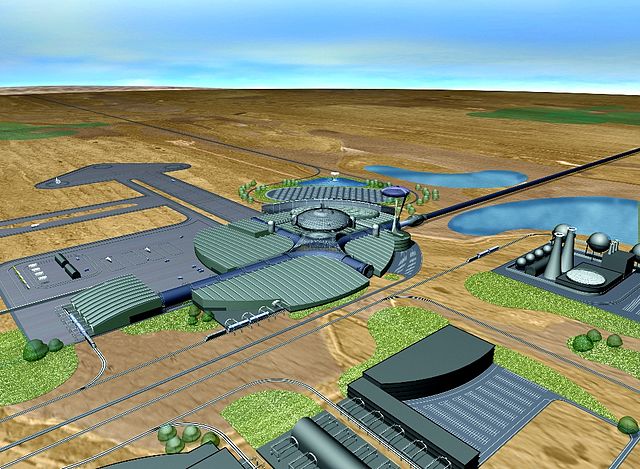
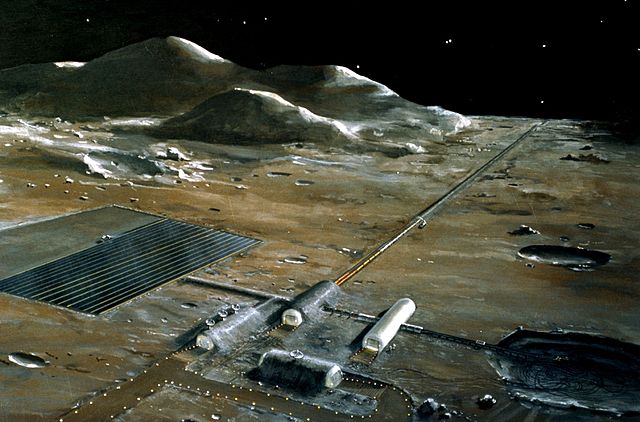
The moon is ideal for sled launch because:
*) The lunar orbit speed is 1.68 km/s, well below the practical maximum of 3 km/s for sleds. The sled can be launched directly to orbit without needing a rocket stage.
*) The moon has no atmosphere and so you can launch horizontally and none of the kinetic energy is wasted on vertical motion.
*) Horizontal launch allows the track to be arbitrarily long, enabling human-friendly low-g launch.
*) The moon has abundant iron from metallic asteroid impacts for constructing the track.
The moon has abundant ice in polar craters and it can be launched into space in bulk with sleds. If the sled power comes from solar cells then the mass launch rate is:
Launch speed             =  V          =  1.68  km/s
Launch energy/mass       =  e  = ½ V2  =  1.41  MJoules/kg
Solar cell average power =  p          =   200  Watts/meter2
Solar cell area          =  A                   meters2
Launch power             =  P  =  p A  =  e m   Watts
Mass launch rate         =  m  =  p A / e       kg/second
A spaceship needs 1000 tons of ice to shield cosmic rays. Launching this much ice in one month requires .5 MegaWatts and 2500 meters2 of solar cells.
Mars is ideal for a launch sled because the orbit speed is small, the air is thin, and there is a tall mountain. Launch at near horizontal angle is possible from the mountain.
Mars launch speed         =  3.6  km
Sled practical max speed  =  3    km/s
Mars airmass              =   .16 tons/meter2
Earth airmass             = 10.1  tons/meter2
Mars Mount Olympus height = 21.2  km
Earth Mount Everest height=  8.8  km
 |
 |
|---|---|
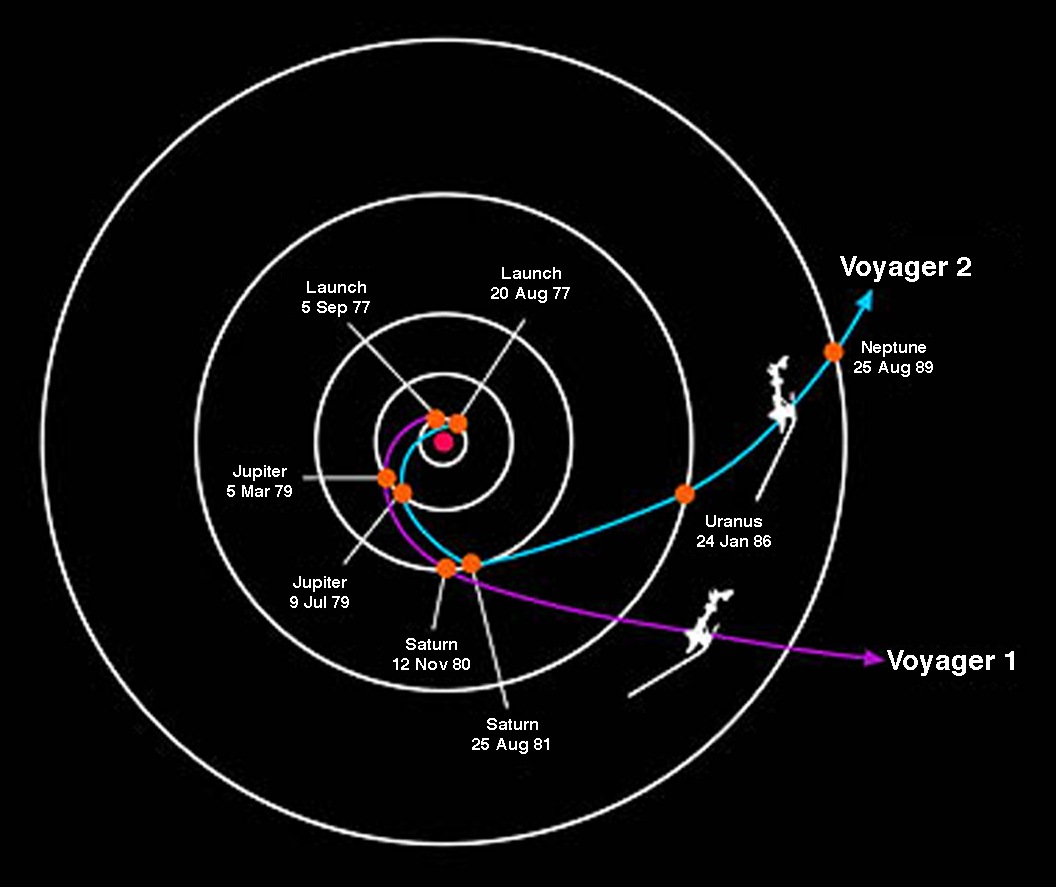
Jupiter provides the most powerful assist and is used for all missions to the outer solar system. Voyager 2 benefitted from an assist from all 4 gas giants.
 |
|---|
The Oberth maneuver uses a planet's gravity to magnify a rocket impulse. Planets act like powered pinball buffers.
Suppose a spacecraft is on a highly elliptical orbit, with a perigee slightly larger than the Earth's radius and an apogee vastly larger than the Earth's radius.
Gravity constant                =  G  =  6.67e-11 Newton meters2/kg2
Mass of Earth                   =  M  =  5.97e24 kg
Earth radius                    =  R  =  6371 km/s
Perigee radius                  =  R1                     Slightly larger than R
Apogee radius                   =  R2                     R1 << R2
Escape velocity                 =  Vesc=  11.2 km/s
Rocket speed at perigee         =  V1  =  Vesc
Rocket speed at apogee          =  0
Circular orbit speed at perigee =  Vcirc=   7.2 km/s  =  G M / R1
Circular orbit speed at apogee  =  0
Rocket speed change at perigee  =  Vroc =  16.6 km/s      Calculated below
Final exit speed from planet    =  Vexit=  25.4 km/s      Final speed after far from the planet
At apogee the energy is
E  =  Kinetic energy  +  Gravitational energy
   =         0        +         0
At perigee the energy is
E  =  Kinetic energy  +  Gravitational energy
   =     .5 m V12     -     G M m / R1

V12 =  2 G M / R1
     =  2 Vcirc2
     =  Vesc2
V1 is equal to the "Escape speed", the speed required to escape the planet.
The escape speed is independent of the direction of the velocity.
The escape velocity can also be obtained from the gravitational potential energy.
.5 m Vesc2 = G M m / R1 → Vesc2 = 2 G M / R1If the rocket fires at perigee and increases its speed by Vroc, the energy becomes
E  =  .5 m (V1 + Vroc)2  -  G M m / R1
   =  .5 m (Vesc + Vroc)2  -  .5 m Vesc2
   =  .5 m (Vroc2 + 2 Vroc Vesc)
The rocket is now on a hyperbolic orbit and will escape the Earth, As it recedes from the Earth it will approaches a constant velocity Vexit. When far from the Earth, the energy is
E  =  .5 m (Vroc2 + 2 Vroc Vesc)
   =  .5 m Vexit2

Vexit=  (Vroc2 + 2 Vroc Vesc)1/2  >  Vroc
If the spacecraft starts in an elliptical orbit and changes its speed by Vroc at perigee, it departs the Earth at speed Vexit, which is larger than Vroc. This is the "Oberth effect".
If a rocket changes its velocity by 5 km/s at perigee, it departs the Earth with a velocity of
Vexit=  (52 + 2 * 5 * 11.2)1/2
    =  11.7 km/s
This gets you to Mars in about 4 months.
 |
|---|
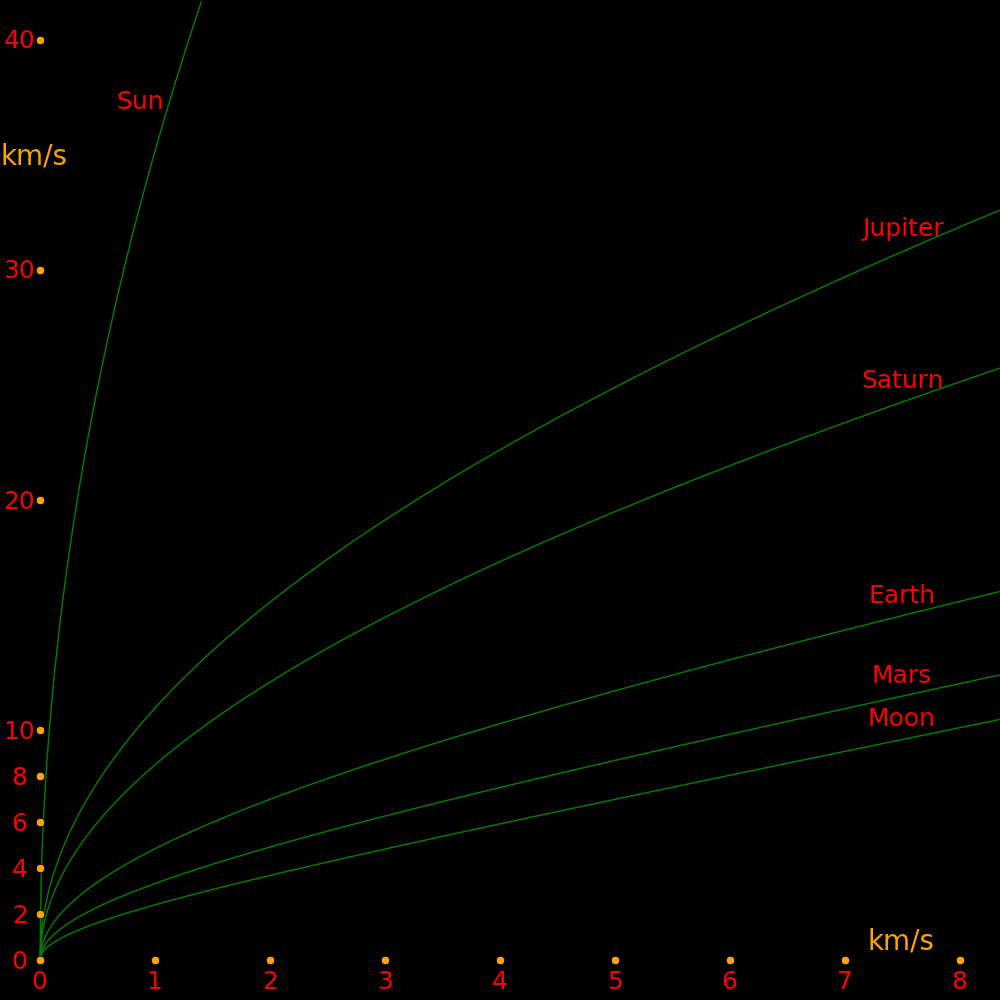
X axis:  Change in velocity at perigee (Vroc)
Y axis:  Departure velocity from the planet.  Vexit = (Vroc2 + 2 Vroc Vesc)
Each curve corresponds to a different planet.
         Escape speed  Orbit speed
             km/s         km/s

Moon         2.38           1.02
Earth       11.2           29.8
Mars         5.03          24.1
Jupiter     59.5           13.1
Saturn      35.5            9.64
Uranus      21.3            6.81
Neptune     23.5            5.43
Sun        618               -
The Oberth maneuver requires a rocket with a large thrust-to-mass ratio. The Oberth effect is most useful when the rocket fires at Perigee, meaning the rocket has only a limited time to burn through its fuel. This restricts the rocket types that can be used for an Oberth maneuver. Chemical rockets deliver the most power, which makes them the rocket of choice for Oberth maneuvers. Nuclear rockets have a heating challenge. Ion drives and mirror-based rockets are low-thrust and can't be used for the Oberth maneuver. The rocket engine with the largest force/mass is the Vulcain-2. For this rocket,
Planet radius           =  R  =  6371 km for the Earth
Escape velocity         =  Ves=  11.2 km/s for the Earth
Oberth time             =  T  =   9.5 minutes for the Earth  =  R / Ve
                              =       Time that the rocket is near perigee
Rocket exhaust speed    =  Vex=   4.2 km/s
Rocket force            =  F  =  1359 kiloNewtons
Rocket engine mass      =  m  =  1800 kg
Rocket force/mass       =  Z  =   755 Newtons/kg  =  F / m
Fuel mass burnt         =  M  =  T Z m / Vex  =  102 m       Fuel mass burnt during one Oberth time
Oberth velocity         =  Vob=  16.6 km/s  =  3.9 Vex  =  [ln(M/m) - ln(2)] Vex  =  ln(.5 T Z / Vex) Vex
                                                                                 =  [ln(T) - 2.4] Vex

Momentum conservation:    M Vex  =  F T
During one Oberth time, a Vulcain-2 rocket burns 102 times its mass in fuel. The Oberth
time for the Earth is long enough so that a chemical rocket can comfortably burn through all its
fuel.
To calculate the Oberth velocity, we use the Tsoilkovsky rocket equation and assume that the final mass of the spaceship is twice the mass of the rocket engine.
        Escape  Radius   Oberth    Oberth     Exit
        (km/s)          time (s)  velocity  velocity
                                   (km/s)    (km/s)
Mercury   4.3     .38     563       16.5     20.4
Venus    10.5     .95     576       16.6     25.0
Earth    11.2    1.00     569       16.6     25.4
Moon      2.38    .27     723       17.6     19.8
Mars      5.03    .53     671       17.3     21.7
Jupiter  59.5   10.9     1167       19.6     52.1
Saturn   35.5    9.0     1615       20.9     43.9
Uranus   21.3    3.97    1187       19.7     35.0
Neptune  23.5    3.86    1046       19.1     35.6
Pluto     1.23    .184    953       18.7     19.9
Sun     618    109.2     1126       19.4    156.2
"Exit velocity" is the maximum exit velocity from the planet using the Oberth maneuver.
It is also equal to the maximum "capture velocity" for using the Oberth maneuver to be captured
by a planet.
|
|---|
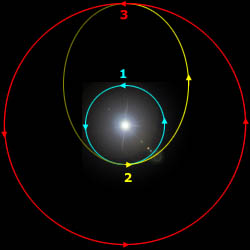
A Hohmann trajectory takes you from one circular orbit to another, such as from Earth's orbit to Mars' orbit.
The spacecraft starts on the cyan circular orbit.
At point "2", the spacecraft fires its rockets and increases its speed. From there, it coasts along the yellow trajectory to point "3".
When the spacecraft arrives at point "3", it fires its rockets to decrease its speed, placing it on the circular red trajectory.
In a trip from the Earth to Mars, the Earth is at point "2" and Mars is at point "3".
Departure velocity from the Earth     =  2.95 km/s
Arrival velocity with respect to Mars =  2.65 km/s
Travel time from Earth to Mars        =  8.5  months
Wait time on Mars for Hohmann window  = 14.9  months
Travel time from Mars to Earth        =  8.5  months
Total mission time                    = 31.9  months
The total change in velocity that the rocket has to generate is 5.60 km/s. This is within the reach of a hydrogen+oxygen rocket, which has an exhaust speed of 4.4 km/s. This is the minimalist trajectory. If more rocket power is available then the travel time decreases.
Calculation of the Earth-Mars Hohmann orbit
 |
 |
 |
|---|---|---|
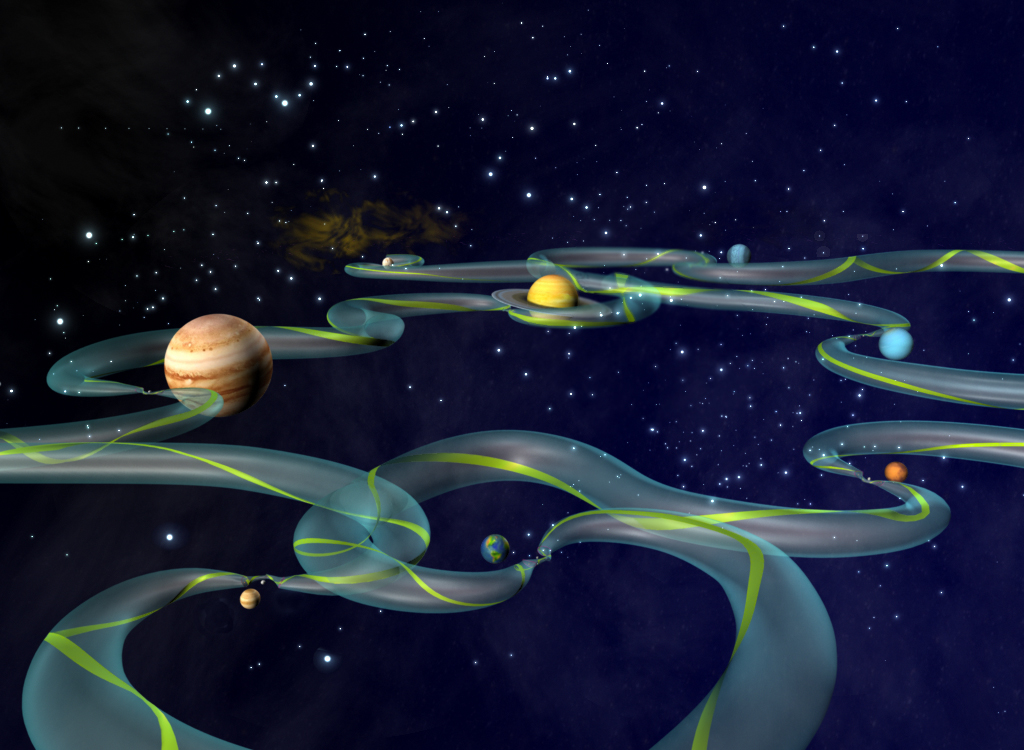
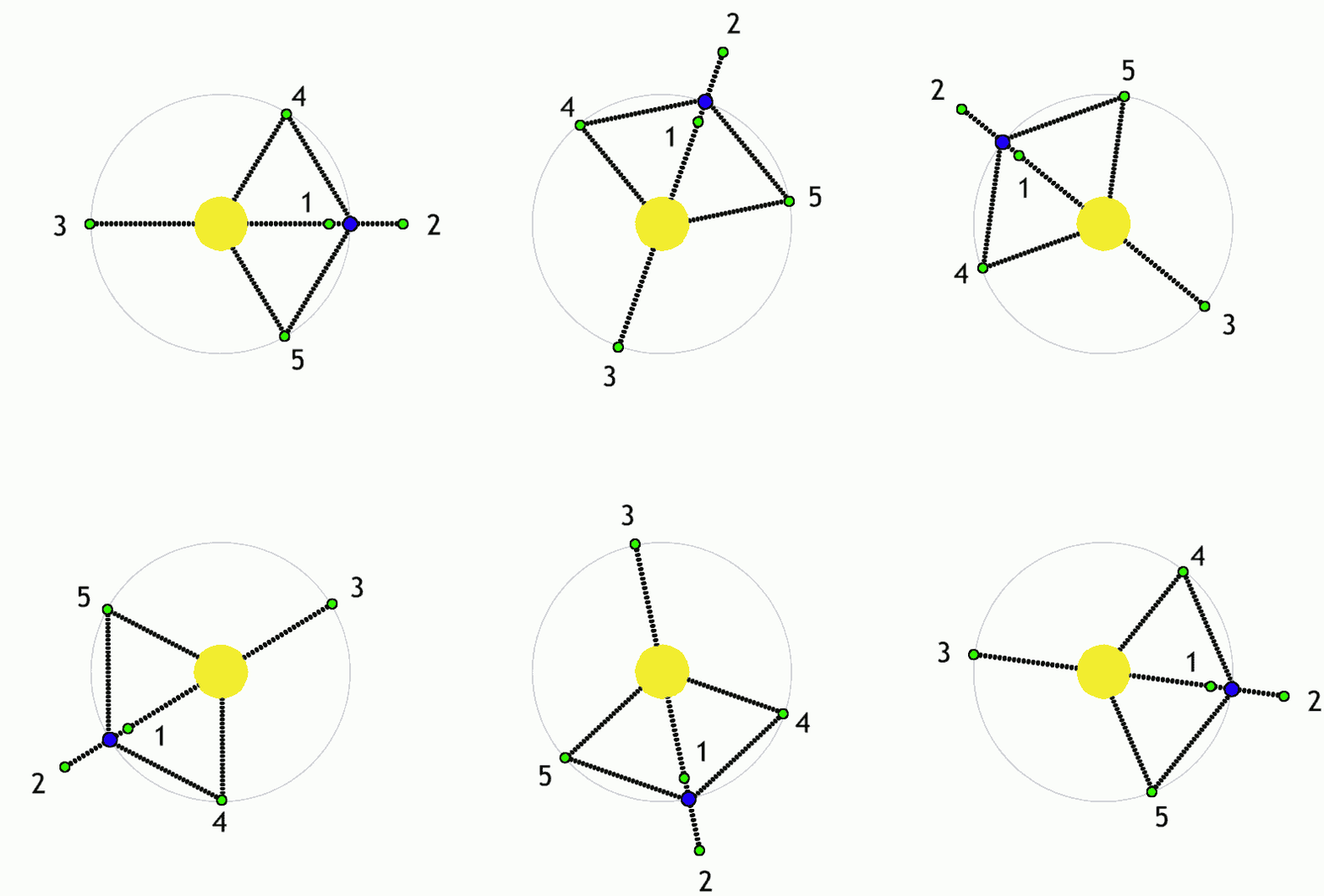
Using Lagrange points and gravity assists, objects can be moved around the solar system with minimal propulsion. With minimalist nudges you can set up billiards-style trick shots and move large objects wherever you like. This is the "interplanetary transport network".
|
 |
 |
 |
|---|---|---|---|
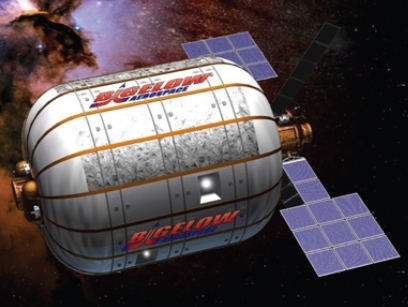
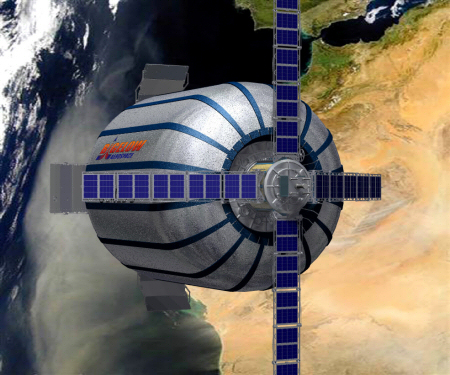
Astronauts can expect luxuriously large spaceships. The Bigelow BA-330 has as much room as the bridge of the Enterprise and the Bigelow Genesis has as much room as a Humvee. Bigelow habitats are lighter than NASA habitats and have thicker walls. Thicker walls are helpful for defending against micrometeorites and radiation.
                        Mass (tons)   Volume (m3)

Bigelow BA-330                23          330
Bigelow Genesis                3           11
International Space Station  450         1005
 |
 |
|---|---|
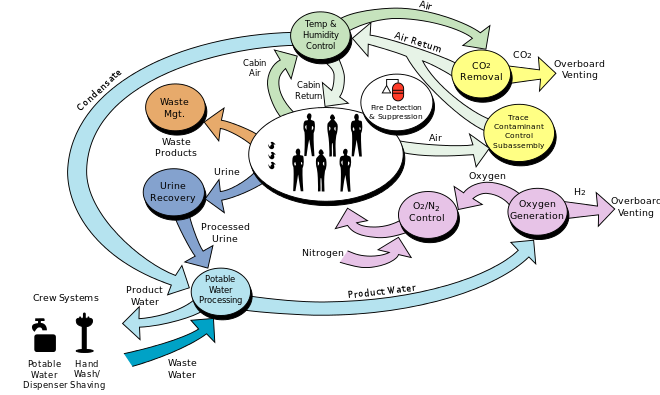
The space station life support system requires:
Power  =  1  kWatt/person
Water  =  1  kg/person/day
Food   =  1  kg/person/day
 |
|
 |
 |
|---|---|---|---|
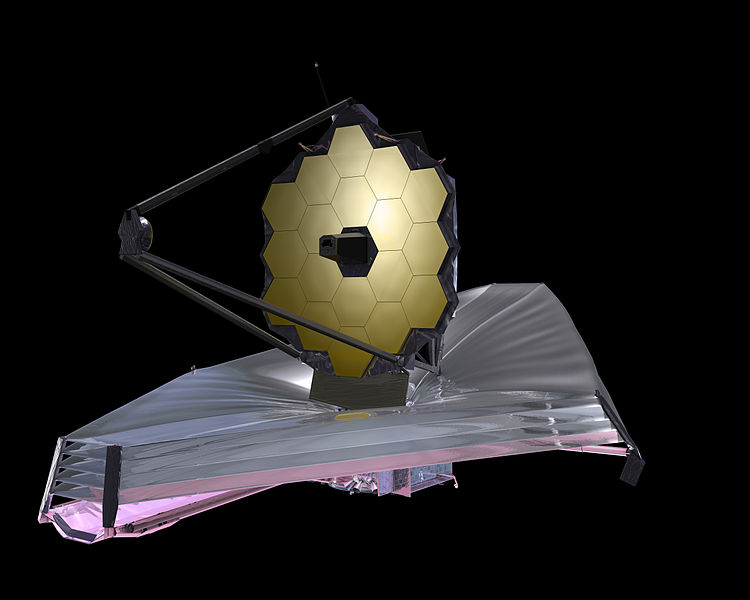
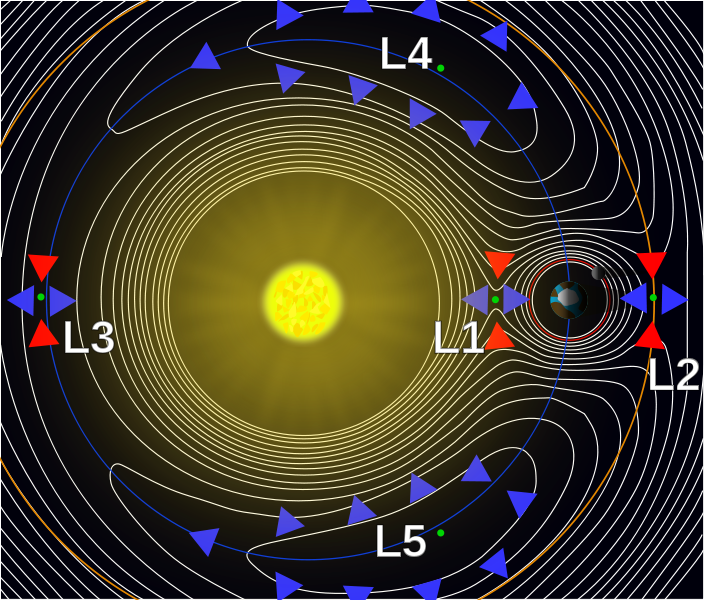
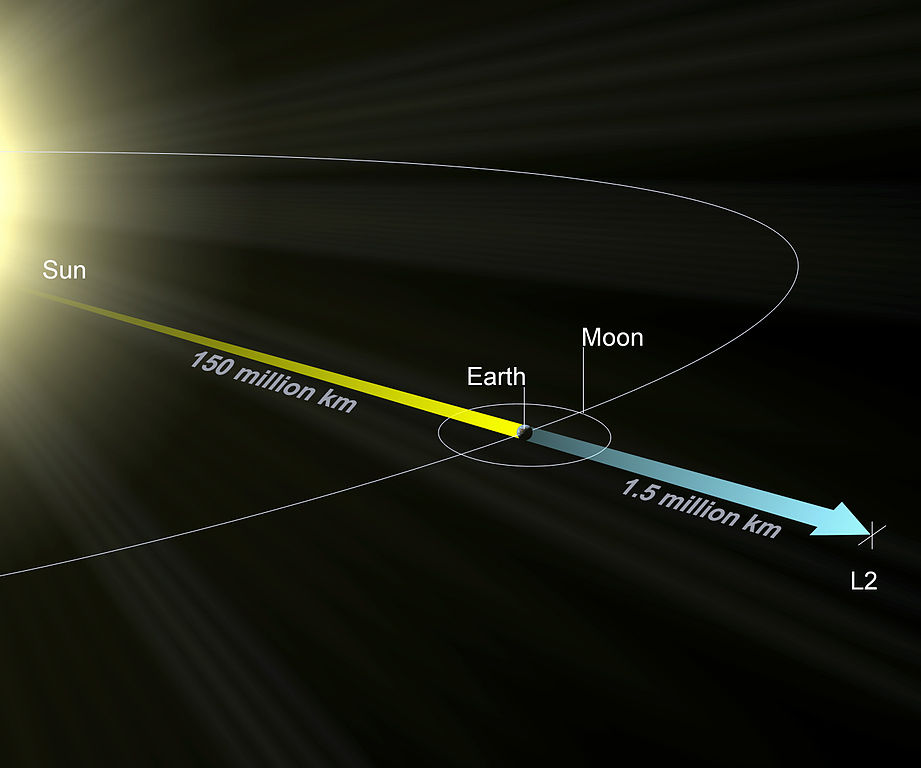
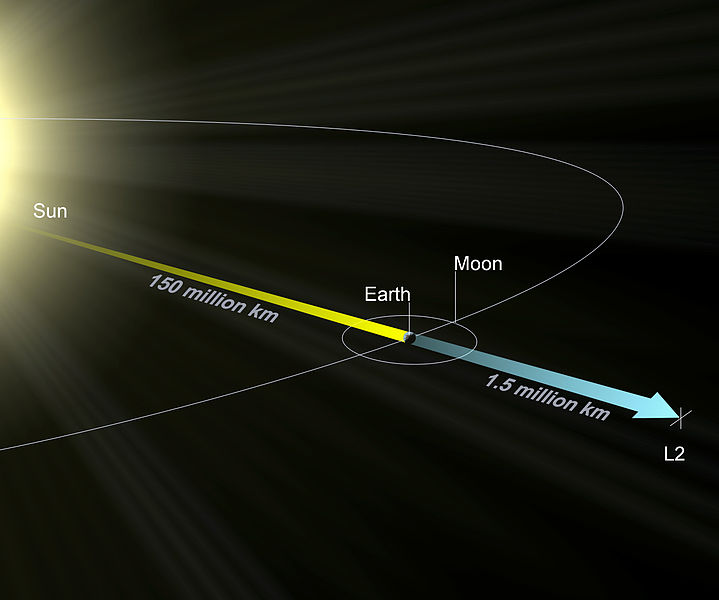
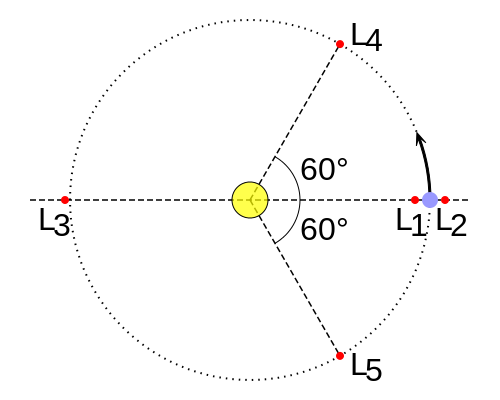
The Lagrange L2 point orbits the sun synchronously with the Earth. It's the best place for space telescopes because it's possible there to simultaneously block out light from the sun, moon, and Earth. The Webb telescope will be sent to L2 when completed.
Existing space telescopes suffer disadvantages because they're not manned. They have to function automously, they have to be prebuilt on the Earth, and they have to be sturdy enough to survive the launch into space.
If you have a manned space station these problems don't exist. Telescopes can be built on site from prefabricated modules. For example, small mirror segments can built on Earth, launched into space, and assembled to form a large mirror. Assembling mirror segments is easy in space because of the zero gravity. A manned space station also makes it possible to operate and repair the telescope on site.
The largest space telescopes are:
          Diameter    Wavelength   Location          Mass
           meters                                    tons

Spektr-R     10       Radio        Geocentric         2.5
Planck        1.9     Millimeter   L2                  .21
Webb          6.5     Infrared     L2                 6.5
Hubble        2.4     Visible      Low Earth orbit   11.1
Chandra       1.2     X-ray        Geocentric         4.8
Fermi         1.8     Gamma ray    L2                 4.3
The only limit to the size of a space telescope is the amount of mass that can be launched from the Earth. Launching 1000 tons into space costs 2 billion dollars. We can expect that the new generation of space telescopes will have masses on the order of 1000 tons and diameters on the order of 100 meters.
 |
|---|
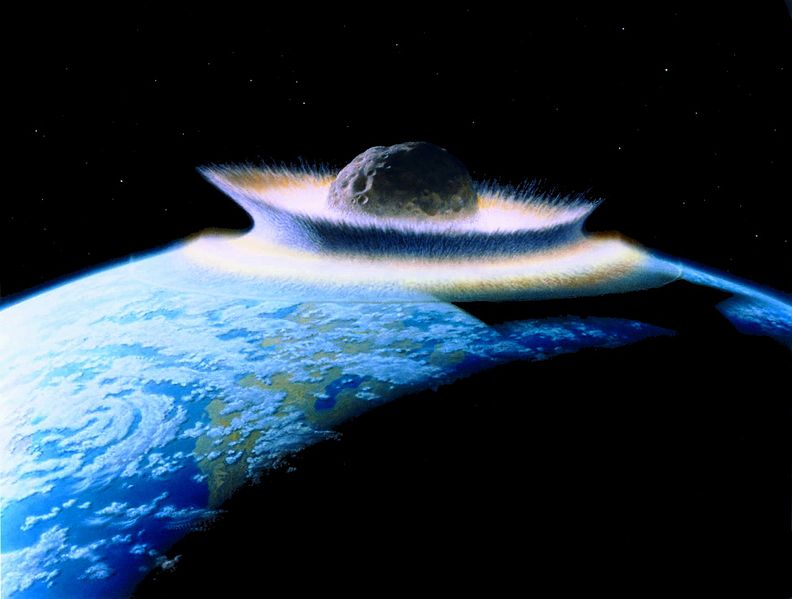
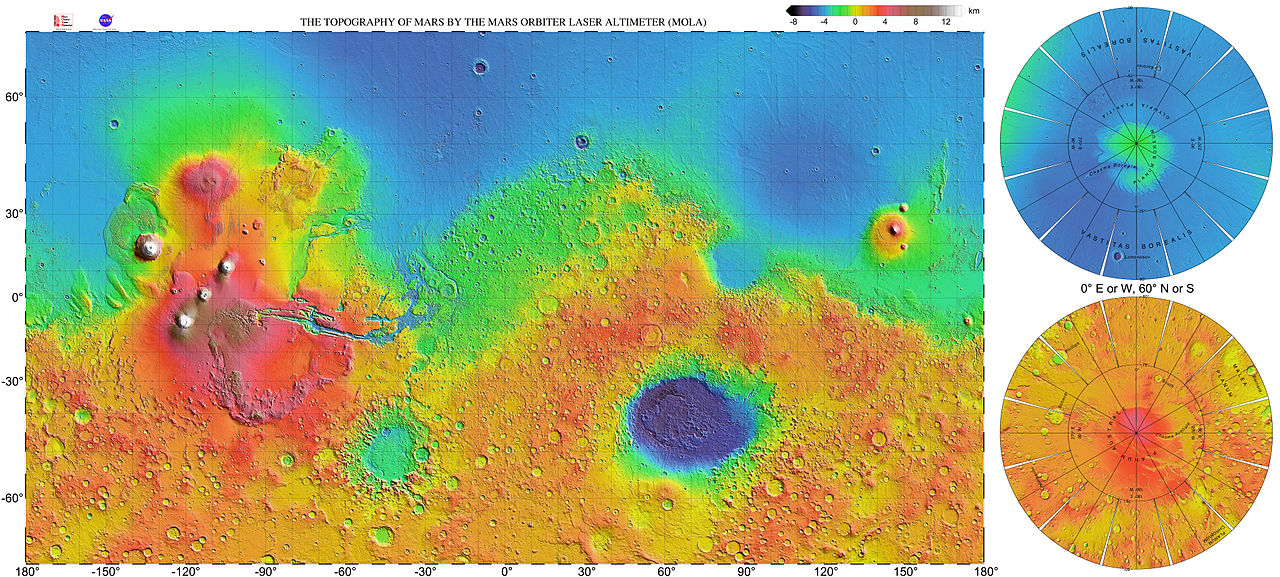
Mars needs water, nitrogen, and carbon dioxide. All three can be provided by crashing a comet into it. Comets have water and nitrogen, and the impact will liberate carbon dioxide from Mars' crust.
 |
 |
 |
|---|---|---|
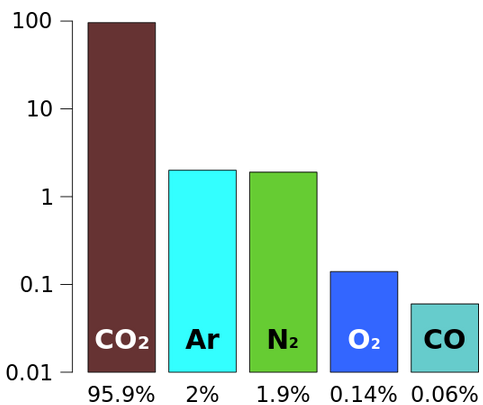
The objects in the solar system with meaningful atmospheres are:
      Density    Column   Pressure  Atmos.   Escape  Gravity  Atmos.  Temp  Adiabatic
     at surface  density             mass    speed            Height        lapse
      kg/m3      tons/m2     Bar    Earth=1   km/s     m/s2     km      K    K/km

Venus   67      1000.     92.1       93.2     10.36   8.87      16     735  10.5
Titan    5.3      73.      1.46       1.19     2.64   1.35     130      94   1.3
Earth    1.2      10.      1          1       11.2    9.78       8     287   9.8
Mars      .020      .16     .0063     .0045    5.03   3.71      11     210   4.5
Hellas    .037      .29     .0116              5.03   3.71             240
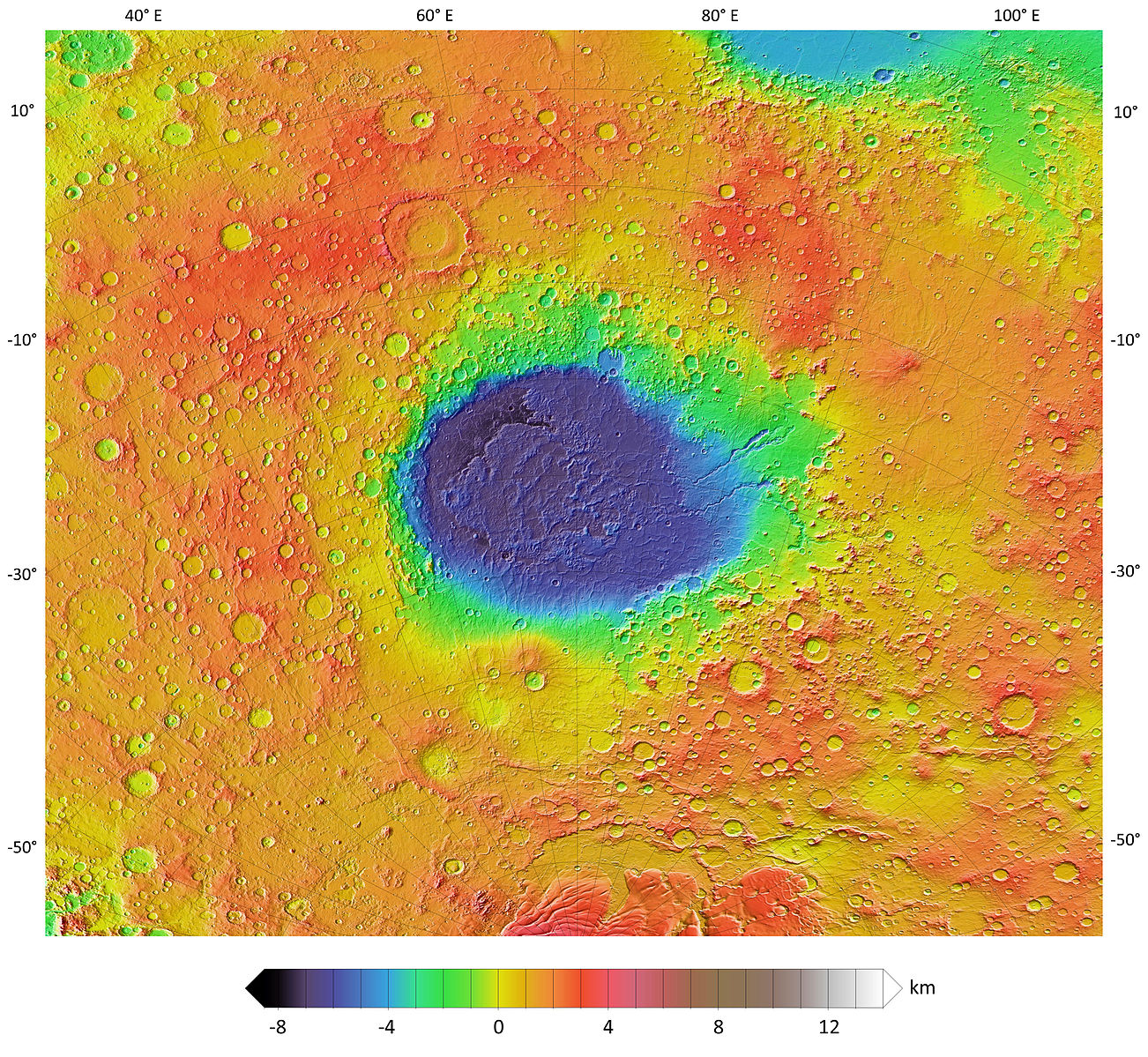
The Hellas basin on Mars is a crater 7.12 km deep. The above data for
"Hellas" is for the environment at the bottom of the crater, where the air
is warmer and more dense than at the surface.
"Lapse" is the adiabatic lapse rate, the characteristic decrease in temperature with altitude.
Earth atmosphere mass = 5.15⋅1018 kg
Mars  atmosphere mass = 2.32⋅1016 kg
Pressure requirements for plants and humans. Pressures in millibars.
          Plant      Human    Mars    Earth

Pressure   >10       >500     6.3     1000
N2         > 1                 .27     780
O2         > 1       >130      .008    210
CO2        >  .15    < 10     6.0         .39
The highest cities on the Earth are at at atmospheric pressure of ~ 600 millibars.
                   Pressure    T
                   (Bar)    (Kelvin)

Earth                1        288
Mars                 .006     210
Mars Hellas Basin    .010     225    7 km deep. Value for the environment at the bottom
Titan               1.46       94
Minimum for plants   .1       273
If Mars were warmed to room temperature, CO2 would evaporate from the
poles and double the atmospheric pressure.
Temperature  Water vapor
(C)          pressure (Bar)
 0        0.0061
10        0.0121
20        0.0230
30        0.0418
40        0.0727
50        0.122
At room temperature, the pressure from water vapor is almost enough for planet growth.
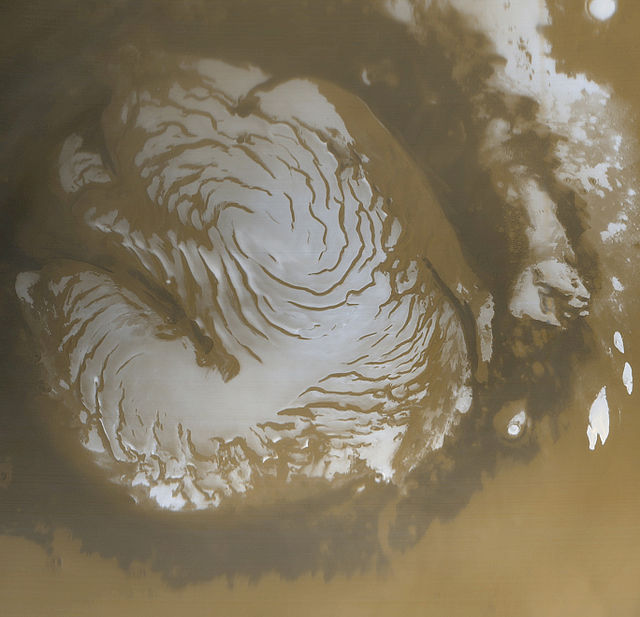
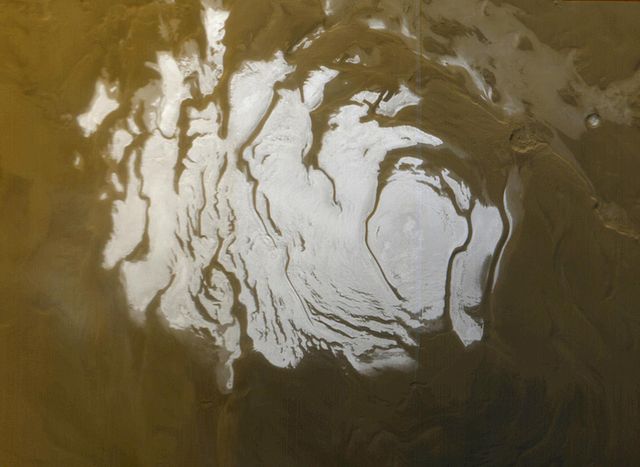
Mars has abundant ice. If the ice on the polar caps were distributed evenly over the surface it would create a layer 11 meters deep. This is more than enough to supply water vapor for the atmosphere if Mars were warmed to room temperature.
Radiation is an obstacle. Mars' atmosphere isn't thick enough to block cosmic rays and there is no ozone to block UV. Being at the bottom of the Hellas Basin doesn't help.
Mars can be warmed with orbital mirrors. Metal can be mined from Phobos and Deimos, where it is easily lifted into space.
       Escape speed (km/s)
Earth     11.2
Mars       5.0
Deimos      .0056
Phobos      .0113
 |
 |
|---|---|
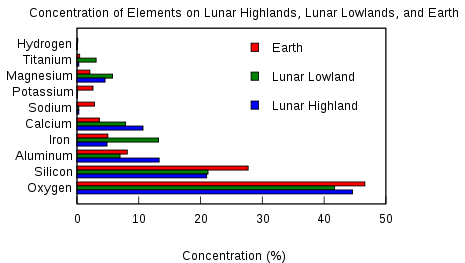
            Moon   Mars
Hydrogen     y      y     From ice
Oxygen       y      y     From ice
Nitrogen     n      y     Mars' atmosphere is 1.9% nitrogen
Carbon       ?      y
Iron         y      y
Phosphorus   y      y
Potassium    y      y
Helium-3     y      n     Fuel for nuclear fusion energy.  The Earth is poor in Helium-3
If the Earth is an ideal blackbody,
Solar heating ~ Blackbody radiation ~ Stefan_Boltzmann_constant * Area * Temperature4

1361 Watts/m2 π Earth_radius2  ~  5.67⋅108 W/m2/K4 4 π  Earth_radius2
Temperature4

Temperature ~ 278 Kelvin
The Earth's average temperature is 287 Kelvin.
The sun's luminosity is increasing and in ~ 1 billion years the oceans will boil off even if the Earth has zero CO2. In ~ 5 billion years the sun will become a red giant and consume the Earth.
.jpg) |
 |
|---|---|
      Radius   Mass     H2O    H2O    Escape  Perihelion  Apehelion
       (km)             Mass   frac   speed     (AU)        (AU)

Earth  6371  59700      14    .00025   11.2      .98       1.02
Mars          6420                      5.03    1.38       1.67
Ceres   487      9.43    2.0  .21        .51    2.55       2.99
Themis   99       .2     ?     ?         .087   2.72       3.54
Europa         480     250    .5        2.02
Ganymede      1480     700    .5        2.74
Callisto      1080     500    .5        2.44
Titan         1350     700    .5        2.64
Triton         214    ~ 40   ~.25       1.46
Masses in 1020 kg
Ceres has as much H2O as the Indian ocean and it has a small escape speed.
The asteroid Themis has been found to have ice.
http://en.wikipedia.org/wiki/24_Themis
mg/m3

  370   CO2 density in Earth air
10000   Onset of drowsiness if not already acclimated
20000   CO2 density on Mars
30000   Tolerable for 1 month
40000   Tolerable for 1 week
Humans can adapt to high concentrations of CO2
mg/m3

     .1 Level of carbon monoxide on Earth
   12   Level of carbon monoxide on Mars
   35   Dizziness within six to eight hours of constant exposure
  100   Slight headache in two to three hours
  200   Slight headache within two to three hours; loss of judgment
  400   Frontal headache within one to two hours
  800   Headache and dizziness, nausea, and convulsions within 45 min; insensible
        within 2 hours
 1600   Headache, tachycardia, dizziness, and nausea within 20 min; death in less
        than 2 hours
 3200   Headache, dizziness and nausea in five to ten minutes. Death within 30 minutes.
 6400   Headache and dizziness in one to two minutes.
        Convulsions, respiratory arrest, and death in less than 20 minutes.
12800   Unconsciousness after 2–3 breaths. Death in less than three minutes.
mg/m3

   10   Eye irritation
   50   Eye damage
  100   The olfactory nerve is paralyzed after a few inhalations, and the sense
        of smell disappears, often together with awareness of danger
  320   Leads to pulmonary edema with the possibility of death.
  530   Causes strong stimulation of the central nervous system and rapid breathing,
        leading to loss of breathing.
  800   lethal concentration for 50% of humans for 5 minutes exposure
 1000   Immediate collapse with loss of breathing, even after inhalation of a single
        breath.
Methane is not toxic.
The closest source of nitrogen for an atmosphere is the moons of Neptune.
              Mean
           Temperature  Min   Max    Parent   Albedo
                (K)     (K)   (K)    planet

Mercury         340     100   700
Venus           735     735   735
Earth           288     184   330
Moon            220     100   390
Mars            210     130   308
Ceres           168       ?   235
Europa          102      50   125    Jupiter
Ganymede        110      70   152    Jupiter
Callisto        134      80   165    Jupiter
Titan            94                  Saturn
Titania          70      60    89    Uranus
Oberon           75                  Uranus
Nitrogen freeze  63
Oxygen freeze    54
Triton           38                  Neptune   .76
Nereid           50                  Neptune   .155
Pluto            44      33    55              .58
Hydrogen freeze  14
The boundary between rocky and icy objects is at Ceres' orbit.
The boundary for frozen nitrogen is at Neptune's orbit.
         Diameter    Mass    Orbit   Orbit   Orbit
          (km)     (e16 kg)  (km/s)  (Mm)    (days)

Naiad       66       19     11.9       48.2      .294
Thalassa    82       35     11.7       50.1      .311
Despina    150      210     11.4       52.5      .335
Proteus    420     5035      7.6      117.6      1.122
Sao         44        6       .55   22228     2913
Laomedeia   42        5       .54   23567     3171
Psamanthe   40        4       .39   48096     9074
Neso        60       15       .37   49285     9741

Neptune orbit speed  =  5.43 km/s
 |
 |
 |
|---|---|---|
|
 |
|
 |
 |
|
|---|---|---|---|---|---|
 |
|
 |
 |
|---|---|---|---|
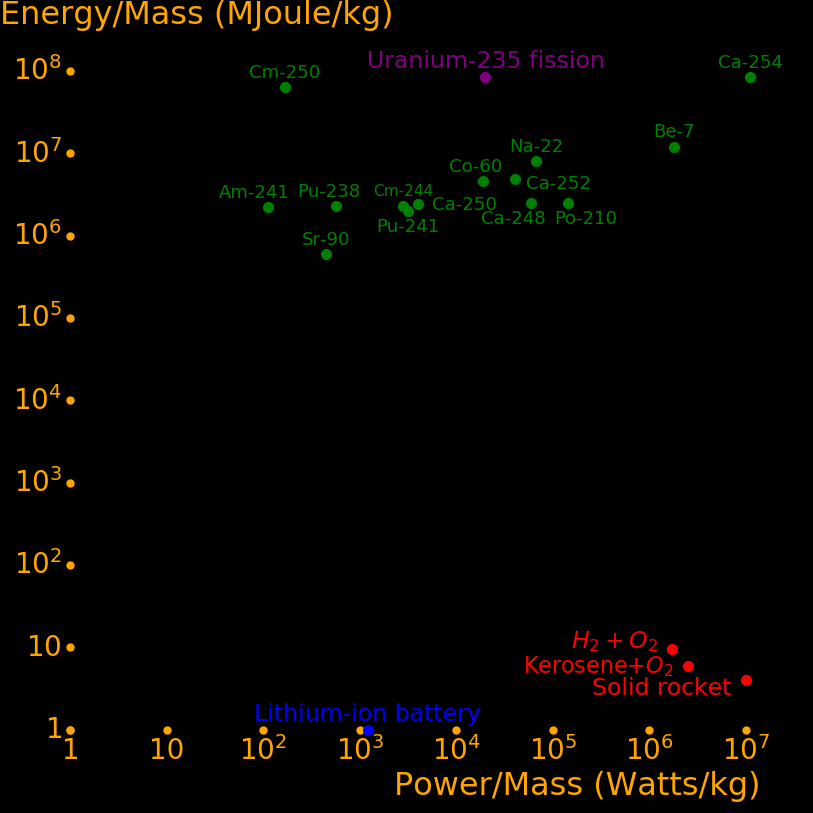
Radioisotopes have more energy per mass than gasoline by a factor of 1 million. They can power an aircraft for 50 years and they power the Voyager spacecraft. They can make a fission bomb the size of a softball. Iron Man gadgets are possible with them. Important isotopes include:
          Half life (year)   Use

Tritium              12.3    Fusion fuel
Helium-3         Stable      Fusion fuel.  Dilution refrigerator.  Fission afterburner rocket

Uranium-235   704000000      Fission fuel.  Fission bomb
Plutonium-239     14100      Fission fuel.  Fission bomb

Thulium-170            .352  Power
Polonium-210           .379  Power.  Alpha rocket
Thorium-228           1.91   Power.  Alpha rocket
Thulium-171           1.91   Power.  Safe around humans because it requires low radiation shielding
Caesium-134           2.06   Power
Cobalt-60             5.27   Power
Europium-152         13.5    Power
Strontium-90         28.9    Power
Uranium-232          68.9    Power.  Alpha rocket
Plutonium-238        87.7    Power.  Alpha rocket
Radium-226         1599      Power.  Breeder for Thorium-228 and Uranium-232

Lithium-6        Stable      Fission afterburner rocket.  Fusion bomb
Boron-10         Stable      Fission afterburner rocket.  Cancer treatment
Beryllium-7            .146  Fission afterburner rocket
Sodium-22             2.602  Fission afterburner rocket

Americium-242m      141      Fission afterburner rocket
Californium-251     900      Fission afterburner rocket. Compact fission bomb. Large neutrons/fission
Californium-252       2.65   Spontaneous fission.        Compact fission bomb. Large neutrons/fission
Curium-250         8300      Spontaneous fission

Carbon-12        Stable      Isotopically-pure diamonds, nanotubes, and graphene
Carbon-14          5700      Low neutron capture cross section

Iridium-192            .202  Power at high temperature
Tantalum-182           .313  Power at high temperature
Tungsten-181           .332  Power at high temperature
Osmium-194            6.02   Power at high temperature
 |
|
|---|---|
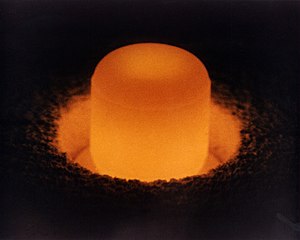
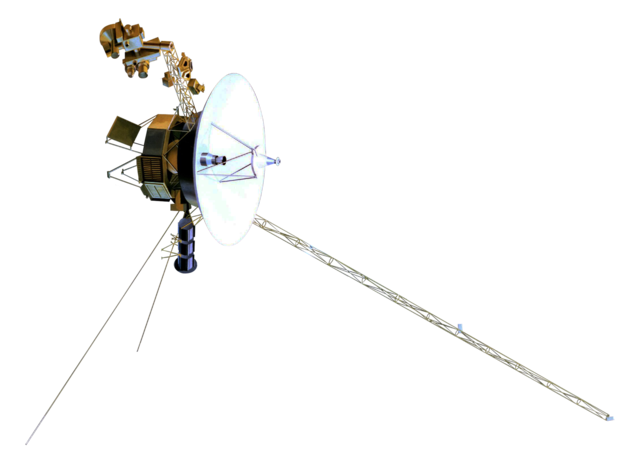
Isotope radioactivity can make electricity. The Voyager spacecraft are powered by plutonium-238.
 |
|---|
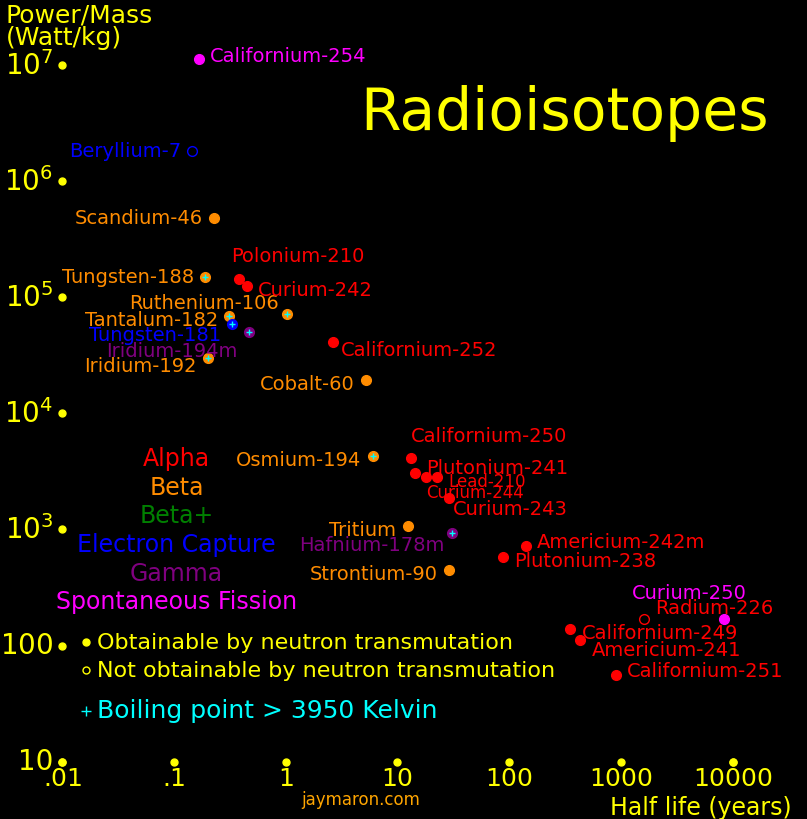
The isotopes with high power/mass are:
                Half life    Heat      Decay      Decay    Obtainable by
                  year      Watt/kg                MeV     neutron transmutation

Californium-254       .166 11200000    Fission      207      *
Iridium-192           .202    29942    β              1.460  *
Scandium-46           .229   485000    β              2.366  *
Thulium-170           .352    33150    β               .968  *
Thulium-171          1.91       606    β               .0965 *
Caesium-134          2.06     15300    β              2.059  *
Californium-252      2.64     41400    α or Fission  12.33   *   α 96.9% (6.12 Mev). Fission 3.09% (207 MeV)
Cobalt-60            5.27     19300    β              2.824  *
Europium-154         8.59      3030    β              1.968  *
Tritium             12.33       315    β               .0186 *
Europium-152        13.5       1821    β & EC         1.86   *
Strontium-90        28.9       2234    β, &beta       2.826  *
Caesium-137         30.1        583    β              1.176  *
Plutonium-238       87.7        578    α              5.59   *
Americium-242m     141          725    2α            12.33   *
Silicon-32         153         1159    β,  β          1.92   *
Iridium-192m       241           72    IT, β          1.615  *
Curium-250        8300          170    Fission      148      *   Fission 74%, Alpha 18%, Beta 8%

Beryllium-7           .146  1822000    EC              .547
Hafnium-172          1.87     11700    EC             1.835
Sodium-22            2.6      68700    β+ or EC       2.842
Rhodium-101          4.07      9890    EC             1.980
Titanium-44         59.1       4318    EC, β+         3.798

Thorium-227           .0512 9194000    5α+2β          36.14
Uranium-230           .0554 9280000    6α+2β
Thorium-228          1.912   235000    5α+2β          34.784
Radium-228           5.75     90660    5α+4β          40.198
Actinium-227        21.8      21600    5α+3β          36.18
Uranium-232         68.9       7545    6α+2β          40.79
Radium-226        1599          286    5α+4β          34.958
Thorium-229       7917           57.7  5α+3β          35.366
Protactinium-231 32600           16.2  6α+3β          41.33
Thorium-230      75380            6.78 6α+4β          39.728
 |
|---|
A battery that's around humans needs radiation shielding. Gammas are the most penetrating radiation, so what matters is the highest-energy gamma produced. Alpha and beta decay produce gammas by bremsstrahlung, and a charged particle can give all its energy to one gamma.
The isotopes with low-energy gammas are:
          Half life   Power/mass   Decay   Gamma   Stopping   Formation   Obtainable by   Decay
                                   energy   max     length      rate      neutron
            year       Watt/kg      MeV     MeV       mm      barn*year   transmutation

Holmium-163   4570                 .00255 .00255              0                         EC
Nickel-63      100.1        5.52   .017   .017      .004      2.5           *           β
Tritium         12.33     315      .0186  .0186     .005     71             *           β
Rubidium-83       .236             .910   .0322               0                         EC
Samarium-145      .931             .617   .061                 .022         *           EC
Tantalum-179     1.82              .110   .065                0                         EC
Promethium-145  17.7      131      .164   .072                 .022         *           EC
Platinum-193    50         17.5    .057   .076                3.81          *           EC
Thulium-171      1.91     606      .096   .096      .09      30.8           *           β
Europium-155     4.76     705      .252   .147              312             *           β
"Gamma" is the energy of the highest-energy gamma produced.
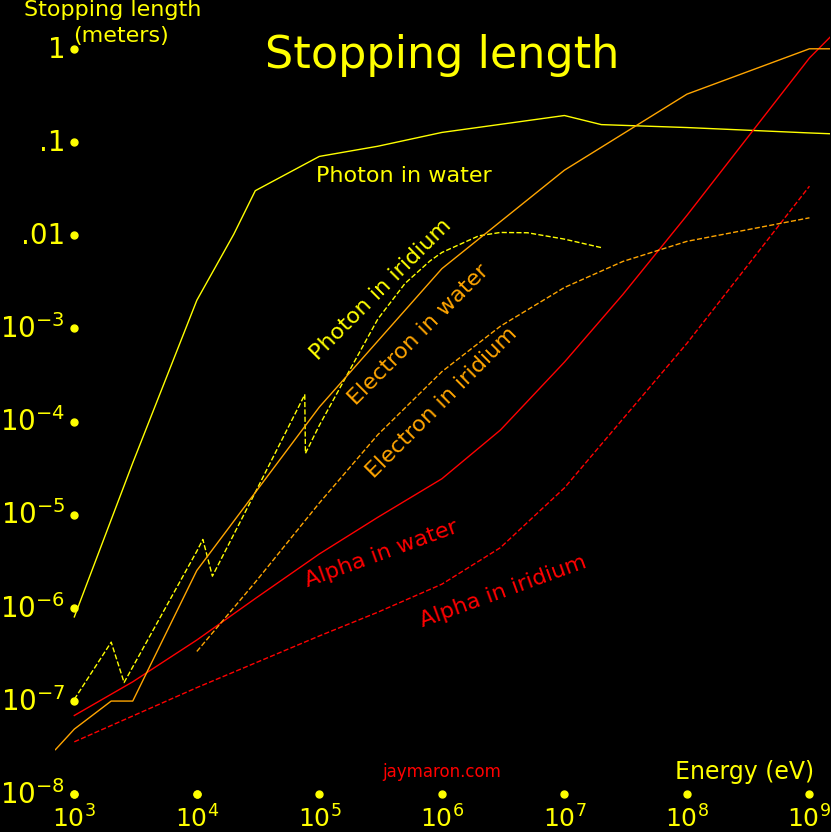
"Stopping length" is the stopping length of the gamma in iridium. The radiation shield should be at least 10 times thicker than the stopping length.
"Formation rate" indicates of how fast it can be produced in a nuclear reactor. See the "Hurdle" section below.
 |
 |
 |
 |
|---|---|---|---|
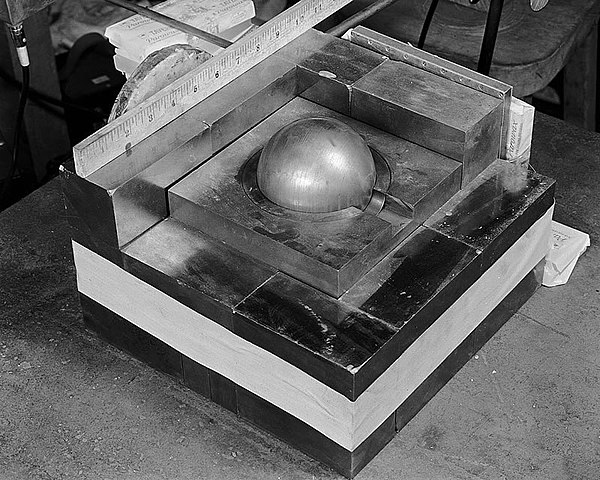
Isotopes exist with a critical mass smaller than plutonium-239. The smallest critical mass is californium-252 at 2.7 kg. The critical sphere diameter is 6.9 cm, the size of a tennis ball.
               Half life   Critical  Critical  Density   Fission
                             mass    diameter             barn
                 year         kg        cm     gram/cm3

Californium-252          2.64    2.73    6.9       15.1         33
Californium-251        900       5.46    8.5       15.1       4894
Californium-249        351       6       9         15.1       1666
Curium-247        15700000       7       9.9       13.5         82

Plutonium-239        14100      10       9.9       19.8        748
Uranium-233         159000      15      11         19.1        536
Uranium-235      704000000      52      17         19.1        538
Natural uranium has a critical mass of 800 with heavy water moderator, and 10000 kg with graphite moderator.
|
|---|
An isotope that sponteously fissions is a neutron source. The easiest such isotope to make is californium-252. The isotopes with a large spontaneous fission rate are:
                 Fission      Decay    Neutrons  Fission
                 half life  Half life    per     fraction
                  years       years    fission

Mendelevium-260       .0895      .0761            .85
Californium-254       .166       .166             .997
Californium-252     85.7        2.65     3.73     .0309
Curium-250       11200       8300        3.31     .74
|
|---|
A fission thermal rocket uses a fission reactor to heat hydrogen exhaust. The higher the temperature, the faster the exhaust. The temperature limit is of the order 4000 Kelvin because this is the highest temperature for which solids exist. The material with the highest melting point is hafnium carbide at 4201 Kelvin.
A fission reactor can alternately heat exhaust by generating neutrons, which trigger fission in the exhaust. The neutrons are generated as a pulse and the exhaust is pulsed. The likelihood for a neutron to trigger fission is quantified as a "cross section". The isotopes with the largest fission cross section are:
               Half life   Fission   Energy   Quality   Neutron capture           Obtainable by
                 year       barn      MeV               output                    neutron transmutation

Americium-242m       141        7024  195       5640    Daughter nuclei + Neutrons   *
Californium-251      900        4894  207       3940    Daughter nuclei + Neutrons   *
Curium-245          8500        2161  198       1740    Daughter nuclei + Neutrons   *
Plutonium-239      14100         748  189        590    Daughter nuclei + Neutrons   *
Uranium-235    704000000         538  181        410    Daughter nuclei + Neutrons   *

Beryllium-7             .146   56800    1.644  11670    Lithium-7 + Proton
Sodium-22              2.602   27490    4.14    4948    Neon-22   + Proton
Helium-3          Stable        5333     .764   1020    Tritium   + Proton           *
Boron-10          Stable        3835    2.34     820    Lithium-7 + Alpha            *
Lithium-6         Stable         940    4.783    640    Tritium   + Alpha            *

Zirconium-88            .228  861000    8      77000    Zirconium-89   + Gammas
Gadolinium-157    Stable      259000    7.94   13020    Gadolinium-158 + Gammas      *
Gadolinium        Stable       49000    8       2500    Gadolinium-158 + Gammas      *    Natural composition
An isotope's quality as fission afterburner fuel is
Atomic mass number    =  M            Dimensionless
Fission energy        =  E            MeV
Fission cross section =  A            barns
Afterburn quality     =  Q = AE/M
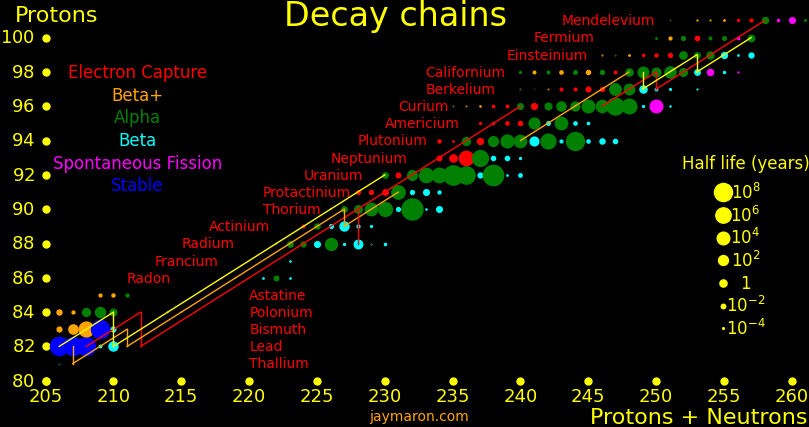
Many superisotopes are actinides. The orange line shows the isotopes can be produced by neutron capture.
|
|---|
Neutron capture transmutes an isotope one space to the right and beta decay transmutes an isotope one space up. Isotopes on or to the right of orange lines can be made with neutron transmutation and isotopes to the left of the lines can't. Elements that are made by neutron-transmutation tend to be neutron-heavy (neutronic), and elements that can't be made by neutron-transmutation tend to be proton-heavy (protonic).
 |
|---|
Suburanics are the isotopes from radium to uranium. Many undergo 5 or 6 alpha decays, such as uranium-232. This is the red line in the plot.
 |
|---|
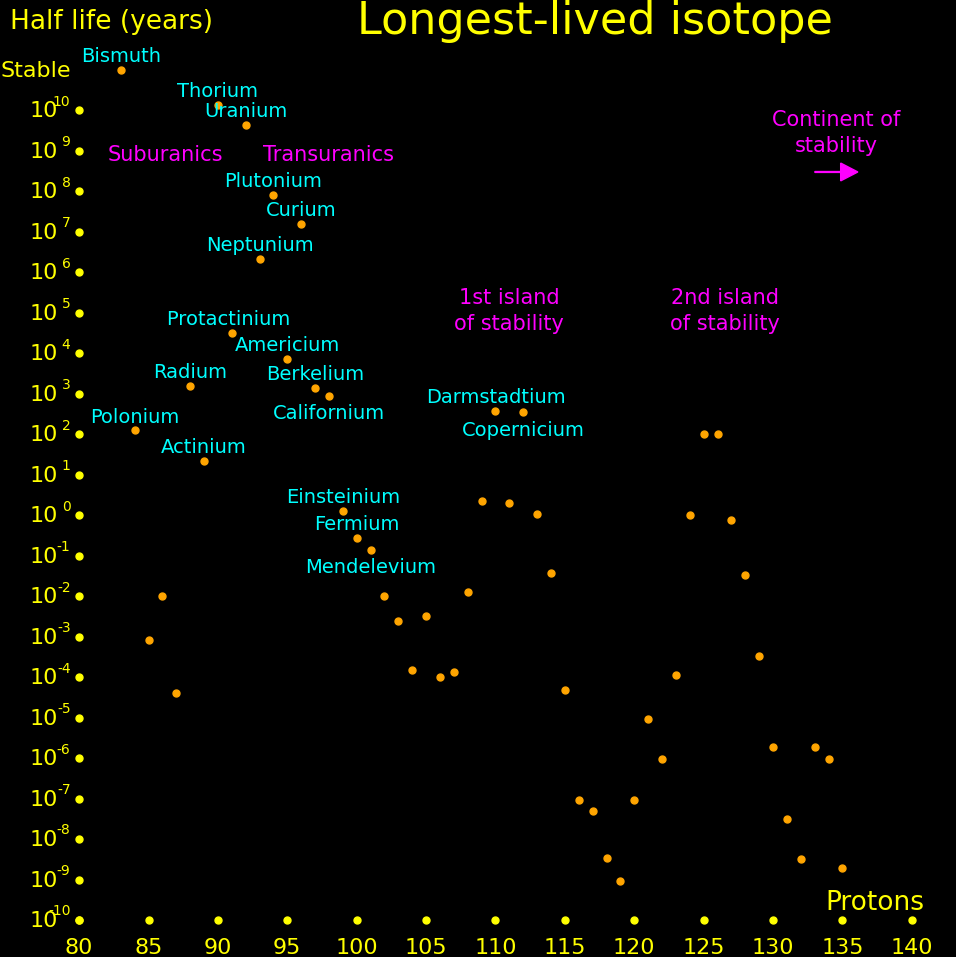
There is a hypothetical "island of stability" around atomic number 112 where isotopes may be long-lived. A second island may exist at atomic number 126.
Experiments can only measure the longest-lived isotope up to a proton number of 105, and beyond that we plot theory. Theoretical half lives are uncertain by an order of magnitude.
 |
|---|
It's possible that for large nucleon number, larger than around 300, that the nucleus transitions to a lower-energy state, called "Up down quark matter", or "udQM". The existence of udQM is unresolved. Theory is uncertain, and it hasn't been experimentally produced. The largest nucleus that's been produced is oganesson-294, with 118 protons and 294 nucleons. It shows no sign of udQM, so if udQM exists, it's beyond oganesson.
If udQM nuclei exist, they could potentially be long-lived. They don't fission because it would take the nucleus to a higher-energy state. They decay by alpha until they're too light to be udQM, at which point they fission.
If udQM nuclei exist, then there may exist long-lived elements from Z=140 to way beyond. These are "continental elements".
The largest nucleus that standard nuclear matter can make has Z=140. Larger nuclei fission instantly. The only way that nuclei with Z>140 can exist is if udQM exists.
Typical energies:
                              MeV        MeV/Nucleon

Chemical reaction                .000002   Varies
Beta decay                      2          Varies
Alpha decay                     6           .026
Superalpha decay               36           .16     5 or 6 alphas, in sequence. For example, Uranium-232
Superheavy decay              280           .98     Alpha, then fission. Superheavy elements with more than 108 protons
Neutron capture                 8          Varies

Fission (Helium-3)               .764       .19
Fission (Lithium-6)             4.783       .68
Fission (Beryllium-7)           1.64        .21
Fission (Boron-10)              2.34        .21
Fission (Uranium-235)         181           .77
Fission (Plutonium-239)       189           .79
Fission (Californium-252)     207           .82
Fusion of D+Li6                22.4        2.8

Beta decay, Beryllium-7          .547       .078
Beta decay, Sodium-22           2.842       .13
Beta decay, Scandium-46         2.366       .051
Beta decay, Cobalt-60           2.82        .047
 |
|---|
                Half life    Heat      Decay  Decay energy   Melt    Boil    Obtainable by         Formation rate
                  year      Watt/kg               MeV       Kelvin  Kelvin   neutron transmutation

Tungsten-188          .191   148700    2β            .349       3695    6203    *     .173
Iridium-192           .202                                                           *  193
Tantalum-182          .313    68866    β            1.814       3290    5731    *    6.42
Tungsten-181          .332    59200    EC           1.732       3695    6203    *          .0239
Ruthenium-106        1.023    71200    2β           3.584       2607    4423    *     .000198
Hafnium-172          1.87     11700    EC           1.835       2506    4876
Thorium-228          1.912   235000    5α+2β       34.784       2023    5061
Rhodium-101          4.07      9890    EC           1.980       2237    3968
Cobalt-60            5.27     19300    β            2.82        1768    3200    *    2.01
Osmium-194           6.02      4313    2β           2.33        3306    5285    *     .130
Platinum-193        50           17.5  EC            .057       2041    4098    *    3.81
Titanium-44         59.1       4318    EC & β+      3.798       1941    3560
Uranium-232         68.9       7545    6α          40.79        1405    4404
Iridium-192m2      241           72                                                  *   100
Thorium-229       7917           57.7  5α+3β       35.366       2023    5061
Protactinium-231 32600           16.2  6α+3β       41.33        1841    4300
Europium-152        13.5                                                                8660
Europium-154         8.59                                                                312
Europium-155         4.76                                                                312

Meitnerium-285       2.24   1020000    α+fission  220          ~3300   ~5000
Darmstadtium-293    37.7      58900    β+fission  220          ~2600   ~4700
Darmstadtium-292   133        16700    α+fission  220          ~2600   ~4700
Darmstadtium-294   380         5820    α+fission  220          ~2600   ~4700
 |
|---|
               Half life   Fission   Fission   Critical mass
                 year       barn     neutrons      kg

Fermium-257             .275 2100    5.7
Einsteinium-254         .75  2900    4.2           9.9
Californium-251      900     4801    4.1           5.46
Californium-249      351      600    4.06          6.0
Curium-245          8500     2161    3.83          9.6
Americium-242m       141     7024    3.26          9.5
Plutonium-239      14100      748    2.89         10
Uranium-235    704000000      538    2.43         52
The transmutation options are:
                          Example                                       Means

Add a neutron             Uranium-238 → Uranium-239                     Slow neutrons from fission. Thermal neutrons at 300 Kelvin and .025 eV
Subtract a neutron        Thorium-232 → Thorium-231                     Superfast neutrons from fusion. Neutron energy = 14.1 MeV
Beta decay                Uranium-239 → Plutonium-239                   Patience
Alpha decay               Uranium-233 → Thorium-229                     Patience
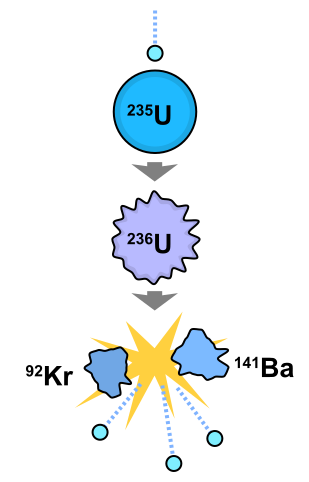
Fission                   Uranium-235 → Daughter nuclei + Neutrons
Accelerator substitution  Lithium-6 + Deuteron → Beryllium-7 + Neutron
Accelerator fusion        Berkellium-249 + Calcium-48 -> Tennessine-297
Some isotopes can be made with present technology and some need future technology. Also, the more energy you have, the more isotopes you can make.
Fission reactors are the easiest way to make isotopes. They produce slow neutrons that are captured by a target nucleus and they make isotopes that are "neutron heavy", or "neutronic".
Slow neutrons tend to stick to nuclei and superfast neutrons tend to eject neutrons from nuclei. Superfast neutrons can make protonic isotopes. Superfast neutrons are produced by fusion:
Deuterium + Tritium → Helium-4 (3.5 MeV) + Neutron (14.1 MeV)
Most isotopes can be made with slow or superfast neutrons. Many that can't can be made with accelerator substitution. A target nucleus is bombarded with high-energy particles such as deuterons, tritons, alphas, and He-3. For example,
Lithium-6 + Deuteron + 2 MeV → Beryllium-7 + Neutron
Isotopes can be made by fission, for example rhodium-103 and palladium-106. Rhodium and palladium are valuable catalysts.
Isotopes can be made by spallation, where a high-energy particle blasts nucleons off a nucleus.
Isotopes can be made by fusion, where 2 nuclei are collided at the resonance energy for fusion. This is how isotopes far beyond uranium are made.
Isotopes can be made by alpha decay. For example, slow neutrons turn thorium-232 into uranium-233, and then uranium-233 alpha decays to suburanics.
Slow neutrons tend to stick to nuclei and superfast neutrons tend to eject neutrons from nuclei. Superfast neutrons can make protonic isotopes. Superfast neutrons are produced by fusion:
Deuterium + Tritium → Helium-4 (3.5 MeV) + Neutron (14.1 MeV)
The cross sections for a fusion neutron hitting thorium-232 are (in barns):
                 Fusion neutrons   Fission neutrons   Thermal neutrons    Energy threshold
                    14.1 MeV       2.4 MeV average    .025 eV average           MeV

Capture the neutron    .0011              .096              7.299                0
Eject 1 neutron       1.786               .017              0                    6.468
Eject 2 neutrons       .522               .000072           0                   11.61
Eject 3 neutrons      0                  0                  0                   18.43
Fission                .361               .080               .000054             0
Elastic collision     2.740              4.832             14.72                 0
Inelastic collision    .468              2.690              0                     .0496
Total                 5.859              7.717             22.02
For fusion neutrons, ejection is half the cross section.
Protonic isotopes can be produced by bombarding a target nucleus with a high-energy particle, such as a proton, deuteron, triton, He-3, or Alpha.
Beryllium-7 can't be made with fission or fusion neutrons, but it can be made by bombarding Lithium-6 with high-energy deuterons.
Target     New    High-energy  Energy  Cross section
nucleus  nucleus   particle     MeV        barn

Li6      Be7         d            2       .2
Mg24     Na22        d            7       .2
Th232    Ac227       t           75       .5
Th232    Ra228       t          100       .0018
Th232    Th228       d           83       .272
Th232    U-232       Alpha       38       .195
Th232    Ac225       p          150       .015
Th232    Ac226       p          150       .015
Th232    Ac227       p          150       .015
Th232    Th227       p           70       .040
Th232    Th228       p           60       .085
Suburanics can be made with a combination neutron addition and subtraction. Starting with thorium-232,
Th-232 → Th-231 → Th-230 → Th-229 → Th228
Th-232 → Th-233 → U-233 → U-232 → U-231 → U-230
Radium can be made by waiting for a thorium alpha decay.
Input      Input half life    Output        Output half life
                year

Thorium-230         75380     Radium-226          1599
Thorium-232   14000000000     Radium-228             5.75
Uranium-235     704000000     Protactinium-231   32600
Uranium-238    4470000000     Thorium-230        75380
Radium-226 can generate all the important suburanics with fission neutrons except for Uranium-230. The sequence is:
Radium-226  →  Actinium-227  →  Thorium-227  →  Thorium-228
→  Thorium-229  →  Thorium-230  →  Protactinium-231  →  Uranium-232
Neutron capture is slow. Some isotopes need a high neutron flux. A prime goal is maximizing neutron density, and a future civilizations will have neutron densities than today.
The neutron capture rate is:
Neutron density               = D           =   e16  neutrons/meter3           Typical for a fission reactor
Neutron speed                 = V           =  2190  meter/second              Thermal neutron at 300 Kelvin
Neutron flux                  = F = D V     =2.2e19  neutrons/meter2/second    Typical for a fission reactor
Neutron capture cross section = A           =  e-28  meter2  =  1 barn         Typical cross section
Transmutation time            = T = (DVA)-1 = 4.6e8  seconds = 14 years
Many isotopes need a small transmutation time. This can be done by increasing the neutron flux or by increasing the capture cross section. The slower the neutron, the larger the cross section.
For neutrons below 100 eV, it's often the case that "VA" is constant as a function of V.
At Oak Ridge National Laboratory, the High Flux Isotope Reactor has a flux of 2.5e19 neutrons/meter2/second.
The Oak Ridge Spallation Source produces neutron pulses with e21 neutrons/meter2/second.
Neutrons are made by hitting beryllium-9 with high-energy alphas. The alpha source is often polonium-210.
Beryllium-9 + &alpha → Carbon-12 + Neutron
                   Continuous flux      Pulse flux   Continuous power
                   Neutron/meter2/s  Neutron/meter2/s     MWatt

Supernova                        -          e36                   e30 neutrons/meter3
Fission bomb                                e28
Oak Ridge fission reactor   2.5e19            -            75
Oak Ridge spallation source   3e18         2e21             1.4
ITER fusion reactor           2e18            -           500
Stellar S process              e15
Californium-252                e13
Polonium-210 + Beryllium-9     e12            -                   Polonium-210 half life = .379 years
Fusor                           e9            -                   Use high voltage to fuse D+T
Radium-226 + Beryllium-9        e8            -                   Radium-226 half life = 1599 years
Earth surface                     .0065
Deep underground               e-9
            Half life   Energy   Production cross   Decay     Neutron produceable
              year       MeV     section (barns)

Krypton-79     .00388                 6.4           Positron     Yes
Iodine-124     .0114                  -             Positron     No
Sodium-22     2.602     2.842         -             Positron     No      Positron max .545 MeV, .215 MeV average
In many cases, the slower the neutron, the higher the capture cross section.
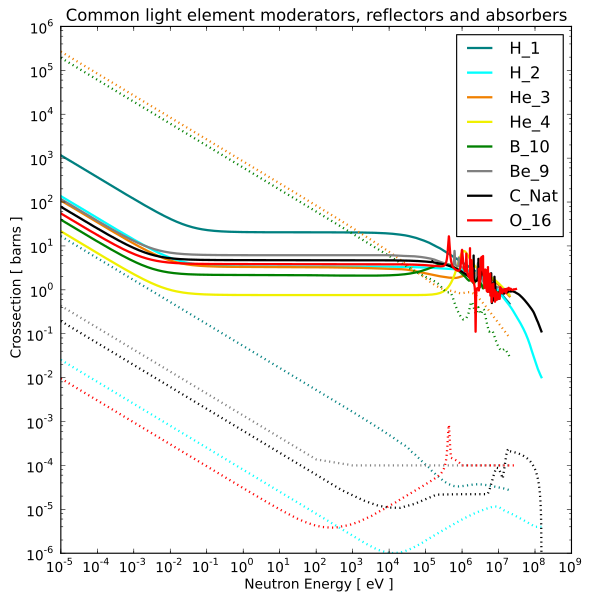 |
|---|
Solid lines are scattering cross sections and dotted lines are capture cross sections.
                                 Kelvin

Water melt                         273
CO2 sublime                        195
Argon boil                          87
Nitrogen boil                       77
Neon boil                           27
Hydrogen boil                       21
Helium-4 boil                        4.2
Helium-3 boil                        3.2
Helium-3 evaporative cooling          .3
Dilution refrigerator                 .002          Uses helium-3 and helium-4
Nuclear demagnetization, typical      .000001
Laser cooling, typical                .000001
Nuclear demagnetization, record low   .0000000001
Laser cooling, record low             .000000000038
Cold neutrons bounce off walls. The critical temperature for various materials is:
          Neutron      Neutron       Neutron
        temperature  temperature      speed
            neV        Kelvin      meter/second

Nickel-58   335        .0039          8.14
Diamond     304        .0036          7.65
BeO         261        .0031          6.99
Nickel      252        .0030          6.84
Beryllium   252        .0030          6.84
Graphite    180        .0021          5.47
This is within reach of a dilution refrigerator, which can reach .002 Kelvin. It's also within reach of magnetic trapping.
An advanced civilization will have unlimited helium-3 and can make a large dilution refrigerator. It can make a neutron wall trap that can collect all the outgoing neutrons from a fission reactor and funnel them to a focus. The only limit on neutron density is neutron degeneracy, which is 1022 neutrons/meter3 at .003 Kelvin.
Ultracold neutrons can be trapped magnetically. Neutrons have a magnetic moment of 50 neV/Tesla. For a 3 Tesla field, this is the same temperature range as a dilution refrigerator and as for wall trapping.
                                            Magnetic fied (Tesla)

Neodymium magnet                                     1.25
Magnetic resonance imaging                           7
Superconducting magnet max, continuous operation    32
Resistive magnet max, continuous operation          38
Pulsed magnet max, non-destructive                 100
Pulsed magnet max, destructive                    2000

White dwarf                                       1000
Neutron star                                  10000000
Magnetar                                   10000000000
Magnetar max                              100000000000
Neutron density is limited by degenercy pressure. For neutrons,
Type         Energy        Temperature   Wavelength     Speed       Degenerate density
               eV            Kelvin      Angstroms   Meter/second   #/meter3

Fusion    14100000                         .000061    51900000
Fast       2000000                         .00016     19600000
Thermal           .0253       294          1.45           2200      3.3⋅1029
Cold              .00036        4.2       12.1             263      5.6⋅1026
Ultracold         .00000022      .0025   497                 6.4    8.1⋅1021
Fast neutrons are from fission.
Fusion neutrons are from the fusion of D+T->He4+n, which produces a 14.1 MeV neutron.
 |
|---|
              Half life    Neutron capture (barns)

Osmium-192       Stable           3.12           Input isotope
Osmium-193      1.25 days        38.0            Hurdle isotope
Osmium-194      6.0 years          .043          Output isotope
If there is a hurdle isotope, the formation rate of the output isotope is proportional to:
Hurdle half life                     = T
Hurdle neutron capture cross section = σc
Hurdle fission cross section         = σf
Natural fraction                     = F             Fraction of the natural element that can transform to the output isotope
Capture fraction                     = C = σc/(σc+σf)
Formation rate of output isotope     = Q = T σc F C
This is for the case of an output isotope with a long half life and a hurdle isotope with a short half life.
If the output isotope has a short half life, then the output isotope is the hurdle. "T" becomes the half life of the output isotope and σc becomes the capture cross section for the isotope preceeding the output isotope.
If the hurdle time is more than 1 year, we use a time of 1 year.
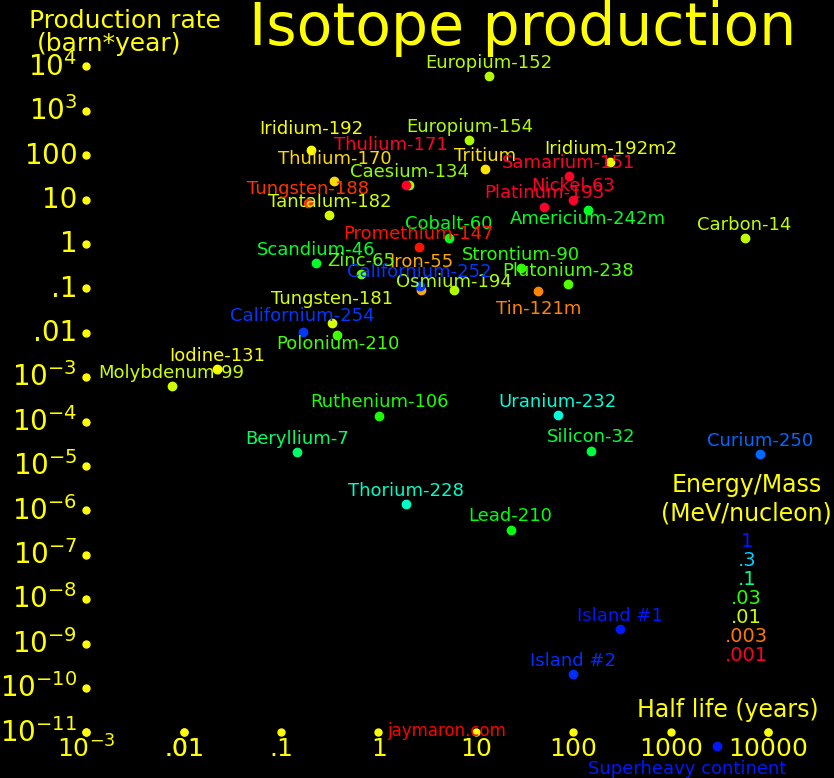 |
|---|
In the plot, "Island #1 and #2" are the nuclear islands of stability. Island #1 needs a formation time of order .1 seconds, and island #2 needs .01 seconds, and superheavy isotopes (udQM regime) need .001 seconds.
The isotopes with hurdles to their formation are:
Output        Output     Hurdle   Capture  Natural   Capture   Production   Hurdle
             Half life  half life                                 rate
               year       year     barn    fraction  fraction  barn*year

Europium-152     13.5   13.5     9100         .952   1       8660          Europium-151
Europium-154      8.59   8.59     312        1       1        312          Europium-153
Europium-155      4.76   4.76     312        1       1        312          Europium-153
Iridium-192        .202   .202    954        1       1        193          Iridium-192
Iridium-192m2   241    241        100        1       1        100          Iridium-192m2
Tritium          12.3    Stable   940         .0759  1         71          Lithium-6
Thulium-170        .352    .352   105.6      1       1         37.2        Thulium-170
Thulium-171       1.91     .352    87.6      1       1         30.8        Thulium-170
Caesium-134       2.06   2.06      30.3      1       1         30.3        Caesium-137
Americium-242m  141    141         84        1        .10       8.4        Americium-242m
Tantalum-182       .313   .313     20.5      1       1          6.42       Tantalum-182
Platinum-193     50      Stable    10.0       .381   1          3.81       Platinum-192
Cobalt-60         5.27   5.27       2.007    1       1          2.007      Cobalt-60
Carbon-14      5730      Stable     1.931     .996   1          1.92       Nitrogen-14
Plutonium-238    87.7   2144000   171         .0072   .146      1.23       Neptunium-237
Argon-39        269      Stable      .8      1       1           .8        Argon-38
Cadmium-109       1.26   Stable     1.1       .518   1           .57       Cadmium-108
Scandium-46        .229   .229      2.366    1       1           .542      Scandium-46
Iron-55           2.737  2.737      2.25      .0585  1           .36       Iron-55
Deuterium       Stable   Stable      .333     .99985 1           .333      Proton
Zinc-65            .667   .667       .93      .492   1           .305      Zinc-65
Tungsten-188       .191   .00270   64.1      1       1           .173      Tungsten-187
Californium-252   2.64   2.64       2.49     1        .0673      .168      Curium-248
Osmium-194        6.0     .00343   38.04     1       1           .130      Osmium-193
Technetium-99 211000   211000        .132     .903   1           .119      Technetium-99
Strontium-90     28.9     .138       .420    1       1           .0580     Strontium-89
Tungsten-181       .332   .332     60         .0012  1           .0239     Tungsten-181
Promethium-145   17.7     .931       .7       .0308  1           .022      Samarium-145
Samarium-145       .931   .931       .7       .0308  1           .022      Samarium-145
Californium-254    .166   .049     20.0      1        .0151      .0148     Californium-253  1303
Polonium-210       .379   .379       .0338   1       1           .0128     Polonium-210
Iodine-131         .0220 Stable      .29      .341   1           .00218    Tellurium-130
Ruthenium-106     1.023   .000507    .390    1       1           .000198   Ruthenium-105
Argon-42         32.9     .000208    .509    1       1           .000106   Argon-41
Silicon-32      153       .000299    .107    1       1           .000032   Silicon-31
Curium-250     8300       .000122   1.60     1        .138       .0000027  Curium-249         10
Lead-210         22.3     .000371    .00143  1       1           .00000053 Lead-209
Caesium-137      30.2     .0360  Unknown     1       1                     Caesium-136

Output        Output     Hurdle   Capture  Natural   Capture   Production   Hurdle
             Half life  half life                                 rate
               year       year     barn    fraction  fraction  barn*year
Einsteinium-257    .0211  .000048    Unknown                  Unknown      Einsteinium-256
Einsteinium-259    .0180  .000074    Unknown                  Unknown      Einsteinium-258
Fermium-257        .275   .000300    Unknown                  Unknown      Fermium-256
Subjecting natural europium to neutrons for a short time produces mostly europium-152.
Subjecting natural europium to neutrons for a medium time produces mostly europium-154.
Subjecting natural europium to neutrons for a long time produces 2/3 europium-154 and 1/3 europium-155.
          Half life   Neutron capture  Natural   Energy   Gamma max   Decay
            year           barn        fraction   MeV       MeV

Europium-151    Stable      9100        .478    -         -
Europium-152     13.5      11800       0       1.86      1.408
Europium-153    Stable       312        .522    -         -
Europium-154      8.59      1663       0       1.968     1.274
Europium-155      4.76      3843       0        .252      .147
Europium-156       .0416     100       0
Europium-157       .00174              0

Thulium-169     Stable       105.6     1        -
Thulium-170        .352       87.6     0                  .968     β
Thulium-171       1.91         9.90    0                  .096     β

Promethium-143     .725        3.07    0                           β+
Promethium-144     .994       15.09    0                           β+
Promethium-145   17.7          5.28    0        .164      .072     EC
Promethium-146    5.53         8.41    0       1.495     1.189     EC
Promethium-147    2.623      167.2     0        .224      .224     Β     72 barn to Pm-148m.    82 barns to Pm-148
Promethium-148     .0147               0                           β
Promethium-148m    .113                0                           β

Neodymium-142   Stable        18.7      .272
Neodymium-143   Stable       337        .112
Neodymium-144   Stable         3.6      .238
Neodymium-145   Stable        42        .0829
Neodymium-146   Stable         1.4      .172
Neodymium-147      .0301     142.9     0                           β
Neodymium-148   Stable                  .0575
Neodymium-149      .000194             0                           β
Neodymium-150   Stable                  .0563

Samarium-144    Stable          .7      .0308
Samarium-145       .931      280.3     0        .617      .061     EC
Samarium-146  68000000          .382   0
Samarium-147    Stable        57        .150
Samarium-148    Stable        24        .112
Samarium-149    Stable     42080        .138
Samarium-150    Stable       104        .0737
Samarium-151     90        14070       0
Samarium-152    Stable       206        .267
Samarium-153       .00528              0
Samarium-154    Stable         8.4      .227
Making transuranics takes many neutrons. Also, fission can halt the process. When going from uranium-238 to californium-251, the fraction of isotopes that make it to californium-251 is .0000151.
There are no hurdles with short half lives until fermium-258, with a half life of .000370 seconds.
The sequence for making transuranics is:
              Half life      Fission    Capture  Capture  Cumulative     Decay
                year          barn       barn    fraction  fraction

Uranium-238  4470000000            .000010    2.68  1        1           α
Plutonium-239     14100         748        1017      .58      .58        α
Plutonium-240      6561            .030     290     1         .58        α
Plutonium-241        14.3       937         363      .28      .16        β
Plutonium-242    373000            .0026     18.5   1         .16        α
Americium-243      7370            .2        75.3   1         .16        α
Curium-244           18.1         1.1        13      .92      .16        α
Curium-245         8500        2161         383      .151     .147       α
Curium-246         4730            .17        1.36   .89      .0222      α
Curium-247     15700000          82          58      .41      .0198      α
Curium-248       340000            .34        2.49   .88      .00811     α
Californium-249     351        1666         483      .22      .00714     α
Californium-250      13.08      112        1701      .94      .00157     α
Californium-251     900        4894        2849      .37      .00148     α
Californium-252       2.64       33.0        20.4    .38      .000546    α
Californium-253        .049    1303          19.95   .0151               β
Californium-254        .166       2.001       4.51   .69                 Fission
Einsteinium-255        .109        .503      55.4   1                    β
Fermium-256            .000300  Unknown   Unknown   Unknown              α
Fermium-257            .275    2951           3.003  .00102              α
Fermium-258            .000370  Unknown   Unknown   Unknown              Fission
Fermium-259           1.5       Unknown   Unknown   Unknown              Fission
Fermium-260            .004     Unknown   Unknown   Unknown              Fission
A neutron could either be captured or it could trigger fission. "Capture fraction" is the fraction of capture events.
"Cumulative fraction' is the product of capture fractions up to the given isotope.
Energy per neutron    = E       =       200  MeV/neutron
Neutron mass          = M       =  1.67e-27  kg
Neutron energy/mass   = e = E/M =    1.9e16  Joule/kg
Electricity energy/$  = L       =        30  MJoule/$
Neutron price/kg      = P = e/L =       640  M$/kg
A neutron can turn uranium-238 into plutonium-239. The energy cost of plutonium-239 is 2.7 M$/kg.
Actinides beyond plutonium take many neutrons to make. It takes 14 neutrons to get from uranium-238 to californium-252.
A calutron separates isotopes with a magnetic field.
Protons              Price/kg       World produce   America stockpile   Natural fraction
                      M$/kg           kg/year            kg

  1  Hydrogen-2               .004       1000000                          .00015
  1  Hydrogen-3             30                10          30             0
  2  Helium-3                1                10          30              .000002
  2  Helium                   .000024   50000000
  3  Lithium                  .000070   36000000
  3  Lithium-6                .06                                         .0759
  4  Beryllium                .00150      425000                                   All beryllium-9
  4  Beryllium-7                                                         0
  5  Boron-10                                                             .20
  6  Carbon-12                .12                                         .989
  6  Carbon-14                                                            .000000000001
 21  Scandium-46
 27  Cobalt-60
 38  Strontium-90             .01
 55  Caesium-137
 63  Europium-152
 63  Europium-154
 77  Iridium-192
 77  Iridium-192m
 84  Polonium-209     50000000
 84  Polonium-210
 88  Radium-226               .1               0          30
 88  Radium-228               .1               0          30
 89  Actinium-227            1
 90  Thorium                  .000290   10000000
 90  Thorium-228
 90  Thorium-229
 90  Thorium-230
 90  Thorium-231
 91  Protactinium-231         .28
 92  Uranium                  .000101   70000000
 92  Uranium-230
 92  Uranium-232
 92  Uranium-233                                        2000
 92  Uranium-235              .1                      480000              .0072
 93  Neptunium-237            .66
 94  Plutonium-238
 94  Plutonium-239           6.5                       80000
 95  Americium-141            .7                          10
 95  Americium-142m
 95  Americium-143            .7                          10
 95  Curium-242                                1          10
 95  Curium-243
 95  Curium-244            185                  .17       10
 95  Curium-245
 95  Curium-246
 95  Curium-247                                             .1
 95  Curium-248         160000                  .0001
 96  Curium-250
 97  Berkelium-249      185000                  .020     N/A
 98  Californium-249    185000                  .0005
 98  Californium-250
 98  Californium-251
 98  Californium-252     60000                  .5       N/A
 99  Einsteinium-253                            .01      N/A
 99  Einsteinium-254                            .000001  N/A
100  Fermium-257
                              Power       Power        Distance
                              Watts       Sun=1       light year

Human civilization, 1800      6.0e11
Human civilization, 1900      1.3e12
Human civilization, 2023      2.0e13
Solar power hitting Earth     1.7e17
Sun                           3.8e26             1            0
Star Sirius                   9.7e27            25.4          8.6
Star Aldebaran                2.0e29           520           65
Star Spica                    7.8e30         20500          280
Star Naos                     3.1e32        813000         1080
Star eta Carine               1.7e33       4600000         7500
Milky Way central region      1  e35                      26000   Stars within 10 light years of the center
Galacy Centaurus A AGN                                 11000000   Nearest active galactic nucleus
Milky Way total               5  e36                          -
Virgo central galaxy          5  e37                   53500000
Quasar Markarian 231          1.4e39                  581000000   Nearest quasar
Quasar Ton 618                4  e40                18200000000   Brightest quasar
Galaxy W2246-0526             1.3e41                12600000000   Brightest galaxy
Isotopes that decay by alpha and don't produce betas or gammas have value because they can be around humans. The pure alpha isotopes are:
                 Half life   Power/Mass   Obtainable by
                   year       Watt/kg     neutron transmutation

Fermium-257           .275                     *        Fm257 -> Es253 -> Bk249
Polonium-210          .379   144000            *
Curium-242            .446   124000
Polonium-208         2.898
Curium-244          18.1       2823            *        Cm242 -> Pu240 -> U236
Curium-243          29.1       1885            *        Cm243 -> Pu239 -> U235
Gadolinium-148      75          800
Plutonium-238       87.7        578            *
Polonium-209       125.2                                Po209 -> Pb205 -> Tl205   The electron capture has a half life of 15 Myr
Americium-241      432          114            *
A nuclear reactor needs materials with a low neutron capture cross section. Zirconium is the favored structural metal.
         Neutron capture   Natural    Neutron       Density    Atom      Stopping
                           fraction   scatter                 density    power
             barn                      barn          g/cm3

Oxygen            .00028          -
Carbon            .0035           -
Helium            .007            -
Beryllium         .0092           -
Bismuth           .034            -
Neon              .04             -
Magnesium         .063            -
Lead              .171            -
Zirconium         .184            -
Aluminum          .232            -
Hydrogen          .332            -
Niobium          1.15             -
Ruthenium        2.56             -
Molybdenum       2.6              -
Nickel           4.49             -
Platinum        10                -
Osmium          15                -
Tungsten        18.3              -
Tantalum        20.6              -
Hafnium        104                -

Hydrogen-3       0                0           2.178
Helium-4         0                1.000        .961     .145   .036      .036
Carbon-14         .000000310      0           3.152    4.11    .294      .93
Nitrogen-15       .000024          .004       5.293
Beryllium-10      .000100         0           6.291    2.06    .206     1.30
Oxygen-18         .000141          .00205     3.987
Oxygen-16         .000190          .998       4.498
Lead-208          .000230          .524      12.94    11.34    .055      .72
Hydrogen-2        .000550          .000145    4.705
Carbon-13         .00137           .011
Carbon-12         .00389           .989
Boron-11          .00508           .80
Beryllium-9       .0076           1                    1.85
Zirconium-90      .0107            .514
Magnesium-26      .0382            .110
Lithium-7         .0454
Molybdenum-92     .0614            .146
Ruthenium-106     .146            0
Titanium-50       .179             .0518
Aluminum-27       .231            1
Oxygen-17         .244
Hydrogen-1        .333             .9999     32.81
Chromium-54       .36              .0236
Platinum-196      .72              .253
Iron-58          1.28              .0028
Nickel-64        1.52              .00926
Osmium-192       3.12              .41
Tungsten-183    10.1               .143
Hafnium-180     12.92              .351
Tantalum-181    20.5               .999
The best isotope for neutron shielding is gadolinium-157, with a neutron capture cross section of 259000 barns. Natural gadolinium is a mix of isotopes with an overall cross section of 49000 barns.
Elements and isotopes with a high neutron capture cross section are:
          Neutron capture  Price/kg  Quality
              barns          $/kg    barns/$

Gadolinium       49000       29     2450
Samarium          5922       13.6    740
Europium          4600      287       15
Cadmium           2450        2.7   1220
Boron              767        3.7    183
Lithium             70.5     70         .35

Xenon-135      3219000                         Half life = .00104 year
Zirconium-88    861000                         Half life = .228 year
Gadolinium-157  259000
Gadolinium-155   61100
Beryllium-7      56800
Samarium-149     42080
Cadmium-113      30000
Europium-151      9100
Helium-3          5333
Boron-10          3835
Lithium-6          940
Neutrons can be generated by bombarding beryllium-9 with alpha particles.
α + Beryllium-9 → Carbon-12 + Neutron
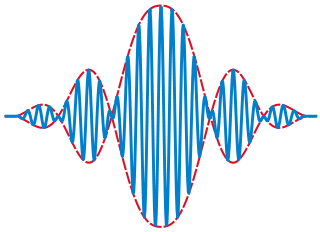 |
|---|
             Half life   Decay   Gamma energy   Obtainable by neutron transmutation
               year                  MeV

Antimony-124      .165   Beta       2.09                Most gammas are 1.69 MeV. Max 2.09 MeV
Cobalt-60        5.26    Beta       1.33        *
Sodium-22        2.6     Beta+      1.28
Hafnium-178m    31       Gamma       .507       *
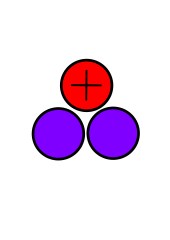 |
|---|
Lithium-6 + Neutron → Helium-4 + Tritium Cross section of 940 barns
               Half life   Obtainable by
                 year      neutron transmutation

Fluorine-18       .000209
Molybdenum-99     .00752     *      Decays to Technetium-99m, which has a half life of 6.01 hours
Thallium-201      .00832
Iodine-131        .022       *
Iodine-125        .0362
Palladium-103     .0465      *
Strontium-82      .0694             Decays to Rubidium-82
Iridium-192       .202       *
Strontium-89                 *
Samarium-153                 *
Rhenium-186                  *
Lutetium-177                 *
Bismuth-213                  *
Lead-212                     *
Radium-223
Boron-10         Stable    Natural
Gadolinium-157   Stable    Natural
 |
|---|
Some isotopes undergo 5 or 6 alpha decays, such as uranium-232. This is the red line in the plot.
U-232 → Th-228 → Ra-224 → Rn-220 → Po-216 → Pb-212 → Bi-212 → Po-212 → Pb-208
The double-decay nuclei with half lives between 1 month and 100 years are:
                                       1st decay  2nd decay  Total    1st     2nd   Obtainable by neutron transmutation
                                       half life  half life  energy  energy  energy
                                         year       year      MeV     MeV     MeV

Osmium-194    → Ir-194 → Pt-194   6.02     .00022   2.330   .096   2.234  *
Tungsten-188  → Re-188 → Os-188    .191    .00194   2.469   .349   2.120  *
Rhenium-184m  → Re-184 → Os-184    .463    .104     .646    .188    .458  *
Hafnium-172   → Lu-172 → Yb-172   1.87     .0283    1.835   .338   1.497
Fermium-247   → Es-253 → Cm-249    .275    .0560                          *
Rhodium-102m  → Rh-102 → Ru-102   3.742    .567     1.509   .141   1.268
Einstein-254  → Cf-250 → Cm-246    .755  13.3                             *
Titanium-44   → Sc-44  → Ca-44   59.1      .00046   3.798   .146   3.652
Strontium-90  → Y-90   → Zr-90   28.9      .00731   2.826   .546   2.280  *
Iridium-192m  → Ir-192 → Pt-192 241        .202     1.615   .155   1.460  *
Tin-121m      → Sn-121 → Sb-121  43.9      .00308    .396   .0063  .390   *
Argon-42      → K-42   → Ca-42   32.9      .00141   4.124   .599   3.525  *
Silicon-32    → P-32   → S-32   153        .0391    1.919   .21    1.709  *
Germanium-68  → Ga-68  → Zn-68     .742    .000129
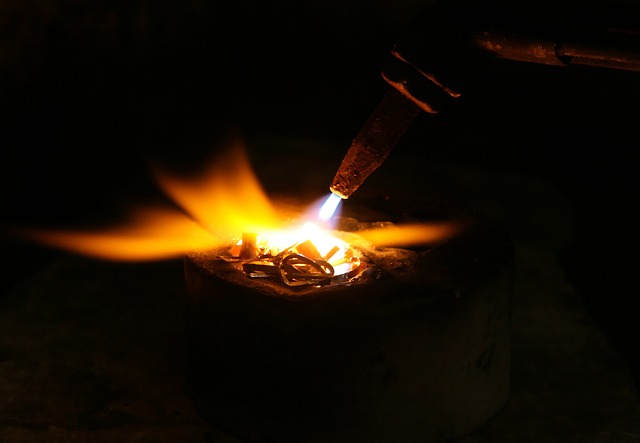 |
|---|
              Melt    Boil   Density

Zirconium      2128   4650
Niobium        2750   5017
Molybdenum     2896   4912
Technetium     2430   4538
Ruthenium      2607   4423
Rhodium        2237   3968
Lutetium       1925   3675
Hafnium        2506   4876   13.3
Tantalum       3290   5731   16.7
Tungsten       3695   6203   19.2
Rhenium        3459   5309   21.0
Osmium         3306   5285   22.6
Iridium        2719   4403   22.6
Platinum       2041   4098   21.4
Thorium        2023   5061
Protactinium   1810   4300
Uranium        1405   4404   19.1
Neptunium       912   4447
Curium-240 produces 2 alphas with short half lives and becomes Uranium-232, which has a long half life. Uranium-232 produces an alpha with a long half life and then 5 more alphas with short half lives. It can be used as an alpha rocket where the first two decays give it a fast launch, and the remaining decays power it for a long time. The decay sequence of Curium-240 is:
              Half life
                year

Curium-240       .0739       Alpha
Plutonium-236   2.858        Alpha
Uranium-232    68.9          Alpha
Thorium-228     1.912        Alpha
Radium-224       .00986      Alpha
Radon-220        .0000018    Alpha
Polonium-216     .000000005  Alpha
Lead-212         .00121      Alpha
Bismuth-212      .00012      Beta
Tellurium-208    .0000057    Alpha
Lead-208       Stable        Beta
Cross sections for fusion neutrons at 14.1 MeV, in millibarns. All columns are fusion neutrons except the last column, which is fast fission neutrons. For fusion neutrons, the usual outcome is for neutrons to be subtracted from the target nucleus.
Thorium is more likely to lose neutrons than uranium.
           (n,2n)  (n,3n)  (n,fission)  (n,inelastic)  (n,G)    (n,2n)
                                                                fission


Actinium-227  2170   353            62.8     445        1.119    15.87
Thorium-228   1897    85.8         598       498        1.23      7.39
Thorium-229   1717    92.7         864       346        1.19     33.5
Thorium-230   1856   244           564       424         .96     12.2
Thorium-231   1685   336           658       349        1.21     42.7
Thorium-232   1786   522           361       468        1.14     16.8
Uranium-320    174      .0126     2518       416         .78       .138
Uranium-321     75      .000028   2474       403         .69      2.08
Uranium-322    401      .77       2570       420         .82       .760
Uranium-233    181      .271         1.84    368         .58      1.84
Curium-242     231      .120      2907       359        1.19       .921
The prompt kinetic energy released by fission is:
         Fission energy (MeV)

Actinium        168
Thorium         172
Protactinium    177
Uranium         181
Neptunium       185
Plutonium       189
Americium       195
Curium          198
Berkelium       203
Californium     207
|
|---|
There is a hypothetical "island of stability" around atomic number 112 where nuclei may be long-term stable. A second island may exist at atomic number 126.
Experiments can only measure the longest-lived isotope up to a proton number of 105, and beyond that we plot theory. Theoretical half lives are uncertain by an order of magnitude.
|
|---|
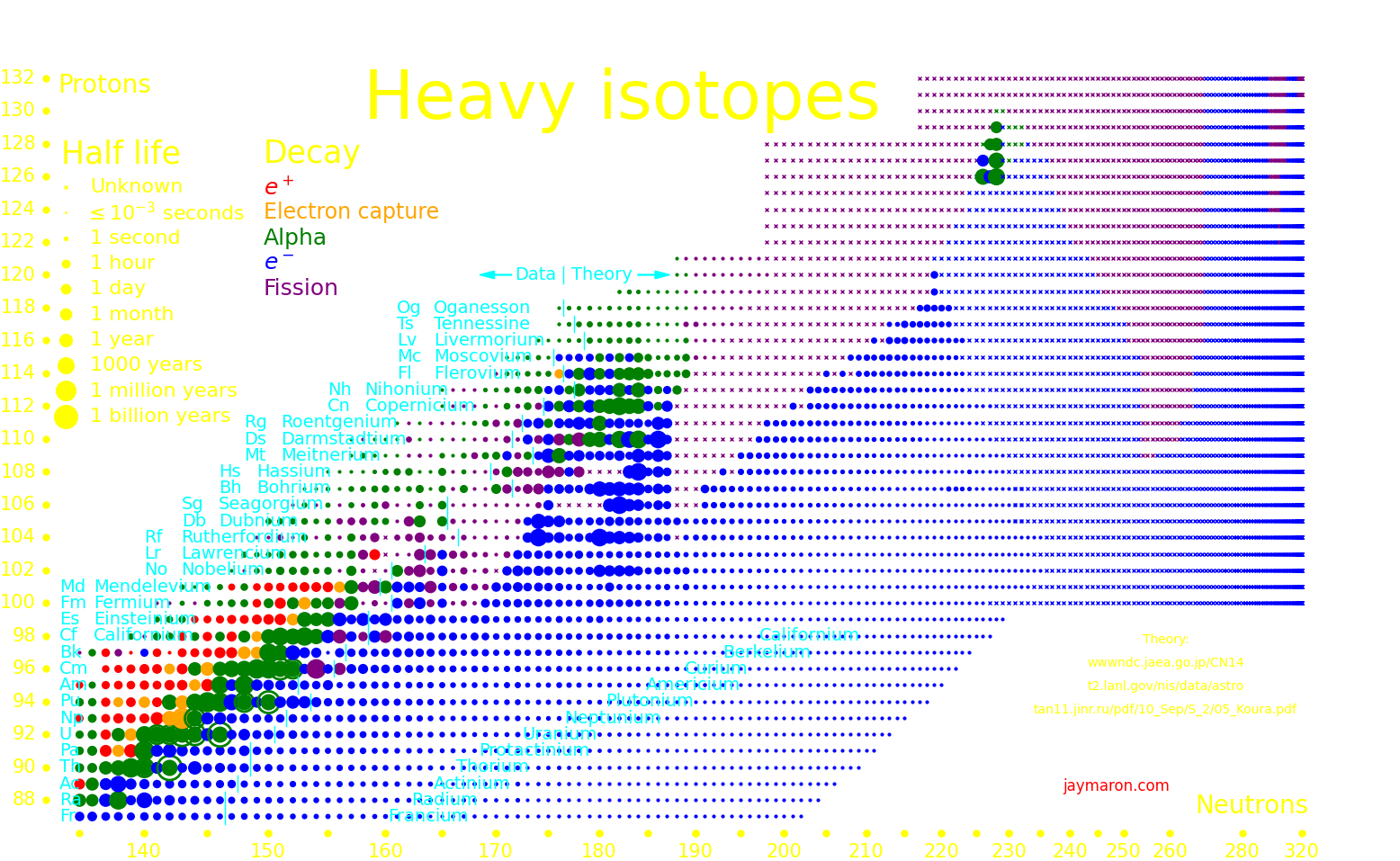 |
|---|
It's possible that for large nucleon number, larger than around 300, that the nucleus transitions to a lower-energy state, called "Up down quark matter", or "udQM". The existence of udQM is unresolved. Theory is uncertain, and it hasn't been experimentally produced. The largest nucleus that's been produced is oganesson-294, with 118 protons and 294 nucleons. It shows no sign of udQM, so if udQM exists, it's beyond oganesson.
If udQM nuclei exist, they could potentially be long-term stable. They don't fission because it would take the nucleus to a higher-energy state. They decay by alpha until they're too light to be udQM, at which point they fission.
If udQM nuclei exist, then there may exist long-lived elements from Z=140 to way beyond. These are "continental elements".
The largest nucleus that standard nuclei can make has Z=140. Nuclei larger fission instantly. The only way that nuclei with Z>140 can exist is if udQM exists.
In the isotope table, we use experimental data from Wikipedia if it exists, otherwise we use theory from https://wwwndc.jaea.go.jp/CN14 and https://t2.lanl.gov/nis/data/astro. Nobel gases have a closed shell of electrons, and the shell numbers are called "magic numbers". The magic numbers for electron shells are:
Helium       2
Neon        10
Argon       18
Krypton     36
Xenon       54
Radon       86
Oganesson  118
The magic numbers for neutrons are 2, 8, 20, 28, 50, 82, 126, 184. The magic numbers for protons are the same as for neutrons, up to 82, and the next proton magic numbers are 114, 126, 154, and 164. Nuclei that are magic for both protons and neutrons are:
             Protons  Neutrons

Helium-4          2      2
Oxygen-16         8      8
Calcium-40       20     20
Calcium-48       20     28
Lead-208         82    126
Flevorium-298   114    184   Undiscovered
Unnamed         126    216   Undiscovered
Unnamed         126    228   Undiscovered
Unnamed         154    308   Undiscovered
Unnamed         164    308   Undiscovered
Unnamed         164    318   Undiscovered
Unnamed         164    406   Undiscovered
The nuclei from helium-4 to lead-208 are stable.
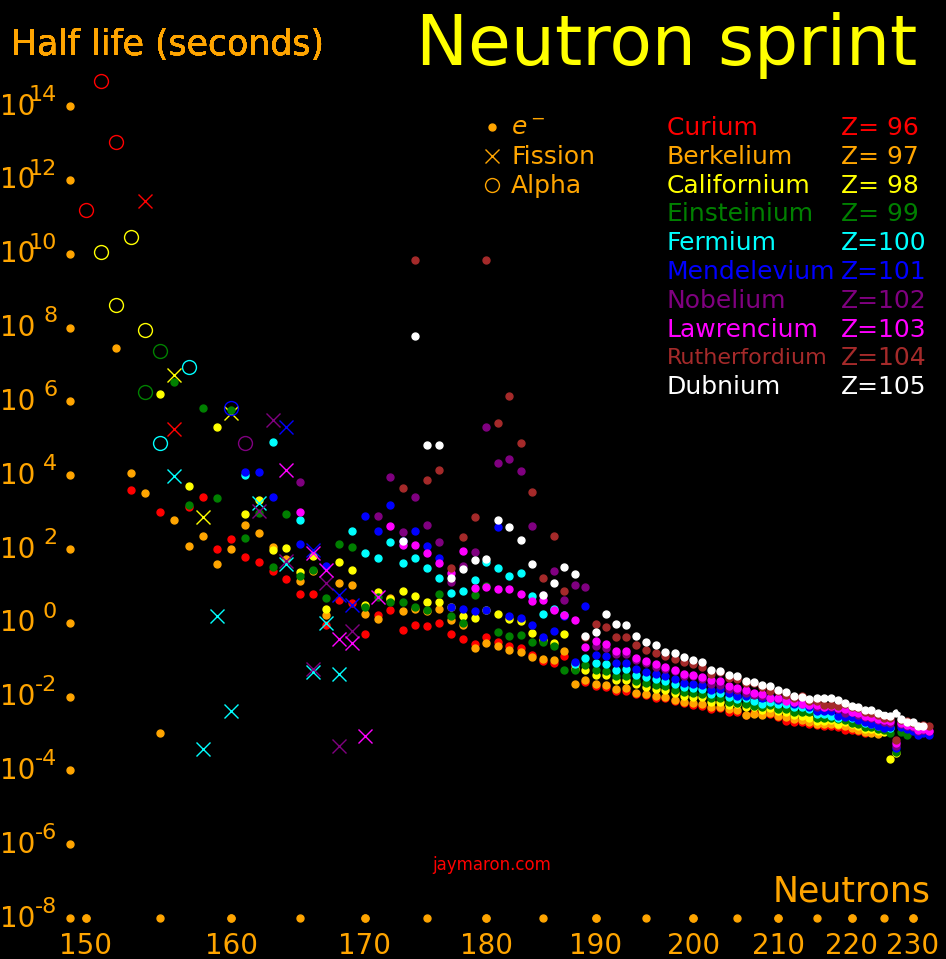 |
|---|
A Fermi gas with a Fermi energy of 335 neV has a density of 1.39e23 particles/meter3
Fermi number density     =  n = 16π/3 λ-3=      1.39e23  particles/meter3
Fermi wavelength         =  λ            =      4.94e-8  meter
Fermi momentum           =  Q            =     1.34e-26  kg*meter/second
Planck constant          =  h =  Q ℏ     =    6.626e-34  Joule*second
Fermi energy             =  E =  Q2/(2m) =  ℏ2/(2m) (3π2n)2/3
                                         =          335  neV
Neutron mass             =  m            =    1.675e-27  kg
         Half life  Energy  Capture  Source  Hotness  Spice  Agile  Saturate   Gamma
           year      MeV     barn            MeV/yr

Dyspros-165   .000266  1.286  2840    1      4835    261             .054
Mercury-197   .00732    .600  3080     .0016   82     82            1.61
Rhenium-186   .0102    1.207   112     .374   118      9.6            .082
Lutetium-177  .0181     .498  2065    1        27.5   27.5           2.67
Ytter-169     .0822           2230     .0014                        13.1
Iridium-192   .202     1.460   954     .373     7.2    7.2          13.8    Calutron
Cal-252      2.64     12.33   2849    1         4.7    4.7         537
Scandium-46   .229     2.366    27.5  1        10.3                   .45    1.121
Osmium-185    .256     1.013  3003     .0002    3.96   3.96         55      Calutron
Hafnium-175   .192      .684   550.5   .0016    3.6    3.6           7.5
Hafnium-181   .116     1.027    12.9  1         8.85    .95           .107
Hafnium-183   .000122  2.010   133.1  1     16500     19.1            .00116
Tantalum-182  .313     1.814    20.5            5.8    2.67           .46
Tungsten-181  .332     1.732    60     .0012
Spicy isotopes have a high melting point and short half life. They can make a solid ball with a temperature of 4000 Kelvin and a radius as small as 1 cm. Some can be made in bulk, those for which the precursor isotope has a high neutron capture cross section.
            Spiciness  Half life    Energy   Precursor   Bulk         Gamma
            MeV/year     year        MeV       barn


Scandium-46    10.3    .229       2.366       27.5                      1.121
Californium-252 4.7   2.64       12.33      2849          4.7
Ytterbium-169          .0822                2230

Osmium-185      4.0    .256       1.013     3003          4.0              Calutron
Iridium-192     7.2    .202       1.460      954                           Calutron
Hafnium-175     3.6    .192        .684      550.5        3.6
Hafnium-183            .000122    2.010      133.1                      0
Rhenium-186   118      .0102      1.207      112          9.6   .082
Iridium-194            .00220                111
Rhenium-188            .00194                 76.4
Tungsten-187           .00270                 35
Tungsten-181    5.2    .332       1.732       60
Tungsten-188           .191        .349        -
Osmium-191             .0421                  13.1
Hafnium-181            .116       1.027       12.92                      .137
Tantalum-182           .313       1.814       20.5
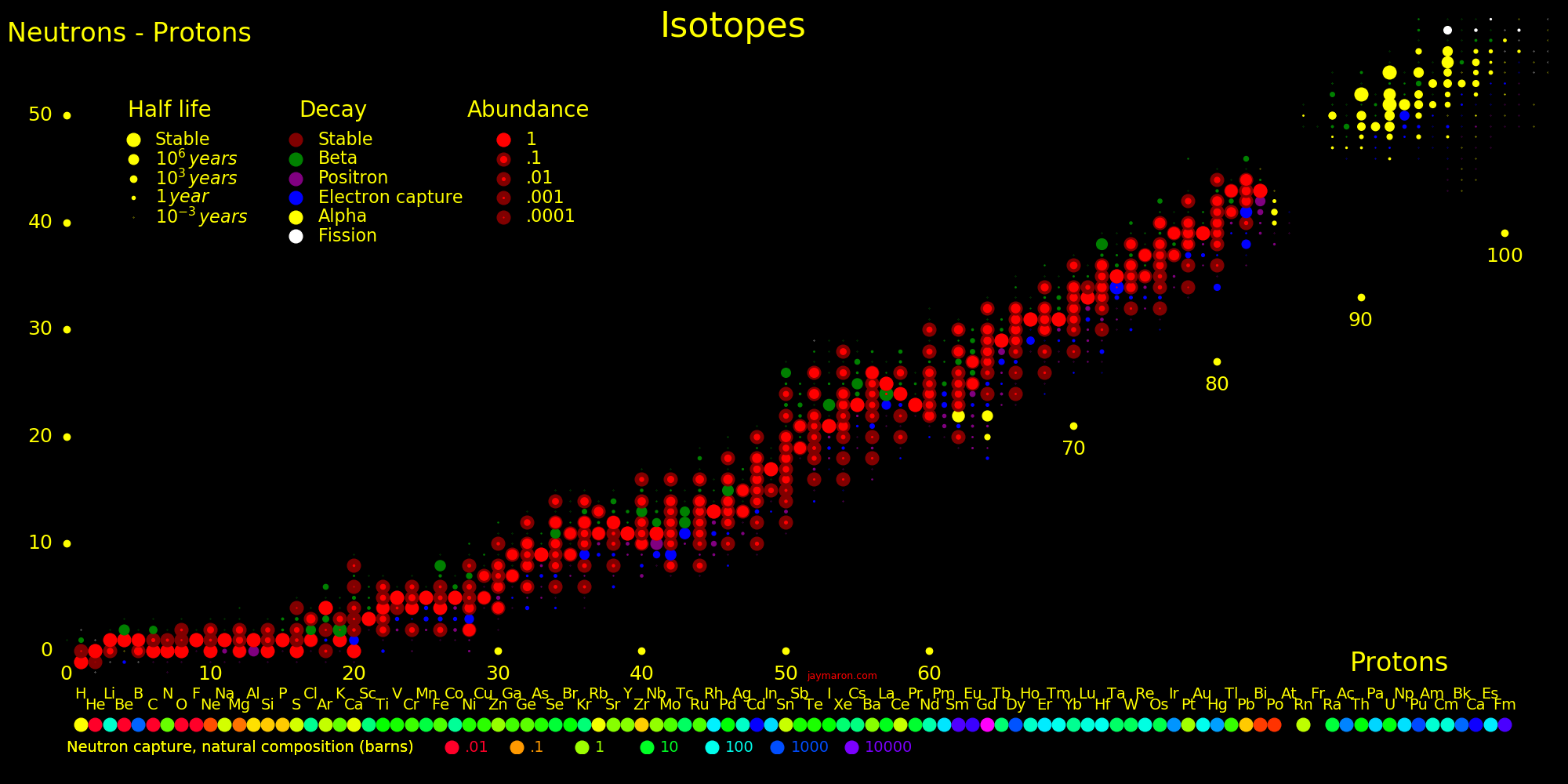 |
|---|
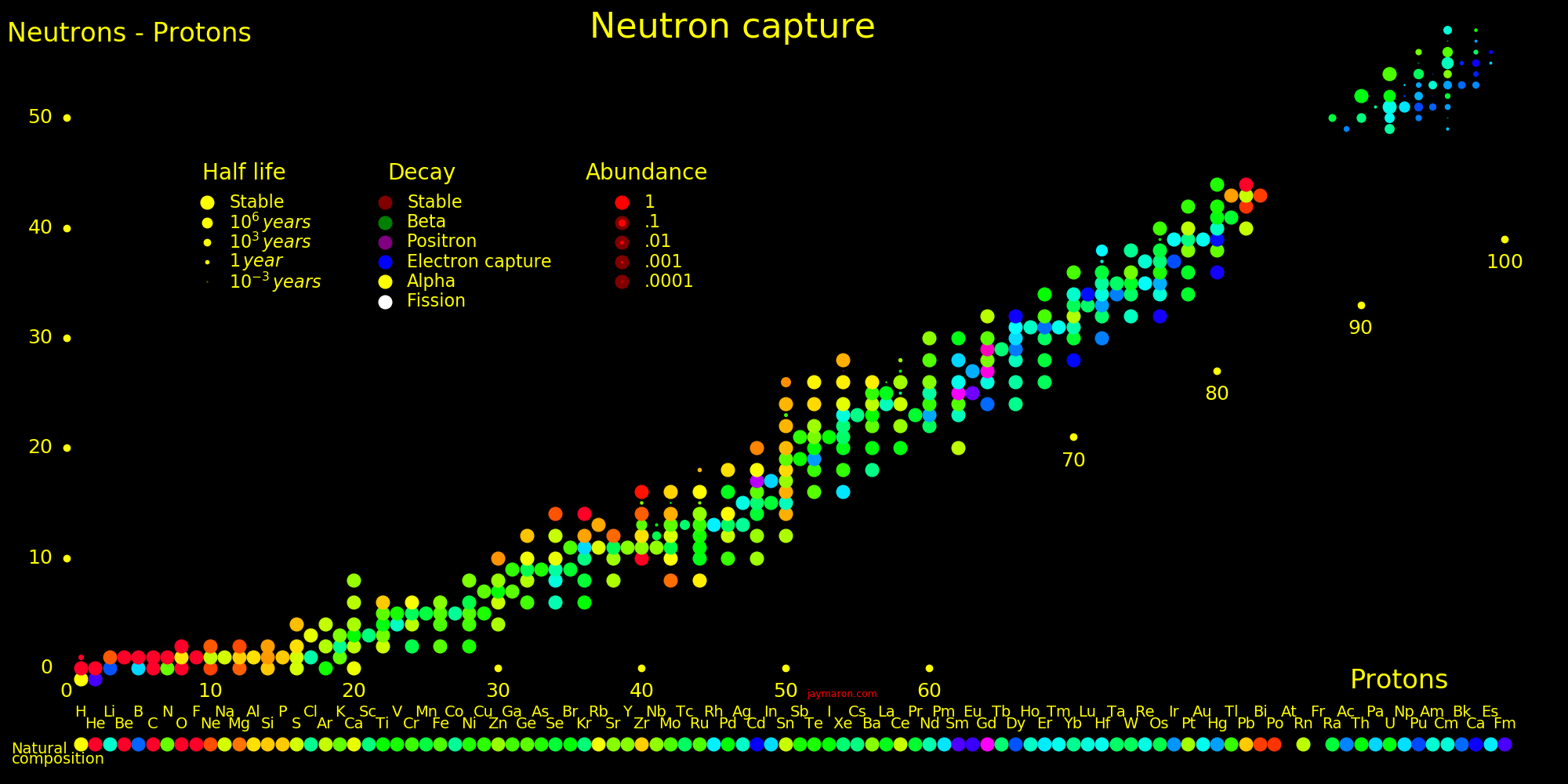 |
|---|
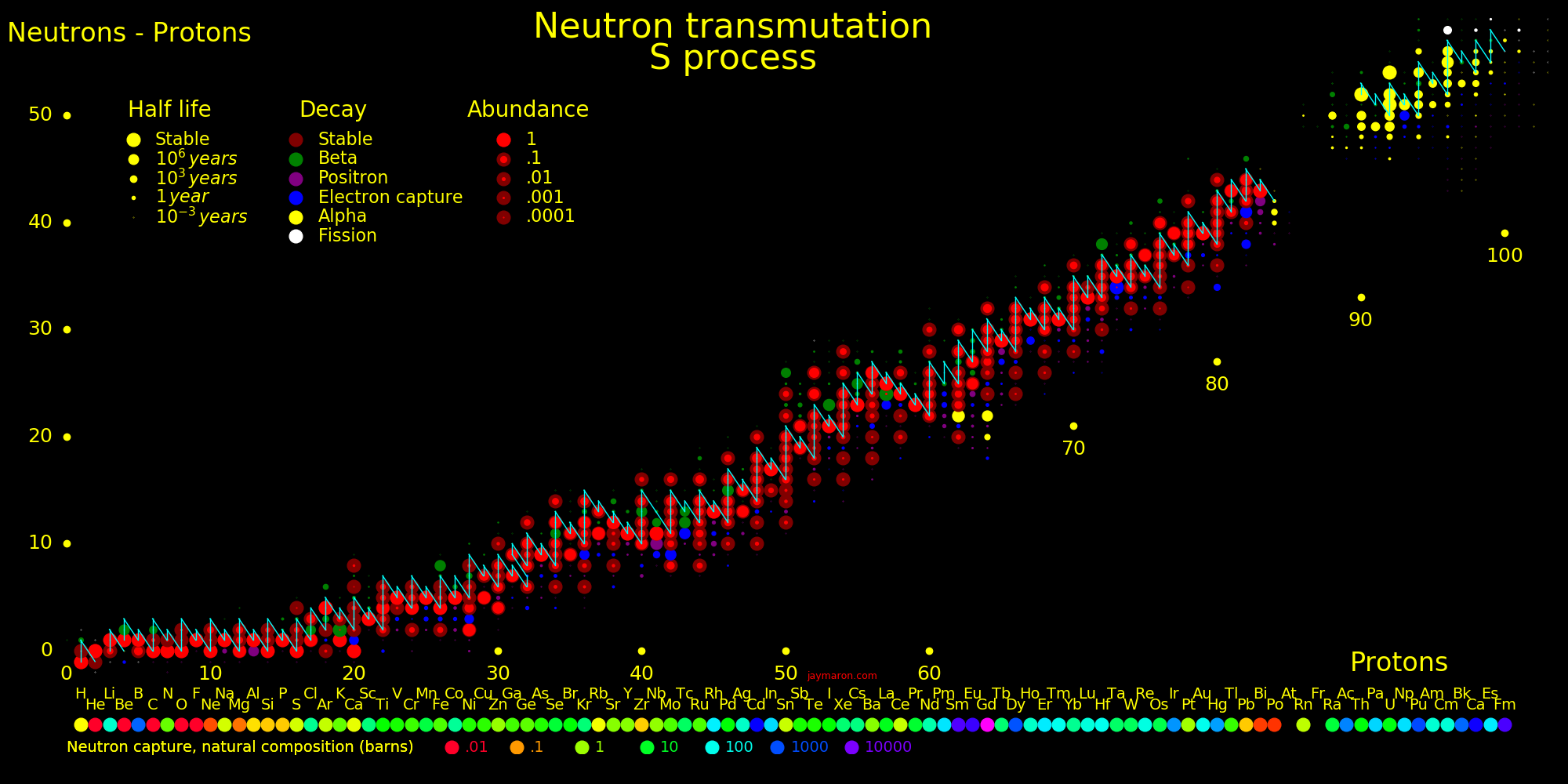 |
|---|
 |
|---|
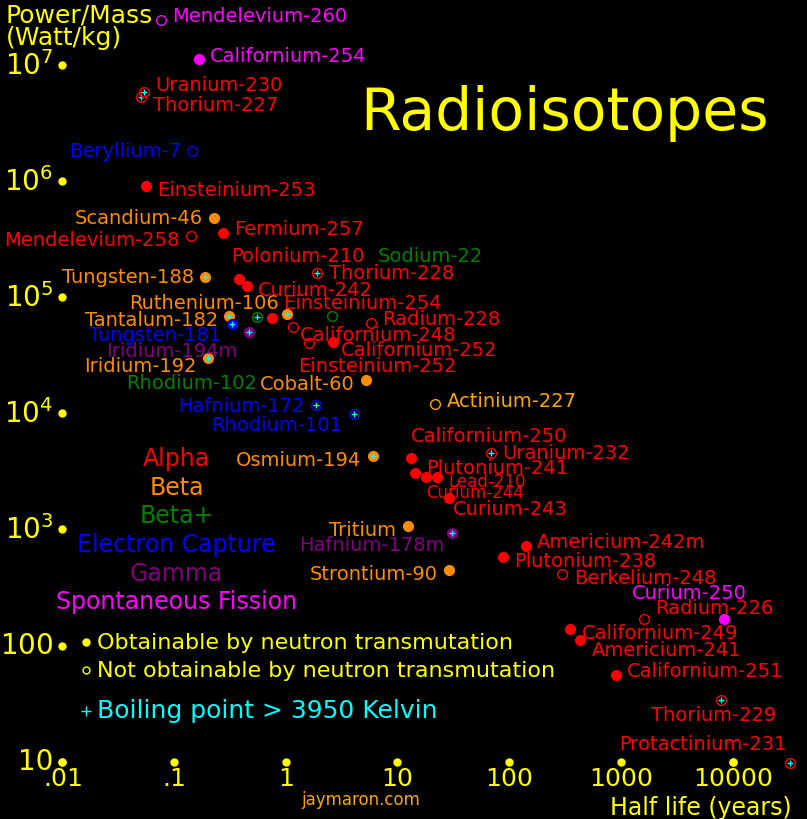 |
|---|
Full list.
Half life Heat Decay Electron Elect Gamma Form rate Obtainable Decay
max ave max by neutron
year Watt/kg MeV MeV MeV MeV barn*year transmute
Neutron .000027 .782 .782 * β Half life = 879 seconds
Einsteinium-253 .0560 * α
Tungsten-188 .191 19920 .349 8.49 * 2β
Californium-254 .166 11200000 207 .0102 * Fission
Iridium-192 .202 77147 1.460 134 * β
Scandium-46 .229 460000 2.366 .357 .112 1.121 .38 * β
Sulfur-35 .239 .167 .0488 * β
Fermium-247 .275 * α
Tantalum-182 .313 65260 1.814 4.45 * β
Tungsten-181 .332 59100 1.732 .0166 * EC
Thulium-170 .352 11800 .968 .968 .968 37.2 * β M 73% e- .968 MeV. 22% e- .884 MeV & .084 MeV gamma
Polonium-210 .379 139000 5.41 0 .0089 * α M
Calcium-45 .445 .257 .257 .257 * β
Curium-242 .446 * α
Gadolinium-153 .658 .484 .173 * EC
Zinc-65 .668 63900 1.352 .21 * β+
Einsteinium-254 .755 * α
Samarium-145 .931 * EC
Ruthenium-106 1.023 67700 3.584 .00014 * 2β
Cadmium-109 1.267 * EC
Thulium-171 1.91 .0965 30.8 * β
Caesium-134 2.06 15300 2.059 21 * β
Promethium-147 2.6 1200 .224 .86 * β
Californium-252 2.64 41400 12.33 0 * α 96.9% (6.12 Mev). Fission 3.09% (207 MeV)
Iron-55 2.74 3140 .231 .091 * EC
Thallium-204 3.78 .766 * β
Europium-155 4.76 705 .252 * β
Cobalt-60 5.27 18300 2.82 1.39 * β
Promethium-146 5.5 1.495 * EC 66%, e- 34%
Osmium-194 6.02 4313 2.330 .090 * 2β
Europium-154 8.59 3049 1.968 216 * β
Barium-133 10.51 758 .517 .0049 * EC
Tritium 12.33 1031 .0186 .0186 .0057 49 * β
Europium-152 13.5 1858 1.86 6005 * β & EC
Californium-250 13.08 * α
Cadmium-113m 14.1 340 .264 * β
Plutonium-241 14.3 3050 4.90 * β
Promethium-145 17.7 131 .164 * EC
Curium-244 18.1 * α
Lead-210 22.3 2907 9.100 0 .00000037 * β
Strontium-90 28.9 460 2.826 .29 * β, β M
Curium-243 29.1
Caesium-137 30.1 583 1.176 * β
Hafnium-178m2 31 930 2.446 * γ
Argon-42 32.9 .599 * β
Tin-121m 43.9 153 .396 .088 * IT, β
Platinum-193 50 17.5 .057 6.93 * EC
Plutonium-238 87.7 578 5.59 0 .125 * α
Samarium-151 90.0 11.6 .077 34 * β
Nickel-63 100.1 5.52 .066 .066 .017 .066 9.96 * β
Americium-242m 141 725 12.33 0 5.8 * 2α
Silicon-32 153 804 1.92 2.22 * β, β
Iridium-192m2 241 72 1.628 69 * β
Argon-39 269 .566 * β
Californium-249 351 * α
Americium-241 432.2 114 * α M
Californium-251 900 * α
Curium-246 4760 * α
Carbon-14 5730 3.99 .156 .156 .049 * β
Plutonium-240 6561 5.256 * α
Americium-243 7370 * α+β
Curium-250 8300 170 148 .000019 * Fission 74%, Alpha 18%, Beta 8%
Curium-245 8500 * 2α+β
Plutonium-239 24110 * α
Technetium-99 211000 .003 .294 * β
Curium-248 348000 * α
Plutonium-242 375000 * α
Beryllium-10 1390000 .556 * β
Technetium-97 4200000 * EC
Technetium-98 4200000 * β
Curium-247 15600000 * 3α+2β
Uranium-236 23420000 * α
Plutonium-244 81300000 * 3α+2β
Thorium-227 .0512 9194000 36.14 5α+2β
Uranium-230 .0554 9280000 ~40 6α+2β
Thorium-228 1.912 235000 34.784 5α+2β
Radium-228 5.75 90660 40.198 5α+4β
Actinium-227 21.8 21600 36.18 5α+3β
Uranium-232 68.9 7545 40.79 6α+2β
Radium-226 1599 286 34.958 5α+4β
Thorium-229 7917 57.7 35.366 5α+3β
Protactinium-231 32600 16.2 41.33 6α+3β
Thorium-230 75380 6.78 39.728 6α+4β
Uranium-233 159200 * 6α+2β
Uranium-234 245500 7α+4β
Neptunium-237 2144000 8α+4β
Curium-247 15600000 * 3α+2β
Uranium-235 703800000 * 7α+4β
Uranium-238 4468000000 .00010 51.771 * 8α+6β
Thorium-232 14050000000 47.655 * 6α+2β
Mendelevium-260 .076 Fission
Mendelevium-258 .141 α
Beryllium-7 .146 1822000 .547 EC
Cobalt-56 .212 β+
Rhenium-184m .463 16000 IT, β
Thulium-168 .255 β+
Gold-195 .510 .227 .210 EC
Cobalt-57 .744 .836 .137 EC
Manganese-54 .855 64400 EC
Vanadium-49 .901 .602 EC
Californium-248 .913 α
Einsteinium-252 1.29 0 α, EC
Lutetium-173 1.37 .630 EC
Tantalum-179 1.82 1.060 EC
Plutonium-236 2.858 α
Hafnium-172 1.87 11700 1.835 EC
Sodium-22 2.6 68700 2.842 β+ or EC
Polonium-208 2.99 0 α
Rhodium-101 3.3 EC
Lutetium-174 3.31 β+
Rhodium-102m 3.742 β+
Rhodium-101 4.07 9890 1.980 EC
Niobium-93m 16.1 IT
Bismuth-207 31.55 2.397 β+
Europium-150 36.9 2.259 β+
Titanium-44 59.1 4318 3.798 EC, β+
Terbium-157 71.0 11.0 .060 β+
Gadolinium-148 75 800 0 α
Polonium-209 125.2 0 α
Terbium-158 180 β+
Iridium-192m2 241 IT, β
Holmium-163 4570 EC
Darmstadtium-293 37.7 58900 220 β+fission Theoretical
Darmstadtium-292 133 16700 220 α+fission Theoretical
Copernicium-294 355 6230 220 α+fission Theoretical
Darmstadtium-294 380 5820 220 α+fission Theoretical
Argon-37 .0824 .814 0 * EC
Argon-39 269 * β
Argon-42 32.9 * β
Krypton-85 10.78 * β
Xenon-127 .0994 .662 0 .618 * EC
Half life Heat Decay Electron Elect Gamma Form rate Obtainable Decay
max ave max by neutron
year Watt/kg MeV MeV MeV MeV barn*year transmute
A neutron has a half life of 610.1 seconds and a decay energy of .782 MeV.
Full list.
          Half life   Power/mass   Decay   Gamma    Formation   Obtainable by   Decay
                                   energy   max       rate      neutron
            year       Watt/kg      MeV     MeV     barn*year   transmutation

Nickel-63      100.1        5.52   .017   .017       2.5           *           β
Tritium         12.33     315      .0186  .0186     71             *           β
Rubidium-83       .236             .910   .0322      0                         EC
Arsenic-73        .220             .341   .0534      0                         EC
Terbium-157     71.0       11.0    .060   .054       0                         EC
Samarium-145      .931             .617   .061        .022         *           EC
Tantalum-179     1.82              .110   .065       0                         EC
Promethium-145  17.7      131      .164   .072        .022         *           EC
Samarium-151    90.0       11.6    .077   .077                     *           β
Platinum-193    50         17.5    .057   .076       3.81          *           EC
Cadmium-109      1.26              .216   .088        .57          *           EC
Thulium-171      1.91     606      .096   .096      30.8           *           β
Gadolinium-153    .658             .484   .100                     *           EC
Iron-55          2.74    3140      .231   .126        .36          *           EC
Cobalt-57         .744             .836   .136       0                         EC
Europium-155     4.76     705      .252   .147     312             *           β
Cerium-139        .377             .278   .166                     *           EC
Gadolinium-153    .658             .484   .173                     *           EC
Gold-195          .510             .227   .210                                 EC
Promethium-147   2.6     1200      .224   .224       1.3           *           β
Calcium-45        .445             .257   .257                     *           β
Rhodium-101      3.3     9890      .541   .325       0                         EC
Europium-149      .255             .692   .328       0                         EC
Barium-133      10.51     758      .517   .384                              *           EC
Tin-121m        43.9      153      .396   .390        .01          *           IT & β
Beryllium-7       .146             .862   .478       0                         EC

Vanadium-49       .901    232      .602   ?          0                         EC
Making radium from polonium needs extreme neutron flux. The hurdle is polonium-212 with a half life of 249 nanoseconds. Once you have radium, it's easy to get to thorium.
                    Half life   Neutron capture   Decay
                     second          barn

Bismuth    209    Stable             .0338
Bismuth    210    433000                          e-
Bismuth    211       130                          alpha
Polonium   210  12000000             .00123       alpha
Polonium   211          .516                      alpha
Polonium   212          .000000249                alpha
Polonium   213          .00000365                 alpha
Polonium   214          .000164                   alpha
Polonium   215          .00178                    alpha
Polonium   216          .145                      alpha
Polonium   217         1.47                       alpha 95%, beta 5%
Polonium   218       186                          alpha
Polonium   219       618                          beta 71.8%, alpha 28.2%
Polonium   220        40                          beta
Polonium   221       132                          beta
Polonium   222       546                          beta
Polonium   223         6                          beta
Polonium   224       180                          beta
Polonium   225        10                          beta
Polonium   226        60                          beta
Polonium   227         2                          beta
Astatine   217          .0323                     alpha
Astatine   218         1.27                       alpha
Astatine   219        56                          alpha 97%, beta 3%
Astatine   220       223                          beta 92%, alpha 8%
Astatine   221       138                          beta
Astatine   222        54                          beta
Astatine   223        50                          beta
Astatine   224       150                          beta
Astatine   225         3                          beta
Astatine   226       420                          beta
Astatine   227         5                          beta
Astatine   228        60                          beta
Astatine   229         1                          beta
Radon      225       280                          beta
Radon      226       444                          beta
Radon      227        20.8                        beta
Radon      228        65                          beta
Radon      229        12                          beta
Radon      230         ?                          beta
Radon      231         ?                          beta
Francium   228        38                          beta
Francium   229        50.2                        beta
Francium   230        19.1                        beta
Francium   231        17.6                        beta
Francium   232         5                          beta
Francium   233          .9                        beta
Radium     223    988000                          alpha
Radium     224    314000                          alpha
Radium     225   1290000                          beta
Radium     226      1600 year                     alpha
Radium     227      2550                          beta
Radium     228 182000000                          beta
Radium     229       240                          beta
Radium     230      5580                          beta
Radium     231       103                          beta
Radium     232       250                          beta
Radium     233        30                          beta
Radium     234        30                          beta
Many light isotopes fission with slow neutrons.
              Natural     Half     Neutron        Neutron capture       Decay mode
              fraction    life     capture        output
                          years     barn

  Hydrogen-1     .99985   Stable       .3326      Deuterium
  Hydrogen-2     .00015   Stable       .000519    Tritium
  Hydrogen-3    0          12.32      0           -                     β
  Helium-3       .000002  Stable   5333           Tritium
  Helium-4       .99999   Stable      0           -
  Lithium-6      .0759    Stable    940           Helium-4 + Tritium
  Lithium-7      .9241    Stable       .0454      Helium-4 + Helium-4
  Beryllium-7   0           .146  56800           Lithium-7             Electron capture
  Beryllium-8   0           e-16                                        α
  Beryllium-9   1         Stable       .0076      Beryllium-10
  Beryllium-10  0        1510000       .00010     Boron-11              β
  Boron-11       .20      Stable   3835           Lithium-7 + Helium-4
  Boron-12       .80      Stable       .0055      Carbon-12
For a neutron in a material, the collision length is
Density of nuclei in the material       = ρ
Cross section of nuclei in the material = σ
Neutron collision length                = X  = 1/(ρσ)
Suppose the neutrons are in thermal equilibrium with nuclei in the material, and that there's a bulk speed between neutrons and the material of V.
Neutron bulk speed                      = V
Neutron thermal speed                   = Vn
Neutron interaction speed               = Vi = (Vn2 + V2)½         Between neutrons and the material
Neutron collision time                  = T = X/Vi
Neutrons feel a characteristic acceleration of
Characteristic acceleration = A = V/T = V Vi ρ σ
The cross section is a function of the characteristic collision speed.
Thermal speed of nuclei in the material = Vm
Characteristic collision speed          = Vc = (Vn2 + Vm2 + V2)½   Between neutrons and the material
For high speed, σ is a constant of speed, and for low speed, σ times speed is constant.
|
|---|
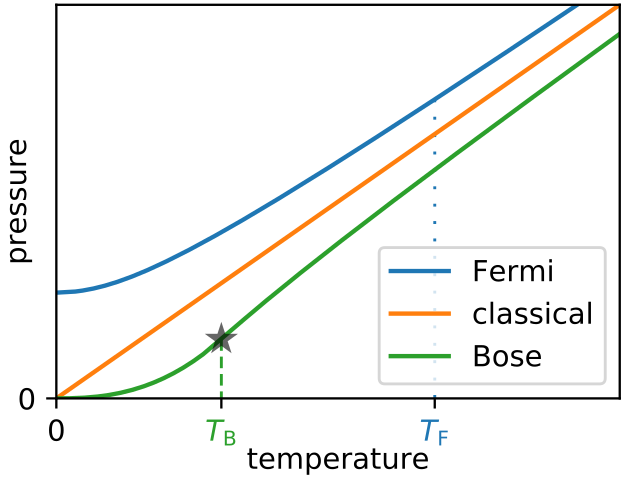 |
|---|
For a degenerate gas,
Energy total                 =  E
Volume                       =  V
# of particles in the volume =  N
Particle number density      =  n  = N/V
Particle mass                =  m
Density                      =  ρ  =  mN/V
Pressure of a monatonic gas  =  P  =  ⅔ E/V
Fermi pressure               =  PF  =  ⅔ PF5/(10π2mℏ3)
                                    =  3⅔ 5-1 π4/3 ℏ2 m-1 ρ5/3
Neutron source
Moderator, beryllium-10
Moderator, liquid nitrogen
Moderator, liquid deuterium
Moderator, liquid helium-4
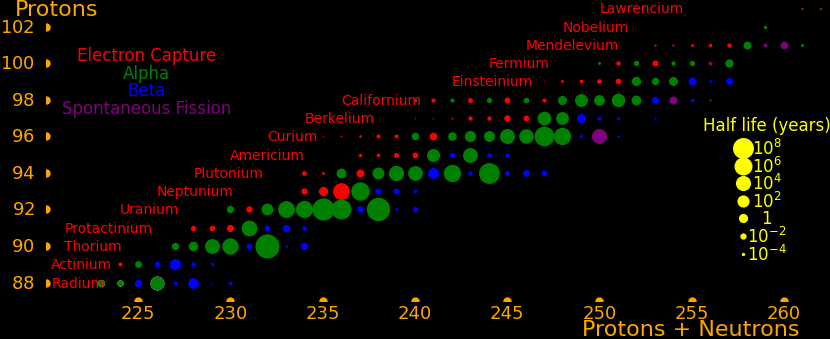 |
|---|
The actinides are the elements from actinium to lawrencium. None are stable but many are long-lived.
|
|---|
Neutron capture transmutes an isotope one space to the right and beta decay transmutes an isotope one space up.
The most massive nuclei that exist naturally are thorium-232, uranium-235, or uranium-238. All are unstable but have half lives larger than 700 million years. The road starts with these isotopes and then adding neutrons transmutes them according to the orange lines. The road forks at beta isotopes, which can either beta decay or capture a neutron.
The end of the road is fermium. Neutrons can't further increase the proton number because no fermium isotopes on the road beta decay. The road goes as far as fermium-258, which has a half life of .00037 seconds and spontaneously fissions. Producing heavier isotopes requires an accelerator or an extreme neutron flux (such as occurs in a fission bomb).
Most of the long-lived isotopes are on the neutron road, the most significant exceptions being neptunium-236 and berkelium-247. These isotopes can be reached by alpha decay, which moves an isotope 2 spaces down and 4 to the left.
Americium-242m (half live 141 years) is an excited state of Americium-242 (half life .0018 years) with a high thermal neutron capture cross section.
The thermal neutron capture cross section of Americium-241 to Americium-242 is 748 barns, and to Americium-242m is 83.8 barns.
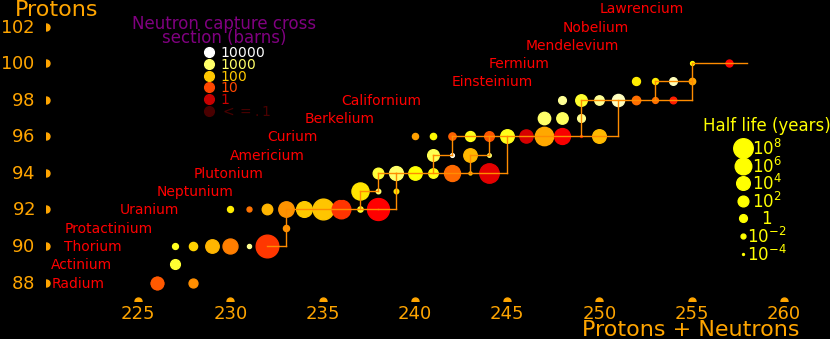 |
|---|
Transmutation rate is proportional to the neutron capture cross section. In order to move rightward on the road the isotope has to have a large neutron capture cross section and it has to have a large half life. This is true everywhere on the road except for curium-249, and so all the long-lived isotopes on the road are easily created, except for curium-250.
The road has a bottleneck at curium-246, which is the isotope with the lowest capture cross section (1.36 barns). The capture cross section of curium-248 is also low (2.49 barns). Traffic slows down here and all the isotopes further down the road have to wait for curium-246 and curium-248.
To create curium-250 you start with curium-248 and add a neutron to produce curium-249. Curium-249 has a half life of 64 minutes and you have to hope it captures a neutron before the decay.
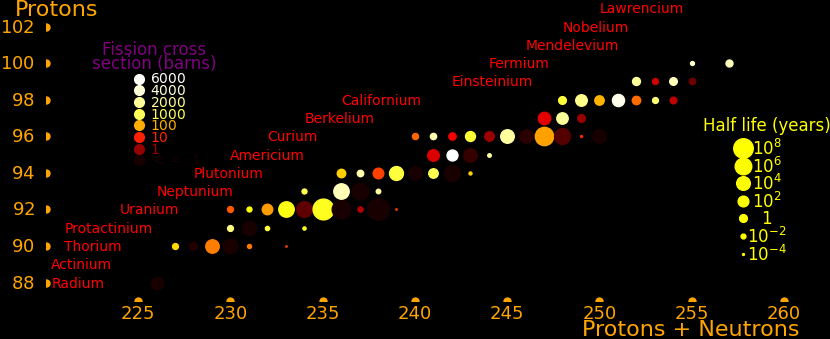 |
|---|
The fission cross section is for thermal neutrons with a Maxwellian spectrum centered at .025 eV. The isotopes with large fission cross sections are:
                Thermal  Critical  Half life
                neutron    mass
                fission
                 barns      kg       years

Americium-242m   6686      11         141
Californium-251  4801       5.5       900
Einsteinium-254  2900       9.9          .75
Neptunium-236    2800       6.8    154000
Curium-245       2161      10        8500
Californium-249  1665       6         351
Plutonium-241     937      12          14.3
Plutonium-239     748      10       24100
Curium-243        690       8          29.1
Uranium-235       538      52   704000000
Uranium-233       468      15      159200
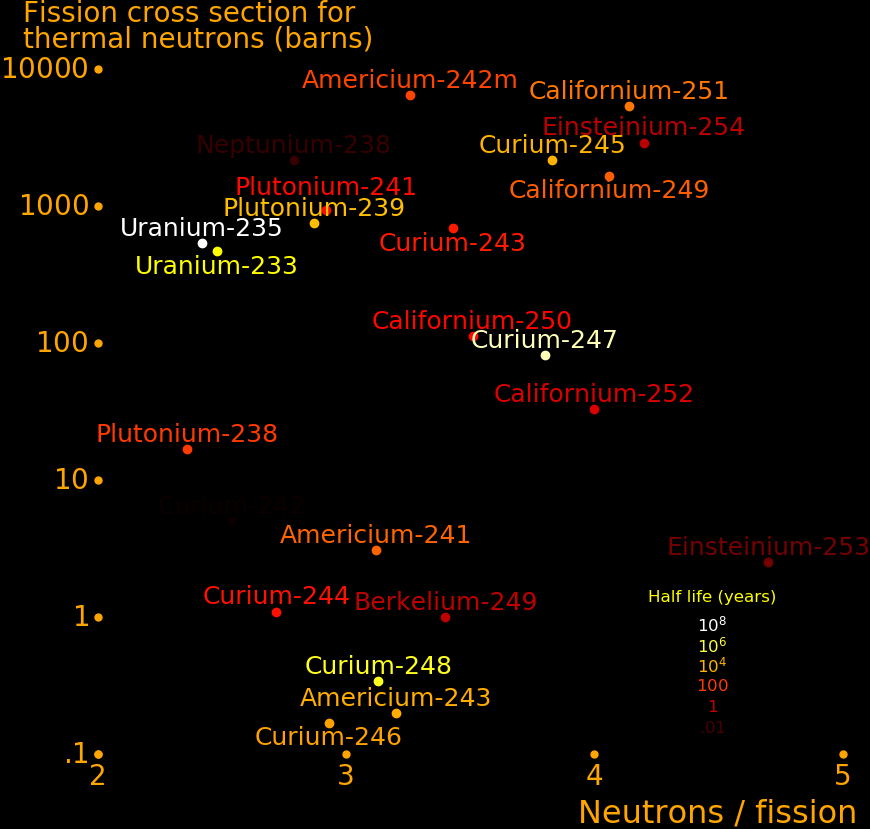 |
|---|
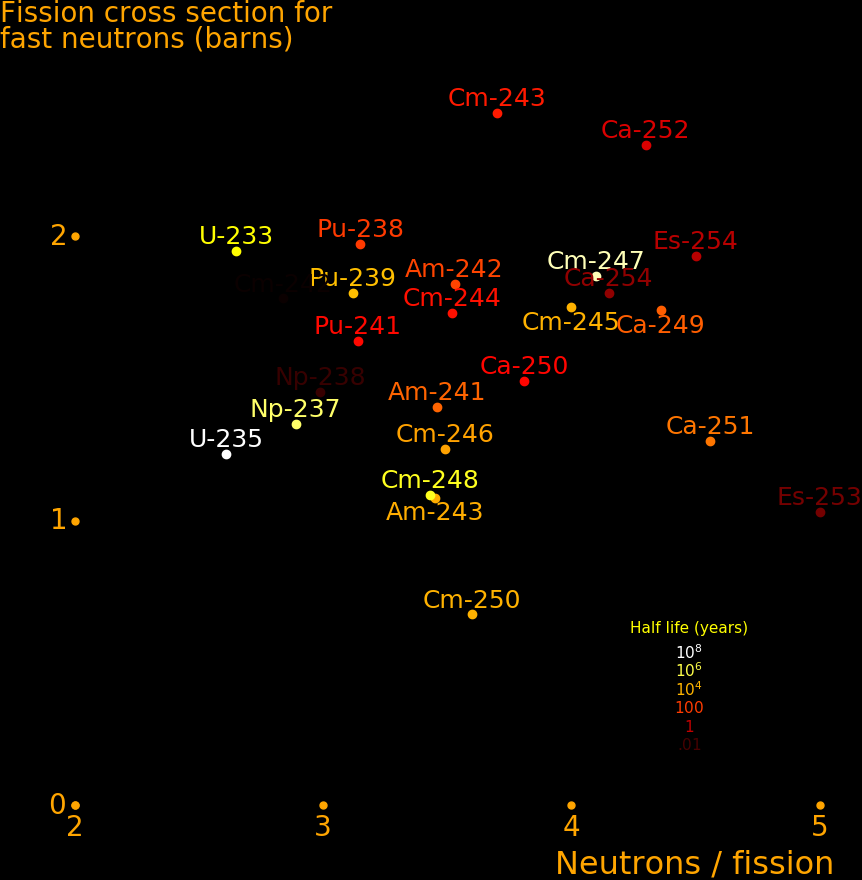 |
|---|
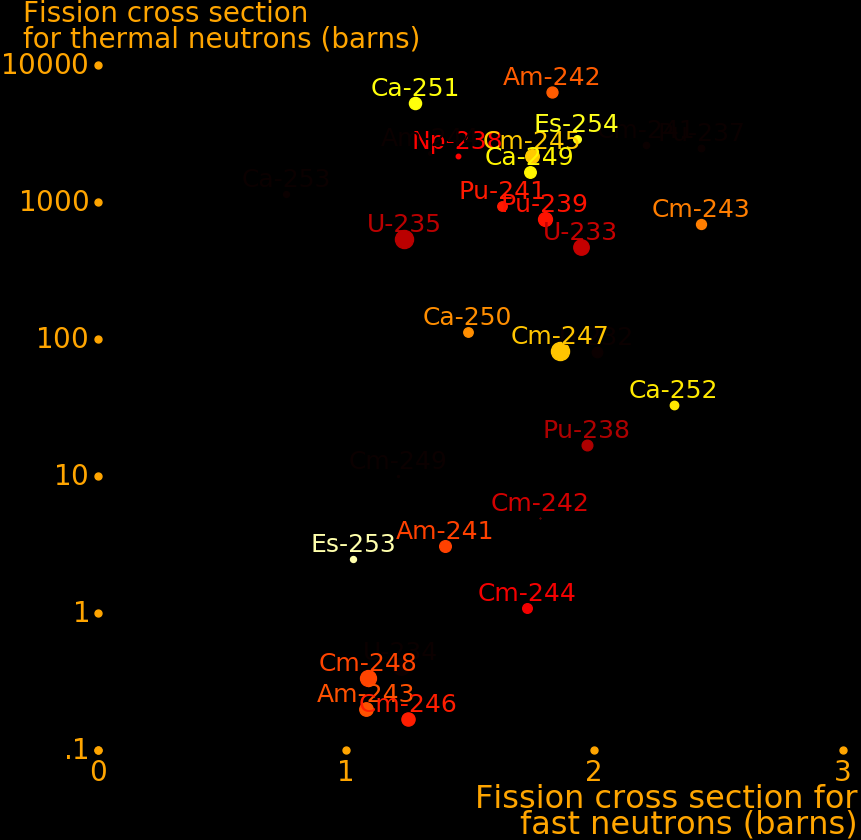 |
|---|
                  Fast     Crit   Crit  Half life        Fast      Fast
                 neutron   mass   diam                 neutrons   capture
                 fission                               /fission
                  barns     kg     cm     years                    barns

Californium-252     2.32     2.73                         4.30
Californium-251     1.28     5.46            900          4.56       .63r
Californium-249     1.74     6               351           *
Curium-247          1.86     7.0                           *
Neptunium-236                7            154000           *
Curium-243          2.43     8                29.1        3.70        .4
Plutonium-238       1.994    9.5                          3.148
Einsteinium-254              9.89               .75        *
Curium-245          1.75    10              8500          4.0         .4
Plutonium-239       1.800   10             24100          3.123
Americium-242m      1.83    10               141          3.53        .6
Plutonium-241       1.648   12                14.3        3.142
Curium-244          1.73    15                            3.52        .8
Uranium-233         1.946   15            159200          2.649
Uranium-235         1.235   52         704000000          2.606
Plutonium-240       1.357   40                            3.061
Curium-246          1.25    45                            3.49        .4
Neptunium-237       1.335   60                            2.889      1.8
Berkelium-247               75.7
Plutonium-242       1.127   80                            3.07
Americium-241       1.378   60                            3.457      2.0
Berkelium-249              192                            3.74
Americium-243        .2i   200                            3.45       1.8
Einsteinium-254m
Isotopes with a neutron capture cross section of 1 barn or more can be transmuted on a timescale of 10 years. Isotopes with a cross section smaller than this can't be practically transmuted.
To calculate the transmutation rate,
Neutron flux       =  F         = 10-8  neutrons/barn/second
Neutron capture    =  A         =    10  barns
Transmutation rate =  R  =  FA  =  10-7  transmutations/second  =  3.2 transmutations/year
 |
 |
|---|---|
If a nucleus is hit with a pulse of neutrons then the probability that a fission occurs is:
Thermal neutron fission cross section =  A  =  6400 barns = 6.4⋅10-25 meters2   For Americium-242m
Neutron pulse magnitude               =  F  =  1020 neutrons/meter2
Fission probability                   =  P  =  AF  =  6.4⋅10-5 fissions
Actinides are useful for:
*) Neutron-induced fission
*) Radioactivity heat
*) Spontaneous fission
All of these properties are useful for spacecraft. The most useful actinides are:
                   Half life   Neutron  Spontaneous  Radioactivity
                               fission    fission
                     years      barns    Watts/kg      Watts/kg

Uranium     233       159200       468
            235    704000000       538
Plutonium   238           87.7                            818
            239        14100       748
            241           14.3     937                   4315
Americium   241          432
            242m         141      6686
Curium      243           29.1     690                   2666
            244           18.1                           4014
            245         8500      2161
            246         4730
            247     15700000
            248       340000                     .64         .81
            250         9000                  240         241
Berkelium   249             .90
Californium 248             .91                86       86209              Off-road
            249          351      1665
            250           13.08               158        5778
            251          900      4801
            252            2.64             31227       58470
            253             .049
            254             .166         15896000    15897000
Einsteinium 254             .75   2900
Fermium     257             .275     ?      20000      279000
                 After     Before
                  ppt       ppt

U-234                .2
U-235              10.3      33
U-236               4.4
U-238             943       967
Pu-238               .18
Pu-239              5.7
Pu-240              2.21
Pu-241              1.19
Pu-242               .49
Np-237               .43
Am-241               .22
Am-242               .0007
Am-243               .10
Cm-242               .00013
Cm-243               .00032
Cm-244               .024

Fission products   35
Tc-99                .81
                 Neutron flux (Neutrons/cm2/second)

Power reactor          5e13
High-flux reactor      6e15
Cosmological s-process  e16
Cosmological r-process  e27
Fission bomb            e31
                Thermal   Fast    Crit  Crit  Half life    Slow   Fast      SF     Therm  Fast   Fast    SF       SF
                neutron  neutron  mass  diam               neutr  neut     neut    capt   capt   inel
                fission  fission                           /fiss  /fiss    /fiss   barn   barn           W/kg   neut/s/kg
                 barns    barns    kg    cm     years

Thorium-232                 .078                                     2.16
Protactinium-231            .83                                      2.457
Uranium-232        80      2.013                                     3.296  2
Uranium-233       468      1.946   15           159200        2.48   2.649         73
Uranium-234          .407  1.223                                     2.578  1.8                                  3.9
Uranium-235       538      1.235   52        704000000        2.42   2.606  2.0   690                             .0057
Uranium-236          .042   .594                                     2.526  1.8                                  2.3
Uranium-238          .00001 .308                                     2.601  1.97    2.68                         5.51
Neptunium-236    2800       *       7           154000         *      *
Neptunium-237        .019  1.335   60                         2.54i  2.889  2              1.8                <.05
Neptunium-238    1243      1.45                       .0058   2.79i  2.99i                   .1
Plutonium-237    2100i                                .124     *      *
Plutonium-238      16.8    1.994    9.5             87.7      2.36   3.148  2.28  558                      1204000     Alpha
Plutonium-239     748      1.800   10            24100        2.87   3.123  2.9  1017.3                         10.1     Alpha
Plutonium-240        .030  1.357   40             6560               3.061  2.189                           478000
Plutonium-241     937      1.648   12               14.3      2.92   3.142        36                             <.8     Beta
Plutonium-242        .0026 1.127   80           373000               3.07   2.28                            805000
Plutonium-243     181i
Plutonium-244                                 80800000
Plutonium-245                                     8500
Americium-241       3.1    1.378   60                         3.12   3.457                 2.0              500
Americium-242    1322i     3.4i                                                             .7
Americium-242m   6686      1.83    10              141        3.26   3.53i  2               .6
Americium-243        .2     .2i   200                         3.20i  3.45i                 1.8
Americium-244    1528i     3.4i                                *      *                     .9
Americium-244m   1220i     3.4i                               3.14i  3.42i                  .8
Curium-241       2600      2.21                       .090
Curium-242          5      1.78                               2.54
Curium-243        690      2.43     8               29.1      3.43   3.70i                  .4
Curium-244          1.1    1.73    15               18.1      2.72?  3.52i        16.2      .8             3.24i(t)    Alpha
Curium-245       2161      1.75    10             8500        3.83   4.0         383        .4                         Alpha
Curium-246           .17   1.25    45                         2.93   3.49i                  .4             3.19i(t)
Curium-247         82      1.86     7.0       15700000        3.80    *           58                                   Alpha
Curium-248           .34   1.09                               3.13    *                                     .64
Curium-249                 1.21
Curium-250           *      .67                               3.30    *
Berkelium-247               *      75.7
Berkelium-249       1.0     *     192                         3.40   3.74i                             240
Berkelium-250     959i
Californium-246                                               3.1
Californium-248            1.32                                                                          86
Californium-249  1665      1.74     6              351        4.06    *     3.4   481.4
Californium-250   112      1.49                               3.51    *                                 158
Californium-251  4801      1.28     5.46           900        4.1    4.56        2839       .62  2.216                 Alpha
Californium-252    33      2.32     2.73             2.64     4.00i  4.30i  3.75   20.4               31227            Alpha
Californium-253  1138       *                                  *      *
Californium-254     2.001j 1.80                       .75     3.85    *
Einsteinium-253     2.51    *                                 4.7     *                              15.9M
Einsteinium-254  2900       *       9.89              .75     4.2     *
Einsteinium-254m 1840       *                                  *      *
Fermium-244                                                   4
Fermium-246                                                   4
Fermium-254
Fermium-255      3360i      *                                 4       *
Fermium-256                                                   3.63    *
Fermium-257         *       *                         .275    3.87    *                          20000
Nobelium-252                                                  4.2

                Thermal   Fast    Critical  Diam  Half life    Slow      Fast       SF       SF        Spontaneous
                neutron  neutron    mass                     neutrons  neutrons  neutrons             fission
                fission  fission                             /fission  /fission  /fission   W/kg       neutron/s/kg
                 barns    barns      kg             years
The prompt kinetic energy released by fission is:
           Fission energy (MeV)

Actinium        168
Thorium         172
Protactinium    177
Uranium         181
Neptunium       185
Plutonium       189
Americium       195
Curium          198
Berkelium       203
Californium     207
The neutron yield for a 1 GeV proton is:
           Neutrons/Proton

Aluminum        2.2
Iron            4.1
Zirconium       6.3
Lead           11.9
Tantalum       12.7
Tungsten       13.1
Thorium        18
Uranium-238    21.4
Nucleus mass number  =  M  =  184
Proton energy        =  E  =    1  GeV
Neutron yield        =  .10 * (A+20) (E-.12)  =  18
                Energy (GeV)

Secondary protons    212
Primary protons      194
Neutrons              26
Neutral pions         40
Charged pions         15
Heavy particles       15         More than one nucleon
Gammas                13
Muons                  3.6
|
|---|
|
|---|
The actinides are the elements from actinium to lawrencium. None are stable but many are long-lived.
|
|---|
Neutron capture transmutes an isotope one space to the right and beta decay transmutes an isotope one space up.
The most massive nuclei that exist naturally are thorium-232, uranium-235, or uranium-238. All are unstable but have half lives larger than 700 million years. The road starts with these isotopes and then adding neutrons transmutes them according to the orange lines. The road forks at beta isotopes, which can either beta decay or capture a neutron.
The end of the road is fermium. Neutrons can't further increase the proton number because no fermium isotopes on the road beta decay. The road goes as far as fermium-258, which has a half life of .00037 seconds and spontaneously fissions. Producing heavier isotopes requires an accelerator or an extreme neutron flux (such as occurs in a fission bomb).
Most of the long-lived isotopes are on the neutron road, the most significant exceptions being neptunium-236 and berkelium-247. These isotopes can be reached by alpha decay, which moves an isotope 2 spaces down and 4 to the left.
Americium-242m (half live 141 years) is an excited state of Americium-242 (half life .0018 years) with a high thermal neutron capture cross section.
The thermal neutron capture cross section of Americium-241 to Americium-242 is 748 barns, and to Americium-242m is 83.8 barns.
|
|---|
Transmutation rate is proportional to the neutron capture cross section. In order to move rightward on the road the isotope has to have a large neutron capture cross section and it has to have a large half life. This is true everywhere on the road except for curium-249, and so all the long-lived isotopes on the road are easily created, except for curium-250.
The road has a bottleneck at curium-246, which is the isotope with the lowest capture cross section (1.36 barns). The capture cross section of curium-248 is also low (2.49 barns). Traffic slows down here and all the isotopes further down the road have to wait for curium-246 and curium-248.
To create curium-250 you start with curium-248 and add a neutron to produce curium-249. Curium-249 has a half life of 64 minutes and you have to hope it captures a neutron before the decay.
|
|---|
The fission cross section is for thermal neutrons with a Maxwellian spectrum centered at .025 eV. The isotopes with large fission cross sections are:
                Thermal  Critical  Half life
                neutron    mass
                fission
                 barns      kg       years

Americium-242m   6686      11         141
Californium-251  4801       5.5       900
Einsteinium-254  2900       9.9          .75
Neptunium-236    2800       6.8    154000
Curium-245       2161      10        8500
Californium-249  1665       6         351
Plutonium-241     937      12          14.3
Plutonium-239     748      10       24100
Curium-243        690       8          29.1
Uranium-235       538      52   704000000
Uranium-233       468      15      159200
|
|---|
|
|---|
|
|---|
                  Fast     Crit   Crit  Half life        Fast      Fast
                 neutron   mass   diam                 neutrons   capture
                 fission                               /fission
                  barns     kg     cm     years                    barns

Californium-252     2.32     2.73                         4.30
Californium-251     1.28     5.46            900          4.56       .63r
Californium-249     1.74     6               351           *
Curium-247          1.86     7.0                           *
Neptunium-236                7            154000           *
Curium-243          2.43     8                29.1        3.70        .4
Plutonium-238       1.994    9.5                          3.148
Einsteinium-254              9.89               .75        *
Curium-245          1.75    10              8500          4.0         .4
Plutonium-239       1.800   10             24100          3.123
Americium-242m      1.83    10               141          3.53        .6
Plutonium-241       1.648   12                14.3        3.142
Curium-244          1.73    15                            3.52        .8
Uranium-233         1.946   15            159200          2.649
Uranium-235         1.235   52         704000000          2.606
Plutonium-240       1.357   40                            3.061
Curium-246          1.25    45                            3.49        .4
Neptunium-237       1.335   60                            2.889      1.8
Berkelium-247               75.7
Plutonium-242       1.127   80                            3.07
Americium-241       1.378   60                            3.457      2.0
Berkelium-249              192                            3.74
Americium-243        .2i   200                            3.45       1.8
Einsteinium-254m
Isotopes with a neutron capture cross section of 1 barn or more can be transmuted on a timescale of 10 years. Isotopes with a cross section smaller than this can't be practically transmuted.
To calculate the transmutation rate,
Neutron flux       =  F         = 10-8  neutrons/barn/second
Neutron capture    =  A         =    10  barns
Transmutation rate =  R  =  FA  =  10-7  transmutations/second  =  3.2 transmutations/year
|
|
|---|---|
If a nucleus is hit with a pulse of neutrons then the probability that a fission occurs is:
Thermal neutron fission cross section =  A  =  6400 barns = 6.4⋅10-25 meters2   For Americium-242m
Neutron pulse magnitude               =  F  =  1020 neutrons/meter2
Fission probability                   =  P  =  AF  =  6.4⋅10-5 fissions
Actinides are useful for:
*) Neutron-induced fission
*) Radioactivity heat
*) Spontaneous fission
All of these properties are useful for spacecraft. The most useful actinides are:
                   Half life   Neutron  Spontaneous  Radioactivity
                               fission    fission
                     years      barns    Watts/kg      Watts/kg

Uranium     233       159200       468
            235    704000000       538
Plutonium   238           87.7                            818
            239        14100       748
            241           14.3     937                   4315
Americium   241          432
            242m         141      6686
Curium      243           29.1     690                   2666
            244           18.1                           4014
            245         8500      2161
            246         4730
            247     15700000
            248       340000                     .64         .81
            250         9000                  240         241
Berkelium   249             .90
Californium 248             .91                86       86209              Off-road
            249          351      1665
            250           13.08               158        5778
            251          900      4801
            252            2.64             31227       58470
            253             .049
            254             .166         15896000    15897000
Einsteinium 254             .75   2900
Fermium     257             .275     ?      20000      279000
                 After     Before
                  ppt       ppt

U-234                .2
U-235              10.3      33
U-236               4.4
U-238             943       967
Pu-238               .18
Pu-239              5.7
Pu-240              2.21
Pu-241              1.19
Pu-242               .49
Np-237               .43
Am-241               .22
Am-242               .0007
Am-243               .10
Cm-242               .00013
Cm-243               .00032
Cm-244               .024

Fission products   35
Tc-99                .81
                 Neutron flux (Neutrons/cm2/second)

Power reactor          5e13
High-flux reactor      6e15
Cosmological s-process  e16
Cosmological r-process  e27
Fission bomb            e31
                Thermal   Fast    Crit  Crit  Half life    Slow   Fast      SF     Therm  Fast   Fast    SF       SF
                neutron  neutron  mass  diam               neutr  neut     neut    capt   capt   inel
                fission  fission                           /fiss  /fiss    /fiss   barn   barn           W/kg   neut/s/kg
                 barns    barns    kg    cm     years

Thorium-232                 .078                                     2.16
Protactinium-231            .83                                      2.457
Uranium-232        80      2.013                                     3.296  2
Uranium-233       468      1.946   15           159200        2.48   2.649         73
Uranium-234          .407  1.223                                     2.578  1.8                                  3.9
Uranium-235       538      1.235   52        704000000        2.42   2.606  2.0   690                             .0057
Uranium-236          .042   .594                                     2.526  1.8                                  2.3
Uranium-238          .00001 .308                                     2.601  1.97    2.68                         5.51
Neptunium-236    2800       *       7           154000         *      *
Neptunium-237        .019  1.335   60                         2.54i  2.889  2              1.8                <.05
Neptunium-238    1243      1.45                       .0058   2.79i  2.99i                   .1
Plutonium-237    2100i                                .124     *      *
Plutonium-238      16.8    1.994    9.5             87.7      2.36   3.148  2.28  558                      1204000     Alpha
Plutonium-239     748      1.800   10            24100        2.87   3.123  2.9  1017.3                         10.1     Alpha
Plutonium-240        .030  1.357   40             6560               3.061  2.189                           478000
Plutonium-241     937      1.648   12               14.3      2.92   3.142        36                             <.8     Beta
Plutonium-242        .0026 1.127   80           373000               3.07   2.28                            805000
Plutonium-243     181i
Plutonium-244                                 80800000
Plutonium-245                                     8500
Americium-241       3.1    1.378   60                         3.12   3.457                 2.0              500
Americium-242    1322i     3.4i                                                             .7
Americium-242m   6686      1.83    10              141        3.26   3.53i  2               .6
Americium-243        .2     .2i   200                         3.20i  3.45i                 1.8
Americium-244    1528i     3.4i                                *      *                     .9
Americium-244m   1220i     3.4i                               3.14i  3.42i                  .8
Curium-241       2600      2.21                       .090
Curium-242          5      1.78                               2.54
Curium-243        690      2.43     8               29.1      3.43   3.70i                  .4
Curium-244          1.1    1.73    15               18.1      2.72?  3.52i        16.2      .8             3.24i(t)    Alpha
Curium-245       2161      1.75    10             8500        3.83   4.0         383        .4                         Alpha
Curium-246           .17   1.25    45                         2.93   3.49i                  .4             3.19i(t)
Curium-247         82      1.86     7.0       15700000        3.80    *           58                                   Alpha
Curium-248           .34   1.09                               3.13    *                                     .64
Curium-249                 1.21
Curium-250           *      .67                               3.30    *
Berkelium-247               *      75.7
Berkelium-249       1.0     *     192                         3.40   3.74i                             240
Berkelium-250     959i
Californium-246                                               3.1
Californium-248            1.32                                                                          86
Californium-249  1665      1.74     6              351        4.06    *     3.4   481.4
Californium-250   112      1.49                               3.51    *                                 158
Californium-251  4801      1.28     5.46           900        4.1    4.56        2839       .62  2.216                 Alpha
Californium-252    33      2.32     2.73             2.64     4.00i  4.30i  3.75   20.4               31227            Alpha
Californium-253  1138       *                                  *      *
Californium-254     2.001j 1.80                       .75     3.85    *
Einsteinium-253     2.51    *                                 4.7     *                              15.9M
Einsteinium-254  2900       *       9.89              .75     4.2     *
Einsteinium-254m 1840       *                                  *      *
Fermium-244                                                   4
Fermium-246                                                   4
Fermium-254
Fermium-255      3360i      *                                 4       *
Fermium-256                                                   3.63    *
Fermium-257         *       *                         .275    3.87    *                          20000
Nobelium-252                                                  4.2

                Thermal   Fast    Critical  Diam  Half life    Slow      Fast       SF       SF        Spontaneous
                neutron  neutron    mass                     neutrons  neutrons  neutrons             fission
                fission  fission                             /fission  /fission  /fission   W/kg       neutron/s/kg
                 barns    barns      kg             years
The prompt kinetic energy released by fission is:
           Fission energy (MeV)

Actinium        168
Thorium         172
Protactinium    177
Uranium         181
Neptunium       185
Plutonium       189
Americium       195
Curium          198
Berkelium       203
Californium     207
 |
|---|